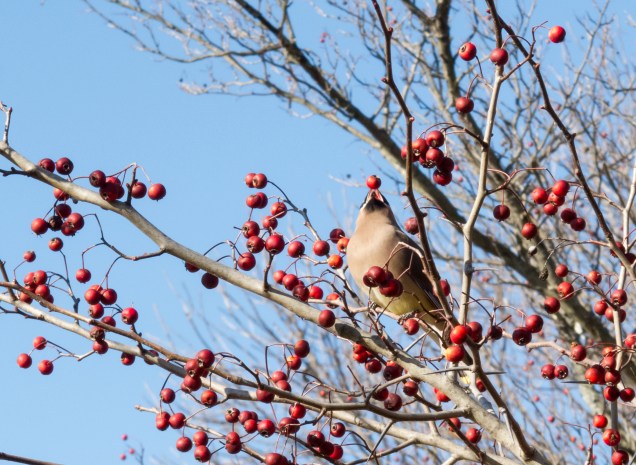
Cedar Waxwing dining on a Green Hawthorn berry. Photo: Miri Talabac
Q: This summer’s mysterious bird illness has me thinking…I’ve become more interested in birds during the past two years and would like to attract them to my yard with plants. Are there favored recommendations?
A: Bird-attracting landscaping definitely beats out bird feeders as the preferable way to bring these beauties into yards for easier viewing as a safer environment than a communal feeder. (While you’re at it, look into ways to discourage window strikes since plants, like feeders, could increase encounters with glass.)
Plant recommendations are going to be incredibly varied because the diet of birds is so varied, both across species and throughout the year. Site conditions in your garden will narrow down what may be an overwhelming list of choices. Here are some general tips:
When looking at berry or seed production, consider productivity for each season.
Try to focus on native plants only, since birds will deposit their seeds beyond your landscape.
To pick a timely category – late-ripening berries – there are some notably popular species. Highly-ranked contenders for both resident and southbound migrant birds include Viburnums, Dogwoods (trees and shrubs), Spicebush, Virginia Creeper, Eastern Redcedar, Magnolia, Black Tupelo, Hackberry, Sassafras, Bayberry, Sumac, Hollies, and Hawthorn.
Cornell’s All About Birds web library plus local Audubon Societies are good resources for more thorough information on individual species diet, habitat preferences, and plant suggestions for both foraging and nesting.
By Miri Talabac, Horticulturist, University of Maryland Extension Home & Garden Information Center. Miri writes the Garden Q&A for The Baltimore Sun.
Have a plant or insect question? University of Maryland Extension has answers! Send your questions and photos to Ask Extension.
In this episode, we keep with our October tradition of talking about spooky plants by chatting all about carnivorous plants! Carnivorous plants are predatory flowering plants that kill animals, primarily insects, to derive nutrition from their bodies. Fun fact: Did you know that there are 19 different species of carnivorous plants found in Maryland. In this episode we cover the famous Venus flytraps, our native pitcher plants, aquatic bladderworts, and the cutest of all carnivorous plants, the dwarf sundew.
Main article photo credit: Photo of dwarf sundew (Drosera brevifolia) by Sturgis McKeever, Georgia Southern University, Bugwood.org.
Photo of yellow pitcher plants (Sarracenia flava) by James Henderson, Golden Delight Honey, Bugwood.org
We also have our native plant of the month (Wax myrtle) at ~23:41, bug of the month ( American Burying Beetle) at ~ 27:54 and garden tips of the month at ~ 33:30.
Photo: Adult American burying beetle (Nicrophorus americanus) by Doug Backlund, SD Game, Fish & Parks
We hope you enjoyed this month’s episode and will tune in next month for more garden tips. The Garden Thyme Podcast is brought to you by the University of Maryland Extension. Hosts are Mikaela Boley- Senior Agent Associate (Talbot County) for Horticulture, Rachel Rhodes- Agent Associate for Horticulture (Queen Anne’s County), and Emily Zobel-Senior Agent Associate for Agriculture (Dorchester County). Theme Song: By Jason Inc
Spooky or silly? How do you carve your jack-o’-lantern?
Whether you go for fun or fright, jack-o’-lantern carving is a family-friendly way to mark the season. Have you ever wondered how the tradition got started?
As with much folklore, it started with the Celts. Northern Europeans carved frightening faces into beets, potatoes and turnips to fend off restless evil souls. To illuminate them, they placed a burning ember or candle inside. A glowing cast of an early carved turnip lantern greets visitors to the National Museum of Ireland – Country Life with blazing eyes and a crooked grin.
A more macabre theory is that Jack-o’-lanterns allude to pagan customs of severed heads as war trophies. That certainly puts the sin in sinister.
The link between jack-o’-lanterns and Halloween started with – you guessed it – another Celtic tradition. The Celts believed the worlds of the living and dead blurred on October 31, the night before their new year began and the start of a long, hard cold winter. So they lit bonfires and wore costumes to ward off ghosts. Through the years, secular and sacred traditions overlapped and All Hallows Eve became Halloween with its scary connotations including our buddy, Jack.
But who put the Jack in jack-o’-lantern? In 17th century Britain, it was commonplace to call any man you didn’t know “Jack.” A night watchman became “Jack of the lantern.”
The Stingy Jack 18th century Irish folktale also colors the tradition. Stingy Jack tricked the devil and was fated to spend eternity traveling between heaven and hell with only an ember of coal in a turnip lantern to light his way.
Irish immigrants brought their traditions to America in the 19th and 20th centuries and discovered that our native pumpkins were much easier to carve than the turnips or taters from the Old Country.
Ever try to carve a turnip?
Local pumpkin patches and garden centers are loaded with jack-o’-lantern potential.
Thrill-seeking youngsters soon realized that the glowing faces of carved pumpkins had serious scare potential and used them to frighten passerby. Boys will be boys.
Literary references morphed from benign to sinister. In his “Twice Told Tales,” Nathaniel Hawthorne offered up the first known literary reference to jack-o’-lanterns.
Discussing where to hide a bright gem, his character says, “Hide it under thy cloak, say’st thou? Why, it would gleam through the holes and make thee look like a jack-o’-lantern.”
Washington Irving’s 1820 “The Legend of Sleepy Hollow” dialed up the fear factor when his headless horseman tossed a glowing jack-o’-lantern at Ichabod Crane who disappeared forever.
Cue the spooky scream.
While jack-o’-lanterns are part of the scene that is Halloween, their meaning has mellowed. Many consider them a symbol of community, a big orange welcome mat for trick-or-treaters.
Last year, I followed the laughter down my street to find a neighbor and her kids gleefully gutting three huge pumpkins for carving. Tossing a gooey handful of seeds, she grinned and said, “It just isn’t Halloween without jack-o’-lanterns!”
Whether you find jack-o’-lanterns fun or frightful, I suggest you grab a plump pumpkin by its stem and have your way with it to honor the long-standing tradition.
Annette Cormany, horticulture educator, University of Maryland Extension – Washington County
After a fun year of building support structures and growing really long squash, it was time to wind down the garden. Our first baby was born (thank you, thank you), and we had no further bandwidth or ambition to continue with cool-season crops, so I decided to pack up the support gear, rip out the remaining plants that were producing but slowing down, start a compost pile with the remains, and plant cover crops in the beds.
Packing it up
My big trellis used for the Tromboncino squash and the one made from part of a fencing panel used for tomatoes both folded up and packed away nicely in this outdoor storage area attached to my house. I’m happy with my designs, as I didn’t want permanent structures out in the garden getting weathered, and I didn’t want them to take up a lot of space in storage. These will be easy to set up next year again. The only thing I will do differently in the future is to use something stronger than twine to string on the trellis and hold up tomatoes with tomato clips. A lot of the twine that was under pressure from crops eventually snapped and needed replacing.
A view of the support contraptions earlier in the year
Support gear all folded up
Support gear stowed away
Empty garden
Rip it, chop it, bin it
We were going to have such a volume of garden waste this year, I decided to start a compost bin. This should give us a head start on the new layer of compost (previously all store-bought) we add to the raised beds each year. Pretty much all we have to do is throw this stuff in a bin and wait, as we are doing passive composting that is slow but requires very little attention.
I bought a cheap compost bin online; this one is just a sheet of black plastic with holes that you form into a vertical cylinder and throw your stuff into.
I ripped up our squash, watermelon, and tomato plants, wheelbarrowed ’em over to the compost bin in our back yard, stabbed at the pile with a shovel and buzzed it with my string trimmer for a while to chop it up a bit. Then I shoveled it all into the bin, attempting to mix up the types of plants in there somewhat uniformly.
The chaos before
Pile of waste
Bin filling up
Tomato, squash vines, and old corn stalks
Full compost bin
Once leaves fall, I’ll drop some leaves that have been shredded by the mower into there as well.
I know you can drop food waste like fruit and vegetable scraps into compost, but I’m not sure we are going bother making the trip from the kitchen to backyard with a couple banana peels since that’s just not a lot of volume to make a difference for our intended purpose.
We will need to turn the pile a couple times in the next year to aid decomposition, but other than that, this is hands off. I’m looking forward to seeing what we get at the beginning of next growing season to start our summer vegetable garden again.
Cover crops for our raised bed garden to make it through the winter
I know it is good to protect my soil from erosion and add a layer of compostable material on the top over the winter. Last year, I had read that a layer of mulched leaves is good to place into raised beds, but when I did that, I found that much of it quickly blew away.
This year, I decided to plant crimson clover, a cover crop.
Cover crops, also known as green manures, are an excellent tool for vegetable gardeners, especially where manures and compost are unavailable. They lessen soil erosion during the winter, add organic material when turned under in the spring, improve soil quality, and add valuable nutrients.
With a couple inexpensive packets of crimson clover, I sprinkled the seeds over the now empty raised beds, raked a bit to cover them lightly with soil, and then watered the soil most days. I could see sprouts in a week or so.
Crimson clover seeds
Raking the soil after sprinkling seeds
Crimson clover sprouts
Crimson clover coming in
The clover will add a layer of protection over the winter, and then nitrogen and nutrients in April when I cut it down with a string trimmer and then turn over the soil.
Sounds easy enough. I’m all about lower-effort gardening!
Fall is here and along with the pumpkins and falling leaves, there is one thing that pops up everywhere: Halloween! And because I can’t add Halloween decorations to a blog post, this blog will have a “conceptual” Halloween twist. Today, I want to talk about something that may seem spooky to many, but that to me showcases the stunning diversity of (pollinators’) life. In today’s post we will talk about bees that are a bit “special”: parasitic bees! Come along and marvel with me about these incredible creatures that coexist with us right here in Maryland!
Parasitic bees? What!?
Yes, you read it right. Although most of the bees we know are solitary and build and provision their nests, there are several groups that have taken an evolutionary path a bit different from their relatives. These bees have evolved parasitic behaviors, exploiting the nests and food from other bee species, and in the process actively killing the host’s brood. Because they display behaviors similar to cuckoos, birds who lay eggs in other birds’ nests and have their chicks reared by the host parents (check out this video), these bees are known as cuckoo bees.
Parasitic (right) and non-parasitic (left) bees look very different. One of the main differences is the fact that parasitic bees do not have structures to collect pollen (like hairy legs with pockets), as we can see in these photos. Photos: J. Gallagher.
Cuckoo bees look different from non-parasitic bees
Because these bees have evolved to not collect nectar or pollen for provisioning (adults do eat nectar and pollen, though), and do not build nests, they have also lost the morphological structures that allow bees to do so. Cuckoo bees thus lack all the structures commonly present in bees that collect pollen (e.g., little pockets on their legs, hairs), and all the structures that allow bees to collect materials and build nests. Unlike non-parasitic bees, who often can lay only one egg per day, cuckoo bees can lay many eggs on the same day. This adaptation allows them to take full advantage of a suddenly-available nest they can parasitize. Finally, as one can imagine, host bees are not super happy about having other bees come and exploit their nests… and they defend them! For this reason, cuckoo bees are strongly “armored”, with thick and bulky structures that can protect the parasitic females against the likely attacks from the host bees. And, last but not least, some cuckoo bees can camouflage using body odors that are similar to the host, which allows them to enter the nests without being “smelled”. Cool, heh?
But how do they do it?
A trait common to all these bees is that they have high levels of specialization on what other species they parasitize, meaning that one parasitic species will often parasitize a relatively small group of closely-related non-parasitic bees. For this reason, there are different methods cuckoo bees use to parasitize their hosts.
Larvae in many cuckoo bees are equipped with impressive mandibles that they use to attack and kill other larvae developing in the parasitized brood cell. Look at these weapons! Image: Rozen et al., 2019; American Museum Novitates.
The first main way is parasitizing brood cells that have been already closed. In this group, the females enter a foreign nest where closed cells are present, open the cell(s) where they want to lay the egg, kill the host’s egg with their sting or mandibles, then lay an egg in the (now empty) cell and close it. Other species that also parasitize closed cells are those in which the females open the cells, but instead of killing the host egg, just lay theirs in the cell before sealing it back. In this case, it is not the female but the larvae that will kill the host egg/larva. These parasitic larvae have strong mandibles that allow them to attack the resident larvae and kill them, keeping all the resources for themselves. Finally, other cuckoo species do not wait until the host cells are closed. The females of these species enter nests where cells are still open, and lay their very small and hard-to-see eggs in the open cells. The host female often oversees them and closes the cells with the parasitic egg in it. The parasitic larva develops in the closed cell and also uses its strong mandibles to attack and kill the host larva while in the cell.
Do parasitic bees exist in Maryland?
Yes! Although these life histories may seem like they are coming from another planet, we do not need to travel to exotic places to be able to encounter these species! They also occur right here!
The small Macropis cuckoo bees Epeoloides pilosula are very rare in Maryland and protected in most of their North American range. Photo: M. Veit.
A very cool species that is very likely present here in Maryland is the Macropis cuckoo bee Epeoloides pilosula, which parasitizes nests of the oil-bee of genus Macropis. Because of the level of specialization of both the oil-bee (on their host plant; see here to learn more) and its parasite, E. pilosula is very rarely encountered and is currently protected at different levels in Eastern North-America.
There are several species of Nomada or Nomad cuckoo bees in Maryland. These species often parasitize nests of ground nesting bees. Photo: M. Lucas.
Another very neat example of local cuckoo bees are the parasites of Andrena and other mining bees: the parasitic bees of genus Nomada. The rule of lack of hairs and structures to collect provisions for the nest is very much true for this species! There are about 30 species of this genus known to be present in our state, and many of them are rare. While the spotted cuckoo bee Nomada maculata is somewhat regularly found in the state, Nomada bethunei is known only from a couple localities. Most of these Nomada species are, however, rare and often under conservation threats.
Will parasitic bees drive other bees to extinction?
Parasitic and non-parasitic bees have been co-evolving for millions of years, and it is very unlikely that this type of interaction would drive species to extinction. Indeed, the parasitized species also have evolved ways to protect their brood (something for another post). Interestingly, however, because parasitic bees are so specialized on their hosts, it is they who may be even more at risk of extinction than their hosts! Indeed, cuckoo bees are rare, hard to find, and are likely to have populations die out as soon as their host species disappears from a locality. From this respect, and if we want to protect the diversity of this super cool group of pollinators, providing resources for them and their hosts (see this and this post to learn some ways to do this) is key to maintaining the populations of these rare and fascinating parasitic bees!
By Anahí Espíndola, Assistant Professor, Department of Entomology, University of Maryland, College Park. See more posts by Anahí.
Anahí also writes an Extension Blog in Spanish! Check it out here, extensionesp.umd.edu, and please share and spread the word to your Spanish-speaking friends and colleagues in Maryland. ¡Bienvenidos a Extensión en Español!
Two of the vegetable crops I grew this year are known for loving the heat: okra and eggplant. I grow eggplant in pots on my deck, to avoid flea beetle infestation, and okra directly in the ground in my community garden plot. Both of them produced adequately over the summer. Now it’s fall; we’re having days in the 70s and nights in the 50s, and there are fewer hours of sunlight in the day. Time to pull the summer crops, right?
Except – boom! Both the okra and the eggplant are going gangbusters. More flowers, more fruits than in the hot summer months, by far.
‘Bride’ eggplant on a cool autumn morning
So why aren’t these plants following the rulebook? Do they not know how to read? Or have the rules changed?