Welcome back to Beyond Broccoli, the brassica blog series! You can find previous entries here. In this edition we’re going to explore the plants in the genus Brassica that are grown for edible leaves.
I think the best place to start is on the shores of the Mediterranean. This is likely the home of the wild relatives of what became the domesticated forms of Brassica oleracea. They would have looked something like what we know as kale. The lineage of these wild plants is still fairly obscured, but if you want to read more about it check out this scholarly article.
The kales we grow today are actually not all one species. Most of them are Brassica oleracea var. acephala(or Acephala Group), but the super-hardy kales like Red Russian and Siberian are Brassica napus var. pabularia, related to rutabaga. Even the B. oleracea kales are amazingly varied, having been bred for millennia into forms with curly leaves, flat leaves, small or enormous leaves, leaves with blue and purple tints, the cabbagey-looking ornamental kale that landscapers plant at the corner to carry through the winter, and kale that forms stems taller than people that are made into walking sticks. (I wish we could grow that kind here, but our heat and humidity don’t agree with it. At least you can read about it.) My favorite kind to grow and eat is the blue bumpy type known as Tuscan, Lacinato, or Dinosaur kale.
Looks like dinosaur skin, I guess? Kid- and adult-friendly!
When it comes to vegetable diseases, an ounce of prevention is worth a pound of cure. Many diseases can be stopped before they start with smart garden practices.
Spring rains cause spots, dots, and fuzzy blots to pop up in everyone’s vegetable patch. That’s fungi having fun. But whether our weather is wet or dry, fungi, bacteria and viruses stand ready to harm plants.
So, how do you keep them at bay? Be informed and watchful. Look at your plants often to spot small problems before they get big and use the following tips to prevent disease problems.
If you have repeat offenders – diseases that show up year after year – look for disease-resistant varieties. For example, there are varieties of tomatoes labeled as resistant to both verticillium and fusarium wilt.
Early blight is a common disease of tomatoes. Photo: J. Traunfeld, UME
Some plants are available in certified, disease-free starts. Choose potato tubers, garlic bulbs, and asparagus and rhubarb crowns that are certified and disease-free.
Vegetables hate soggy soil. If your garden area is wet, consider creating a raised bed to improve drainage. Or, grow in containers or move the garden to an area that drains well.
You’ve heard me preach the gospel of compost time and again. But did you know that compost actually discourages some plant diseases? Garden smart by adding compost every year.
Help prevent disease by spacing your plants properly to encourage good air circulation. Plant labels often give spacing tips as do garden books and websites.
Warm, humid weather invites powdery mildew on squash. Photo: UME Home & Garden Information Center
Rain can spread soil-borne diseases, splashing infected soil up on plants’ leaves. So keep your soil covered with an organic mulch such as untreated grass clippings or newspaper covered with straw.
Fungi love wet leaves, so water wisely. Water at the base of the plant using soaker hoses or drip irrigation. And water in the morning, not the evening, so leaves dry before nightfall.
Practice tough love. Remove infected leaves or pull entire plants if they become badly infected. It’s better to lose one bad plant than the whole row. Don’t compost sick plants: bag and trash them.
Overripe vegetables invite disease organisms. So, harvest your vegetables before they get mushy.
A thorough cleaning of your vegetable bed at the end of the season is crucial since many diseases can overwinter in the soil. Again, if anything had a serious disease issue, bag and trash it.
If you spot a problem, e-mail your local Extension horticulturist a photo or bring them a sample to identify. Here’s a list of our county offices. We can usually get back to you in a day or two with advice.
For other growing tips and diagnostic help, visit our Home & Garden Information Center website. It has photos, management tools, and a wealth of resources. There’s even an Ask Extension link to submit gardening questions to certified horticulturists.
Enjoy your vegetable garden this year. A few seeds and transplants, some rain, sun, and a watchful eye will have you enjoying fresh, healthy homegrown food all season long.
By Annette Cormany, Principal Agent Associate and Master Gardener Coordinator, Washington County, University of Maryland Extension. This article was previously published by Herald-Mail Media. Read more by Annette.
This is a guest post by Esther Bonney, a student in Charles County, Maryland, and a member of the University of Maryland Extension 4-H Program.
Invasive plants are detrimental to Maryland’s well-being, and their damaging effects are becoming more evident each year as we witness declines in crop productivity, reductions in pollinators critical to maintaining stable ecosystems, and widespread displacement of native habitats. Between 2008 and 2013, wild bees declined by 23 percent across the U.S.—a serious concern to farmers and consumers alike. Through educational programs, guides, and native giveaways, Nurture Natives is taking a stand against invasive species to protect native plants and pollinators, restore natural habitats, and support farmers. Nurture Natives is led by University of Maryland 4-Hers Esther Bonney and Samantha Rutherford and Extension 4-H Educator Amy Lang and UME Charles County Master Gardener Marlene Smith.
Visitors line up for native trees at Maryland Day, stretching down the courtyard and around the sidewalk, sometimes longer than the line for free ice cream!
In March 2022, our team was selected to attend the National 4-H Youth Summit on Agriscience. There, we developed our project, Nurture Natives, to address a prevalent agricultural issue in our community: invasive plant species. Invasive plants choke out native species and are a major cause of crop loss and food insecurity. Invasive trees such as the Tree of Heaven rapidly overtake farmlands and attract invasive pests such as the Spotted Lanternfly, which is a serious threat to grape crops. In the U.S. alone, invasive species cause $40 billion worth of production losses to crops and forests per year.
Nurture Natives is dedicated to increasing biodiversity through the planting of native trees and the eradication of invasive plants. In the past year, Nurture Natives has been featured on the National 4-H and University of Maryland Extension websites, won a Lead to Change Grant, and was selected by the National 4-H Council as one of two projects nationwide to receive the highly-competitive Scale for Success Award. Nurture Natives was also recently featured in the Southern Maryland Independent: Nurturing natives and the next generation of environmental scientists.
Our team began our work by educating and raising awareness about invasive species in our community of Charles County. We hosted educational programs at schools and camps and, in October 2022, partnered with eight local organizations to host the first annual Nurture Natives Giveaway. We hosted games, crafts, presentations, and a honey-tasting to showcase the importance of native species and pollinators. In just two hours, we distributed 150 native trees and shrubs and reached over 70 families.
Samantha Rutherford (left) hands out trees to visitors at Maryland Day, and Marlene Smith (right), Charles County Master Gardener, collects forms from patrons before they reach the tree distribution table.Continue reading →
Food gardeners are an important part of any local food system. In Achieving Sustainability through Local Food Systems in the United States (PDF) (2013), agricultural economists Dale Johnson and James Hanson, Ph.D. state: “By far the greatest, but often overlooked, local food source in the United States is gardening.”
About 35% of Maryland households are doing some type of food gardening and have lots of important questions: What’s this worm eating my kale? How do I improve my soil and test it for lead? How do I start a school garden? Where can I take a vegetable gardening class?
Since 2009 many residents and communities have received science-based food gardening answers and help from Grow It Eat It (GIEI)– one of the six major sub-programs of the University of Maryland Extension (UME) Master Gardener Program that teaches and promotes home, school, and community food gardening. This article serves to introduce this amazing program and some of its successes. I plan to write a second article later this year on some of the exciting 2023 GIEI projects from around the state.
What is GIEI?
Grow It Eat It was developed late in 2008 by UME staff, faculty, and volunteers in response to the Great Recession. Many people were already interested in trying their hand at food gardening as a way to eat more fresh produce and connect with nature. The economic collapse forced folks to find ways to reduce household expenses.
The main GIEI objective has been to increase local food production by combining the power of grassroots education and technical assistance delivered by field faculty and Master Gardeners, with UME’s digital gardening resources. Master Gardeners (MGs) have taught hundreds of classes, developed demonstration gardens, and helped thousands of individuals and groups start food gardens and learn and use best practices. Residents can learn about GIEI classes and events by visiting their local Extension web pages and connecting on social media. MGs also help residents solve food gardening problems at Ask a MG Plant Clinics around the state. The Home and Garden Information Center (HGIC) supports GIEI by training MGs, creating and maintaining digital resources, and answering food gardening questions through the Ask Extension service.
GIEI intersects and collaborates with other MG sub-programs– Bay-Wise Landscaping, Ask a MG Plant Clinic, Composting, and Pollinators– and with UME’s nutrition, natural resources, youth development, and urban ag programs. This helps the program address four of the five Strategic Initiatives guiding the College of Ag & Natural Resources.
As the faculty lead, I have loved every minute spent working with UME faculty, staff, and volunteers to shape, improve and expand the program. Master Gardener Coordinators and Volunteers decide how to best shape GIEI to meet local needs. The State MG Office organizes regular GIEI statewide planning/sharing meetings and continuing education classes, and provides seeds, teaching, and marketing materials. MGs responded to the pandemic by moving GIEI classes online. GIEI projects and activities steadily increased in 2021 and 2022 and should surpass pre-COVID levels in 2023.
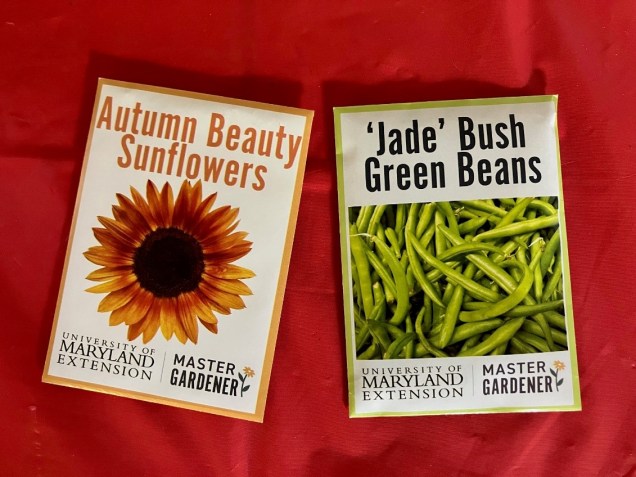
75K seed packets have been distributed to residents to promote food gardening and the UME MG Program. Sunflower and bean seeds in 2023!
Q: Do you have any information related to the “no mow” movement? We have a very weedy lawn and are considering replacing it with Dutch clover. Is that a good idea? Bad idea?
A: We do not recommend replacing lawn outright with clover. Clover goes dormant in winter, losing leaves, which leaves the soil surface exposed to weed seed colonization and potential erosion. The clovers used in lawns are also non-native and would not support the majority of our native bees (which are specialists, relying on certain native species for pollen, nectar, or plant oils). Generalist bees can use clover or other blooms but these tend not to be the local bees needing the most support from garden plantings.
If you prefer to augment your existing lawn with clover, consider microclover, which is a dwarf and less-aggressive variety of white clover that cohabitates with turfgrass more cooperatively. While not solving any of the other above issues, at least this is a more suitable choice when using clover in a lawn. Our Lawns and Microclover page provides some pros and cons plus links to a more detailed publication (PDF document) about how to go about creating and maintaining this mix.
Chanticleer’s flowery lawn interpretation, more of a no-mow-ever than a no-mow May situation, and thus of more benefit to wildlife. Photo: M. Talabac
Opinions among professional horticulturists about “No Mow May” actions are mixed because there are both benefits and drawbacks that it creates. You will probably find both proponents and opponents to this practice in Extension and other science-based web publications and articles. The main benefit of the movement is its ability to get gardeners thinking about their landscaping choices and actions and the impacts of these on the ecosystem. (And that’s a good thing!) That said, most of the flowering lawn weeds that no-mow is supposed to protect are non-native and do not support many of our native bees, and allowing them to set seed only enables them to spread further in places where native plants should ideally be growing instead.
For gardeners interested in having turf serve double-duty as a “bee lawn” – that is, intentionally planted with seed mixtures containing low-growing flowering plants – the benefits and shortcomings of this approach are similar to those with clover lawn conversions or from reducing mowing for limited periods of time. University of Minnesota research shows that bee lawns do provide benefits for pollinators, including native ones. However, most commercially-available bee lawn mixes contain plants from Europe and/or Asia, and are perhaps not the best nutritionally for Maryland’s specialist bee adults or a resource they will be able to use for their young. Some Maryland native plants that can be incorporated into bee lawns, such as Self-Heal (Prunella vulgaris subspecies lanceolata), are not readily available in seed mixes here, and research on Maryland-native plants for use in bee lawns is not available at this time. Visit UMN’s “Planting and Maintaining a Bee Lawn” web page for more detail.
Prunellavulgaris. Photos: M. Talabac
Our energies and efforts aimed at benefiting insects, birds, and other organisms may be better spent creating native plant gardens alongside of (or in place of) lawns, which will not only serve specialist bees more suitably but also will support a variety of other native wildlife in the process. In any garden setting, including when plant selections are native-focused, using a diversity of plant species has several benefits: it can support a greater diversity of wildlife (including pollinators and beneficial insects that help suppress pests), it adds aesthetic and seasonal interest, and it increases the resiliency of the planting as a whole, because different species won’t have the same degree of vulnerability to any one issue (like drought or flooding) that may arise.
Native common fleabane (Erigeron philadelphicus) blooms in a front yard where a portion of the turfgrass was removed and replaced with little bluestem, switchgrass, and a mixture of flowering perennials. Fleabane supports a variety of native bees, solitary wasps, and other beneficial insects. Photo: C. Carignan
Not mowing lawns regularly also stresses the turf by creating a situation where, when mowing does resume, it’s removing much more of the turf’s leaf mass at one time, causing stress and interfering with its normal growth habit that creates a dense lawn. The “grazing response” that mowing triggers, promoting more low growth that fills-in gaps, won’t be happening to the same extent if the grass goes for weeks without being cut, especially as it diverts some energy for growth into producing pollen and seed. (This turfgrass flowering also might be a consideration for people with bad grass pollen allergies.)
This topic of bee resources in lawns as addressed by the no-mow movement is touched upon by wildlife biologist Sam Droege in the native bee special episode of the University of Maryland Extension Garden Thyme Podcast from last summer.
Lawn alternatives, even if not purely native species, are another option when dealing with a lawn that is struggling. While a healthy lawn is providing more environmental services (carbon sequestration, erosion control, nutrient filtering, etc.) than a struggling lawn, if you do not wish to devote resources to improving its health and vigor, then converting those areas to non-lawn is more practical, even if a bit more expensive at first than just rehabbing the lawn. If a tolerance to regular foot traffic from people or pets is needed, then lawn is the best groundcover for this use and you might want to work to improve its health, but otherwise areas not being stepped-on can be planted with other species.
By Miri Talabac, Horticulturist, University of Maryland Extension Home & Garden Information Center. Miri writes the Garden Q&A for The Baltimore Sun and Washington Gardener Magazine. Read more by Miri.
Have a plant or insect question? The University of Maryland Extension has answers! Send your questions and photos to Ask Extension.Our horticulturists are available to answer your questions online, year-round. You can also connect with your local County/City Extension Office and Master Gardenerlocal programs.
Spring is incomplete without the bold and soft hues of azaleas in your home garden. These spectacular plants are prevalent and have dominated yards and countless gardens in North America. These plants originated in Asia and made their way to the US via Europe around two hundred years ago. Since then, according to the American Azalea Society (ARS), over 10,000 different cultivars, or cultivated varieties, have been registered or named. The high demand for cultivated azalea can be attributed to its small manageable dwarf sizes, diverse attractive colors, deep green leaves year-round, and adaptability to the climate, making them easy to grow.
However, there are equally beautiful native azaleas in North America that are seldom seen in home gardens and are still not as well-known as their Asian cousins. To find them, it would be best to wander from the landscaped yards into the woods. In this post, I talk about the extraordinary beauty and ecology of native azaleas, as they require more attention and care from the gardening community.
What are native azaleas?
Azaleas are members of the heaths (Ericaceae) plant family, which includes cranberry, blueberry, and huckleberries. Because there is often confusion among people between azaleas and rhododendrons, it is much easier to remember that all azaleas are rhododendrons, but that all rhododendrons are not azaleas. In fact, azaleas belong to the genus Rhododendron. Azaleas native to North America are usually medium-sized or tall shrubs with soft, deciduous leaves, funnel-shaped flower lobes, and long tubular flowers with stamens extending beyond their showy petals. There are eighteen North American native azaleas (visit the American Azalea Society and American Rhododendron Society to learn more).
Rhododendron vicosum and Rhododendron calendulaceum. Photos: S. Basnett
Why grow native azaleas?
Native azaleas display shades of white, orange, pink, red, and yellow throughout the spring and summer. Although most people associate azaleas with spring, several native ones bloom in mid and late summer. It is often noticed that azaleas in their natural habitat show some staggering in their flowering timing, and their flowering durations usually range between 15 to 20 days. So, if you carefully select species based on their flowering timing, you can have azaleas bloom in your home gardens for at least four to five months. Unlike the evergreen cultivated ones, native azaleas have exceptional fall color before they shed their leaves for winter. Most native Azaleas can reach heights of 4’-8’ and can be used in hedgerows and as the background to other flowering dwarf shrubs. Some of the common native azaleas in the woodlands of Maryland, Virginia, and DC are smooth azalea (Rhododendron arborescens), swamp azalea (Rhododendron viscosum), pinxter azalea (Rhododendron periclymenoides), coast azalea (Rhododendron atlanticum) and early azalea (Rhododendron prinophyllum).
Besides the colorful hues in your green space, growing azaleas will also help maintain the native pollinator network in your local environment. Native azaleas can sustain a variety of fauna through their flowers; they are attractive to bees, butterflies, moths, and hummingbirds. The quantity and quality of nectar and pollen among these plants are often observed to be higher than in the cultivated ones. In general, they have a high amount of concentrated nectar and string-like pollen threads that help attract myriad forms of floral visitors native to North America.
Some azalea species have attractive warm orange and red flowers, and birds can detect warm colors easily. At the same time, insects, including bumblebees and smaller bees (e.g., Andrena sp.), are attracted to light pink, purple, and white palettes. Certain native species, such as sweet azalea and piedmont azalea, have a strong sweet fragrance. Besides providing a sweet smell, their fragrance also helps attract night pollinators such as moths. Nectar volume among the azalea flowers is relatively low compared to its nectar concentration; therefore, the migratory ruby-throated hummingbird makes occasional visits, as birds usually prefer flowers with high voluminous nectar. Their unique floral characteristics also attract diverse butterflies, recognized as potential pollinators for these species. Commonly observed butterflies are eastern tiger swallowtails (Papilio glaucus), silver spotted skippers (Epargyreus clarus), and great spangled fritillaries (Speyeria cybele). The flapping of butterfly wings helps transfer pollen from the male to the female organ and facilitates successful reproduction in these plants. Therefore, growing different shades of native azaleas in your yards and home gardens will be a good idea to support native pollinators.
Native azaleas are also relatively free of pests and diseases compared to cultivars, making them low-maintenance plants. They do not require regular pruning and are moderately slow growers. However, knowing the ecology of these species may be helpful for plant growers. For example, in the forest, these plants are mostly found as an understory of other tall hardwood trees like oaks and chestnuts; therefore, they will do well in less light and shaded areas in the home gardens. Most of them require moisture with good drainage and humus-rich acidic soil. You can learn more about the detailed requirements of the conditions preferred by these plants at the American Azalea Society.
It is never too late to add these cool plants to your home garden.
By Shweta Basnett, Fulbright Postdoctoral Fellow, Department of Entomology, University of Maryland. Visit her website for more information about her current research.
In this edition of Beyond Broccoli (see parts one, two and three for background) we’re going to start exploring some specific species and subspecies (varieties, groups, etc.) within the genus Brassica. Rather than address each species systematically, I’ve decided on an approach based on the plant parts we usually consume. Never fear, I will inform you when introducing each plant how they fit into the genus.
So let’s start at the bottom, with root vegetables.