Q&A: What Can I Grow in Place of Dogwood?

Photo of a fringetree in full bloom with white flowers in spring.
Lovely Fringetree flowers in spring


Q:  I have to remove a declining Flowering Dogwood, and would like to replace it with another white, spring-blooming small tree. Crabapple doesn’t appeal to me, and I already have a Magnolia. What would you recommend?

A: I think Fringetree (Chionanthus virginicus) is underused and quite showy. White is a common flower color for spring-blooming trees, native and otherwise, but for some reason this species is often overlooked. Growing wild essentially state-wide, it’s adaptable enough to handle home landscapes well if given good drainage and a half-day to full sun. Established plants have some drought tolerance, and grow at a similar pace overall to Flowering Dogwood (that is, slow to moderate, averaging a foot per year).

A member of the olive family, Fringetree is a cousin to Ash, and as such might be vulnerable to Emerald Ash Borer, the invasive insect that has decimated Ash trees region-wide over the past two decades. However, I think their susceptibility is low enough to give them a try, as I have not learned about any rampant problems with the beetle seriously damaging Fringetree, especially with the loss of most of the local Ash population’s mature trees.

Photo of a mature fringetree in a landscape. The tree is about 8 ft. tall with a spread of about 15 ft.
A mature Fringetree (Chionanthus virginicus) in a landscape.
This is a photo of a dwarf fringe tree that is less than 5 ft. in height. The variety is 'Little Leslie.'
‘Little Leslie’ is a dwarf cultivar that grows to a maximum height of 5 ft.

The olive-like dark blue berries produced by female Fringetrees are decorative and appealing to birds, but sexing trees is difficult unless they were propagated as cuttings from a tree of known sex. A lone female tree may not fruit if there are no males within pollinating distance, and male trees can’t fruit. Occasionally, a female tree might self-pollinate, but this is not the norm. If you have room, plant two and take a chance of having a pairing for pollination, or just enjoy the flowers (showy on both sexes), which are also scented.

Closeup photo of long, slender Fringetree flowers.
Fringetree flowers
Photo of a cluster of small purple fringetree fruits. Each fruit is about 1/2-in. in diameter.
Fringetree fruits are eaten by many different bird species.

Other candidates for the criteria of white spring-flowering trees with a maturity smaller than a shade tree include: Serviceberry (Amelanchier species); Redbud (Cercis canadensis; there are a couple white-flowering cultivars); Hawthorn (Crataegus viridis ‘Winter King’ being widely available); American Plum (Prunus americana); Chickasaw Plum (Prunus angustifolia); Carolina Silverbell (Halesia species); and Snowbell (Styrax species).

By Miri Talabac, Horticulturist, University of Maryland Extension Home & Garden Information Center. Miri writes the Garden Q&A for The Baltimore Sun and Washington Gardener Magazine. Read more by Miri.

Have a plant or insect question? The University of Maryland Extension has answers! Send your questions and photos to Ask ExtensionOur horticulturists are available to answer your questions online, year-round.

Nurture Natives: 4-Hers Take a Stand to Protect Maryland’s Ecosystems, Economy, and Agriculture

This is a guest post by Esther Bonney, a student in Charles County, Maryland, and a member of the University of Maryland Extension 4-H Program.

Invasive plants are detrimental to Maryland’s well-being, and their damaging effects are becoming more evident each year as we witness declines in crop productivity, reductions in pollinators critical to maintaining stable ecosystems, and widespread displacement of native habitats. Between 2008 and 2013, wild bees declined by 23 percent across the U.S.—a serious concern to farmers and consumers alike. Through educational programs, guides, and native giveaways, Nurture Natives is taking a stand against invasive species to protect native plants and pollinators, restore natural habitats, and support farmers. Nurture Natives is led by University of Maryland 4-Hers Esther Bonney and Samantha Rutherford and Extension 4-H Educator Amy Lang and UME Charles County Master Gardener Marlene Smith. 

people line up for native trees at Maryland Day
Visitors line up for native trees at Maryland Day, stretching down the courtyard and around the sidewalk, sometimes longer than the line for free ice cream!

In March 2022, our team was selected to attend the National 4-H Youth Summit on Agriscience. There, we developed our project, Nurture Natives, to address a prevalent agricultural issue in our community: invasive plant species. Invasive plants choke out native species and are a major cause of crop loss and food insecurity. Invasive trees such as the Tree of Heaven rapidly overtake farmlands and attract invasive pests such as the Spotted Lanternfly, which is a serious threat to grape crops. In the U.S. alone, invasive species cause $40 billion worth of production losses to crops and forests per year. 

Nurture Natives is dedicated to increasing biodiversity through the planting of native trees and the eradication of invasive plants. In the past year, Nurture Natives has been featured on the National 4-H and University of Maryland Extension websites, won a Lead to Change Grant, and was selected by the National 4-H Council as one of two projects nationwide to receive the highly-competitive Scale for Success Award. Nurture Natives was also recently featured in the Southern Maryland Independent: Nurturing natives and the next generation of environmental scientists

Our team began our work by educating and raising awareness about invasive species in our community of Charles County. We hosted educational programs at schools and camps and, in October 2022, partnered with eight local organizations to host the first annual Nurture Natives Giveaway. We hosted games, crafts, presentations, and a honey-tasting to showcase the importance of native species and pollinators. In just two hours, we distributed 150 native trees and shrubs and reached over 70 families. 

Continue reading

Post Oaks in the Big City

Post oak
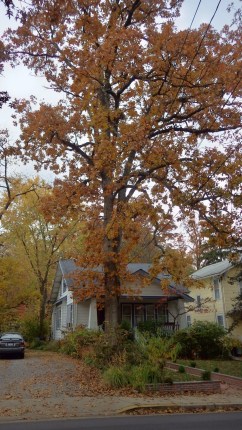
This post oak thrives despite being squeezed between a parking lot and a sidewalk. November 2013. Takoma Park, MD.

If you live in one of Maryland’s older towns, you probably have a lot of heritage trees – native trees inherited from the forests and fields that existed before your town was built out. It’s part of what gives old towns so much character. In my home town, Takoma Park, one of the heritage trees I admire the most is the post oak (Quercus stellata).

Post oaks inspire me. I see beauty in their shiny, cruciform leaves and their tiny, striped acorns. I also admire the species’ capacity to cope with adversity.  Many of the post oaks in Takoma Park are confined to little hell strips, those narrow grassy areas between slabs of asphalt or concrete. There they must cope with soil compaction, deicing salts, copious quantities of dog urine, and the urban heat island, to name a few.

Post oaks are one of the most common trees at Soldier’s Delight Natural Area, where the serpentinite bedrock gives rise to a soil so laden with heavy metals that it’s too toxic for most plants to grow in. Perhaps tolerance of metals helps the post oak perform well at urban sites,  even sites near train tracks and in industrial parks. Continue reading

What Tree is This?

Five trees
Can you identify these trees? The answers are at the end of this post.

How well do you know your trees? Can you identify the trees in the images above? Do you know where to start and what to look for?

When we get tree identification questions at the Home & Garden Information Center, we look not only at the leaves or needles but also the leaf arrangement along the branches, the size and shape of the tree, the bark, buds, and fruits too.

If you want to get better at tree identification, like most anything, it helps to have a good foundation and to practice. If you are interested in getting better at tree identification, you may be interested in the upcoming events we are sponsoring.

Continue reading