Where I grew up, we did not have a county fair, but instead a “Buckwheat Festival” which celebrated buckwheat pancakes. I’ve often heard stories about “old timers” planting buckwheat because it could thrive in poor soils. Buckwheat is not as well known or common as it was several years ago; however, it does have the potential to be a great addition to your landscape and would be a wonderful summer cover crop, which is just one way to help improve soils for a more climate- resilient garden.
Positives about buckwheat include that it matures quickly, is easily seeded by broadcasting, is relatively inexpensive to purchase by seed, is not “fussy” about where it grows, and germinates quickly. It does not mind low-pH soils and can even out-compete weeds! It has shallow roots and is easily terminated — so planting a new crop after it is no problem — or, if it is still growing in the fall of the year, a frost will kill it. Lastly, it is a wonderful nectar and pollen source for a wide variety of insects.
Asian Tiger Mosquito. Photo: Ary Farajollahi, Bugwood.jpg
Mosquito season is (slap) upon us. Fortunately, there are (slap) many things you can do to minimize their (slap) nuisance.
Only females bite, so that’s the good news. Only half of them are out to get you.
Mosquitoes need water. They have four stages of development – egg, larva, pupa & adult – (complete metamorphosis for you geeks) and spend their larval and pupal stages in water.
Mosquito larvae hang upside down in the water and get air from a siphon tube. They wiggle when disturbed, mildly entertaining. Pupae look like commas and are called “tumblers” for the way they move.
After a snack (cue ominous Dracula music,) adult females lay their eggs on water. They can do this in as little as a teaspoon of water. Yes, a teaspoon. So eliminating standing water is crucial to control.
Water collects in obvious places like ponds and marshy areas. But it also pools in birdbaths, rain barrels, wading pools, pot saucers, gutters, and downspouts.
You also find mosquito-attracting water in used tires, plastic toys, recycling bins, tarps, grill covers, tree stumps, wading pools, pet dishes, and more.
So, eliminate water traps such as used tires. Screen rain barrels. Twice a week add fresh water to birdbaths and pet dishes and remove any water you find any of the other hiding spots above.
Clear debris from gutters and downspouts and cover the opening to corrugated drain pipe on downspouts with pantyhose held with a rubber band. Very sexy.
If you have a pond or rain barrel, use mosquito dunks, donut-shaped disks containing Bti, an organic biological control. Getting goldfish or mosquito fish (Gambusia) that eat mosquito larvae also is helpful.
Part two of mosquito control – after managing standing water – is personal protection. Mosquitoes find us very tasty so we need to know how to keep them at bay.
Most mosquitoes are active from dusk to dawn, so avoiding activity then is helpful. If you’re having a party or just want to sit on your deck, hook up a fan. The breeze is a serious deterrent.
For more protection, use repellants with DEET, picaridin, Icaridin, or oil of lemon eucalyptus. Wear long pants and sleeves since mosquitoes can bite through clothing. Clothing treated with the insecticide permethrin also deters mosquitoes.
Citronella candles, mosquito lamps, and butane-powered repellers aren’t very effective. Bug zappers kill few mosquitoes but many beneficial insects. And mosquito traps actually attract more mosquitoes.
Everyone’s instinct is to spray, spray, spray, but sprays kill predators and pollinators. You’re killing the good guys that help control many harmful pests.
Birds, bats, frogs, lizards, and dragonflies eat mosquitoes. So create good habitat for them by planting native plants, adding birdhouses and birdbaths, and avoiding chemicals.
To keep mosquitoes from invading your home, use tight-fitting screens on windows and doors and replace tears quickly.
The newest bad actor is the tiger mosquito which is active throughout the day. Bigger, badder, and with striped legs, it is a brute.
Be a skeeter beater. Seek out and eliminate standing water. Dress for protection. And practice active avoidance. Combine multiple controls for less slapping and more smiling.
By Annette Cormany, Principal Agent Associate and Master Gardener Coordinator, Washington County, University of Maryland Extension. This article was previously published by Herald-Mail Media. Read more by Annette.
Plants that are used as ground cover can provide great services throughout the landscape as they can fill in areas that might otherwise be left bare or covered in mulch. Ground covers can be used to help reduce maintenance chores by preserving moisture and preventing weeds.
If you are looking for a ground cover plant, consider adding a native ground cover. Non-native ground covers and vines can be the plants of nightmares, as the characteristics that we like about them (aggressive, can take over weeds, need little care once established, etc.) are often the characteristics that make them terrible offenders when they escape into natural areas. A great field guide on this exact topic is Plant Invaders of Mid-Atlantic Natural Areas.
Since it’s prime planting season in Maryland, here I highlight three herbaceous plants that are often used as ground covers that can quickly take over. For a more detailed list of some of the other ground covers that are concerning, check out this webpage, Invasive Vines and Groundcovers.
English ivy (Hedera helix). Photo: M. Talabac, University of Maryland Extension
English ivy (Hedera helix) is sometimes just called “ivy” or “European ivy”, which reiterates the point that it is not a plant that is native to the United States. This evergreen, vining plant is one that you should be aware of as it can take over areas through the spread of seeds and through underground stems. It thrives in shade, is drought tolerant, and once established, it creates a thick, dense mat of foliage that can outcompete many perennials. It’s even been reported that it can damage homes/walls where it grows up and even penetrates the bark on living trees and strangles them. A study done in February of 2021 found that there are at least 5,000 trees in Takoma park could be lost because of English ivy. English ivy also serves as a reservoir for bacterial leaf scorch, a disease in maples, oaks, and elms.
Periwinkle (Vinca minor) close-up of purple flowers (left), and spreading along a staircase in Great Falls Park (right). Photos: M. Talabac
Periwinkle is a common plant that many people will recognize by its attractive shiny green leaves and purple-white flowers. There are actually two types, Vinca minor and Vinca major, unfortunately, both are considered invasive species and spread quickly vegetatively by root pieces (digging) and rooting at tips and nodes that contact the ground.
The third plant is bishop’s weed or goutweed (Aegopodium podagraria). Once established, this plant easily gets out of hand and is very difficult to remove. It is on the Maryland Department of Agriculture’s list of plants considered for regulation. Joyce Browning with the University of Maryland Extension in Harford County recently posted a video about bishop’s weed.
Remember that you can help mitigate the negative effects of invasive plants on local ecosystems by not adding them to your landscape. However, if you already have some of these plants, you can also manage them correctly by keeping them contained in certain areas and eliminating their spread into natural areas. Never place yard trimmings into natural areas, and remove the seeds before they can be spread by wind, rain, and/or animals. As you are adding plants to your landscape, please check out these great resources for non-invasive plant suggestions:
Everyone can help in the fight against invasive plants! Check the University of Maryland Extension website for an Introduction to Invasive Plants in Maryland and more information on how to reduce them. The absolute best way is to just never plant or introduce them into your landscape.
By Ashley Bodkins, Senior Agent Associate and Master Gardener Coordinator, Garrett County, Maryland. Read more posts by Ashley.
Welcome back to Beyond Broccoli, the brassica blog series! You can find previous entries here. In this edition we’re going to explore the plants in the genus Brassica that are grown for edible leaves.
I think the best place to start is on the shores of the Mediterranean. This is likely the home of the wild relatives of what became the domesticated forms of Brassica oleracea. They would have looked something like what we know as kale. The lineage of these wild plants is still fairly obscured, but if you want to read more about it check out this scholarly article.
The kales we grow today are actually not all one species. Most of them are Brassica oleracea var. acephala(or Acephala Group), but the super-hardy kales like Red Russian and Siberian are Brassica napus var. pabularia, related to rutabaga. Even the B. oleracea kales are amazingly varied, having been bred for millennia into forms with curly leaves, flat leaves, small or enormous leaves, leaves with blue and purple tints, the cabbagey-looking ornamental kale that landscapers plant at the corner to carry through the winter, and kale that forms stems taller than people that are made into walking sticks. (I wish we could grow that kind here, but our heat and humidity don’t agree with it. At least you can read about it.) My favorite kind to grow and eat is the blue bumpy type known as Tuscan, Lacinato, or Dinosaur kale.
Looks like dinosaur skin, I guess? Kid- and adult-friendly!
When it comes to vegetable diseases, an ounce of prevention is worth a pound of cure. Many diseases can be stopped before they start with smart garden practices.
Spring rains cause spots, dots, and fuzzy blots to pop up in everyone’s vegetable patch. That’s fungi having fun. But whether our weather is wet or dry, fungi, bacteria and viruses stand ready to harm plants.
So, how do you keep them at bay? Be informed and watchful. Look at your plants often to spot small problems before they get big and use the following tips to prevent disease problems.
If you have repeat offenders – diseases that show up year after year – look for disease-resistant varieties. For example, there are varieties of tomatoes labeled as resistant to both verticillium and fusarium wilt.
Early blight is a common disease of tomatoes. Photo: J. Traunfeld, UME
Some plants are available in certified, disease-free starts. Choose potato tubers, garlic bulbs, and asparagus and rhubarb crowns that are certified and disease-free.
Vegetables hate soggy soil. If your garden area is wet, consider creating a raised bed to improve drainage. Or, grow in containers or move the garden to an area that drains well.
You’ve heard me preach the gospel of compost time and again. But did you know that compost actually discourages some plant diseases? Garden smart by adding compost every year.
Help prevent disease by spacing your plants properly to encourage good air circulation. Plant labels often give spacing tips as do garden books and websites.
Warm, humid weather invites powdery mildew on squash. Photo: UME Home & Garden Information Center
Rain can spread soil-borne diseases, splashing infected soil up on plants’ leaves. So keep your soil covered with an organic mulch such as untreated grass clippings or newspaper covered with straw.
Fungi love wet leaves, so water wisely. Water at the base of the plant using soaker hoses or drip irrigation. And water in the morning, not the evening, so leaves dry before nightfall.
Practice tough love. Remove infected leaves or pull entire plants if they become badly infected. It’s better to lose one bad plant than the whole row. Don’t compost sick plants: bag and trash them.
Overripe vegetables invite disease organisms. So, harvest your vegetables before they get mushy.
A thorough cleaning of your vegetable bed at the end of the season is crucial since many diseases can overwinter in the soil. Again, if anything had a serious disease issue, bag and trash it.
If you spot a problem, e-mail your local Extension horticulturist a photo or bring them a sample to identify. Here’s a list of our county offices. We can usually get back to you in a day or two with advice.
For other growing tips and diagnostic help, visit our Home & Garden Information Center website. It has photos, management tools, and a wealth of resources. There’s even an Ask Extension link to submit gardening questions to certified horticulturists.
Enjoy your vegetable garden this year. A few seeds and transplants, some rain, sun, and a watchful eye will have you enjoying fresh, healthy homegrown food all season long.
By Annette Cormany, Principal Agent Associate and Master Gardener Coordinator, Washington County, University of Maryland Extension. This article was previously published by Herald-Mail Media. Read more by Annette.
This is a guest post by Esther Bonney, a student in Charles County, Maryland, and a member of the University of Maryland Extension 4-H Program.
Invasive plants are detrimental to Maryland’s well-being, and their damaging effects are becoming more evident each year as we witness declines in crop productivity, reductions in pollinators critical to maintaining stable ecosystems, and widespread displacement of native habitats. Between 2008 and 2013, wild bees declined by 23 percent across the U.S.—a serious concern to farmers and consumers alike. Through educational programs, guides, and native giveaways, Nurture Natives is taking a stand against invasive species to protect native plants and pollinators, restore natural habitats, and support farmers. Nurture Natives is led by University of Maryland 4-Hers Esther Bonney and Samantha Rutherford and Extension 4-H Educator Amy Lang and UME Charles County Master Gardener Marlene Smith.
Visitors line up for native trees at Maryland Day, stretching down the courtyard and around the sidewalk, sometimes longer than the line for free ice cream!
In March 2022, our team was selected to attend the National 4-H Youth Summit on Agriscience. There, we developed our project, Nurture Natives, to address a prevalent agricultural issue in our community: invasive plant species. Invasive plants choke out native species and are a major cause of crop loss and food insecurity. Invasive trees such as the Tree of Heaven rapidly overtake farmlands and attract invasive pests such as the Spotted Lanternfly, which is a serious threat to grape crops. In the U.S. alone, invasive species cause $40 billion worth of production losses to crops and forests per year.
Nurture Natives is dedicated to increasing biodiversity through the planting of native trees and the eradication of invasive plants. In the past year, Nurture Natives has been featured on the National 4-H and University of Maryland Extension websites, won a Lead to Change Grant, and was selected by the National 4-H Council as one of two projects nationwide to receive the highly-competitive Scale for Success Award. Nurture Natives was also recently featured in the Southern Maryland Independent: Nurturing natives and the next generation of environmental scientists.
Our team began our work by educating and raising awareness about invasive species in our community of Charles County. We hosted educational programs at schools and camps and, in October 2022, partnered with eight local organizations to host the first annual Nurture Natives Giveaway. We hosted games, crafts, presentations, and a honey-tasting to showcase the importance of native species and pollinators. In just two hours, we distributed 150 native trees and shrubs and reached over 70 families.
Samantha Rutherford (left) hands out trees to visitors at Maryland Day, and Marlene Smith (right), Charles County Master Gardener, collects forms from patrons before they reach the tree distribution table.Continue reading →
Food gardeners are an important part of any local food system. In Achieving Sustainability through Local Food Systems in the United States (PDF) (2013), agricultural economists Dale Johnson and James Hanson, Ph.D. state: “By far the greatest, but often overlooked, local food source in the United States is gardening.”
About 35% of Maryland households are doing some type of food gardening and have lots of important questions: What’s this worm eating my kale? How do I improve my soil and test it for lead? How do I start a school garden? Where can I take a vegetable gardening class?
Since 2009 many residents and communities have received science-based food gardening answers and help from Grow It Eat It (GIEI)– one of the six major sub-programs of the University of Maryland Extension (UME) Master Gardener Program that teaches and promotes home, school, and community food gardening. This article serves to introduce this amazing program and some of its successes. I plan to write a second article later this year on some of the exciting 2023 GIEI projects from around the state.
What is GIEI?
Grow It Eat It was developed late in 2008 by UME staff, faculty, and volunteers in response to the Great Recession. Many people were already interested in trying their hand at food gardening as a way to eat more fresh produce and connect with nature. The economic collapse forced folks to find ways to reduce household expenses.
The main GIEI objective has been to increase local food production by combining the power of grassroots education and technical assistance delivered by field faculty and Master Gardeners, with UME’s digital gardening resources. Master Gardeners (MGs) have taught hundreds of classes, developed demonstration gardens, and helped thousands of individuals and groups start food gardens and learn and use best practices. Residents can learn about GIEI classes and events by visiting their local Extension web pages and connecting on social media. MGs also help residents solve food gardening problems at Ask a MG Plant Clinics around the state. The Home and Garden Information Center (HGIC) supports GIEI by training MGs, creating and maintaining digital resources, and answering food gardening questions through the Ask Extension service.
GIEI intersects and collaborates with other MG sub-programs– Bay-Wise Landscaping, Ask a MG Plant Clinic, Composting, and Pollinators– and with UME’s nutrition, natural resources, youth development, and urban ag programs. This helps the program address four of the five Strategic Initiatives guiding the College of Ag & Natural Resources.
As the faculty lead, I have loved every minute spent working with UME faculty, staff, and volunteers to shape, improve and expand the program. Master Gardener Coordinators and Volunteers decide how to best shape GIEI to meet local needs. The State MG Office organizes regular GIEI statewide planning/sharing meetings and continuing education classes, and provides seeds, teaching, and marketing materials. MGs responded to the pandemic by moving GIEI classes online. GIEI projects and activities steadily increased in 2021 and 2022 and should surpass pre-COVID levels in 2023.
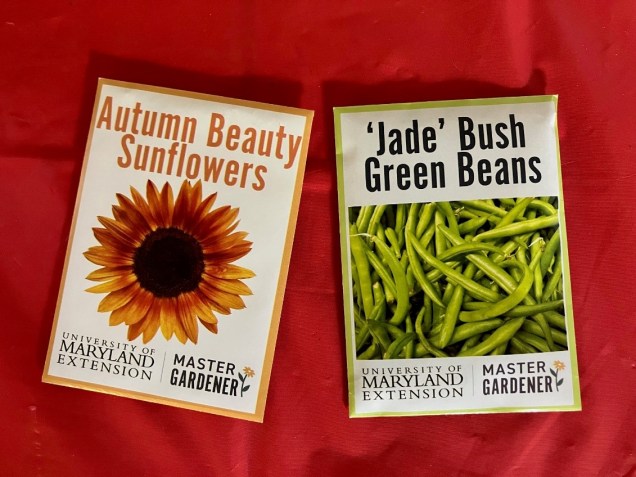
75K seed packets have been distributed to residents to promote food gardening and the UME MG Program. Sunflower and bean seeds in 2023!