
Now that the Brood X cicadas are finally silent, you likely have noticed flagging branches on certain trees eggs were laid in. Take a look at this video explaining maintenance you may want to do on these twigs.
trees and shrubs
How to pick the perfect tree
I think that I shall never see
Joyce Kilmer
A poem lovely as a tree.
I love trees. The wind whispering through a grove of pines. An oak’s limbs raised to the sky in winter. The pink pom-poms of a cherry tree in spring. They are nature’s art.
But you can’t just plunk any old tree anywhere and guarantee grandeur. It takes some thought and planning. Make “right plant, right place” your mantra.
First, look at the spot where you want a tree. Is it sunny or shady? Wet or windy?
Do you need a 20-foot tree to tuck under power lines? Or do you have room for a towering 60-footer? Break out the measuring tape and see how wide your tree can be, too. Size matters.
Now, think about what you want. Do you want an evergreen or deciduous tree? Does it need to flower? Deliver show-stopping fall color? Provide shade?
Are you screening an undesirable view? Do you want to support wildlife with a native tree that offers food and shelter?
At this point, you have a wish list. You want a small, sun-loving, flowering tree to add a splash of spring color to your front yard and a tall evergreen to screen your neighbor’s garage.

Now it’s time to hit the books or websites to find some trees that meet your criteria. Dirr’s Hardy Tree and Shrubs is a favorite for its brief descriptions and color photos of the whole tree, leaves, flowers, fruit and bark.
Make sure the trees you pick will survive our winters. We are in cold hardiness zone 6B, so the zone listing should cover that number. For example, a tree listed as hardy in zones 4 to 7 would be fine here.
Also note any special needs of the tree. Kousa dogwood fruit is lovely, but messy as it falls. So don’t place one by a sidewalk or deck. Ditto with sweetgum whose spiky sweetgum seedpods are especially hard on bare feet.
Oaks drop acorns so they’re not good by a pool. Crape myrtles hate wind. Goldenraintree makes billions of seedlings. Heed the warnings.

As you do your research, compile a list of trees that make the cut, then head to a nursery or two.
Trees come in large containers or balled and burlapped rootballs called B&Bs. Look for a solid root ball, secure wrapping and roots contained in the burlap in a B&B tree.
Does the tree have a good overall shape? Are the leaves or needles deep green? Eliminate trees with damaged bark, rot or circling roots that can strangle a tree.
Check the roots of a container plant by asking a staff member to slide it out of the container. The roots should be light colored and not circling tightly inside the pot.
Have high standards. If a tree doesn’t pass inspection, pass it by. A tree is an investment and you want to make it a good one.As you sip lemonade in the dappled shade of a willow oak or enjoying the confetti rain of cherry blossoms, I hope you’ll agree with Joyce Kilmer as she concludes:
Poems are made by fools like me
But only God can make a tree.
By Annette Cormany, Principal Agent Associate and Master Gardener Coordinator, Washington County, University of Maryland Extension. This article was previously published by Herald-Mail Media. Read more by Annette.
Holly is entwined in holiday traditions
The holly and the ivy,
When they are both full grown,
Of all the trees that are in the wood,
The holly bears the crown.
This traditional British Christmas carol highlights the prominence of holly in our holiday celebrations. But where did that tradition begin?
Because holly retains its green leaves all year long, many ancient cultures believed it had magical powers. The ancient Druids were the first to give it supernatural significance, bringing in boughs to attract woodland spirits.
Other cultures followed suit. Holly was hung in homes to ward off evil spirits, worn by warriors for courage, eaten to purge impurities, drunk as tea for strength, and put under pillows to inspire prophetic dreams.
Romans hung holly in their temples and homes during Saturnalia, the midwinter festival honoring Saturn, god of agriculture. Holly’s evergreen boughs celebrated the return of longer days and the hope for productive farms in the coming year.
The Roman naturalist Pliny added to holly’s lore. He believed that a wild animal could be subdued by throwing a stick of holly at it and that holly trees planted near a home would protect its owners from both bad weather and witchcraft.
Early churches adopted pagan rituals as their own. Christmas Eve was designated as the time to decorate churches and it was forbidden to bring any greens into a home before then.
Those bans on early decorating inspired the belief that bringing in holly too soon would cause misfortune. I wonder what the ancients would think of modern day stores’ policies of putting up Christmas merchandise the day after Halloween?
Holly also spoke of love and relationships. Henry VIII wrote a love song, “Green groweth the holly” which extolled being ever true. And one tradition dictated that the first one – husband or wife – to bring holly into the home at Christmas would rule the roost in the coming year.
Grab that holly, girls!
Sex and the single holly gets complicated. Most hollies are dioecious, having separate male and female trees. You need both for the female to get berries.
Oh, and those berries aren’t really berries. They are drupes, a fleshy fruit with pit that contains a seed. There, you’ve had your botany word of the day.
Ilex is the scientific name for the over 500 species of holly trees and shrubs. Most are evergreen, but a few are deciduous, losing their leaves in fall. And their berries can be red, white, yellow or black.
Holly’s berries feed a multitude of birds from mockingbirds and thrushes to robins and bluebirds. They’re an important food source for other wildlife as well.
But don’t try snacking on holly berries yourself. They can make you ill or worse. In medieval times physicians touted holly berries as a cure for colic. The results were sometimes fatal. Whether you display it for love, protection, good fortune or beauty, let holly grace your holiday home to honor traditions that have been handed down through the ages.
By Annette Cormany, Principal Agent Associate and Master Gardener Coordinator, Washington County, University of Maryland Extension. This article was previously published by Herald-Mail Media. Read more by Annette.
What’s the deal with butterfly bushes: Good or bad for pollinators?
The summer is slowly leaving us, with many of us starting to harvest the last wave of vegetables and enjoying the beautiful late summer flowers. At this time of the year, I like to review what happened in the peak of summer and consider what I may want to plant next year, based on what did and did not work this season. I enjoy thinking about how to help pollinators with their favorite plants. I invite you to join me today in exploring how our plant choices are important, using the famous butterfly bush as an example.

Butterfly bushes, a double-edge sword
You may have seen these plants with their blue-purple flower clusters poking out of the bush, and a ton of butterflies and bees visiting the flowers as soon as it gets warm and sunny. The butterfly bush (Buddleja davidii) is a plant species that originates in China. Given its beauty and ease of growth, it was popularized as an ornamental plant first in Europe and later on in other parts of the world.
Its popularity has real reasons: the plant grows fast, flowers very early on in its life cycle, and produces flowers throughout its life span of up to 30 years. The flowers smell good, are very showy and pretty, with large clusters that bloom for several days. Because their flowers need cross-pollination to produce seeds (see how this works in this post), these plants depend on pollinators for reproduction. In their natural habitat, pollination is done mostly by butterflies.
After reading this you may be wondering where I’m trying to go with this post. It seems that these plants are great, so there is not much more to say. If I am considering planting something that will be attractive to pollinators and that is easy to grow, this is a no-brainer, right? Well… maybe not; let me explain.
The problem with plants that are too good to be true is that they usually have a down side. The down side of the butterfly bush in our region is that they are so good that they can “take over” other native plants, which has a number of negative consequences.
Taking over native plants
First, let’s talk a little bit about what I mean by these plants “taking over.” Like all organisms, plants have specific needs to survive in a given place. These needs and abilities evolved over millions of years and are often an evolutionary response to the climatic and soil conditions and the identity of the other organisms living in that community (for example, pathogens, herbivores, pollinators, etc.).
When a foreign species arrives in a new region (like the butterfly bush being introduced in the USA), the fact that they have not evolved in that region can play against them, since they may not tolerate the climate or soils, or may be attacked by parasites or herbivores that they can’t properly defend against. This is why it is often hard to grow species that come from other regions.
Other times, however, not having evolved in the new area can help, especially when most other organisms are not adapted to the species. This means that the new species now does not have to deal with any parasites or herbivores, clearly giving them an advantage over the local species. These advantaged foreign species end up becoming invasive and problematic. Unfortunately, the beautiful butterfly bush is one of these invasive species.

After being introduced into the USA, the butterfly bush is today present and spreading in many regions, including Maryland. This species can reproduce so well, grows so fast, and importantly, has so few herbivores and diseases, that it is able to not only survive, but also spread into new areas at very high speed. Today, the species is listed by the USDA as a weed or noxious weed. It is displacing native flowers as well as agricultural and forest species.

Monopolizing pollinators
The butterfly bush not only displaces natives by physically occupying the space that native plants would need to survive. The displacement seems to also come in more indirect ways. Because butterfly bushes offer copious amounts of nectar, they become extremely attractive to pollinators, distracting them from other native co-flowering species, and reducing the native’s reproductive success which eventually also harms the native’s populations. This is something that seems to be happening at least in some parts of the USA, suggesting that by favoring this plant in our gardens, we may be indirectly harming the survival and successful reproduction of many of our dear native plants.
You may remember from my previous posts (What should I plant to help pollinators? and Why do pollinators visit flowers?) that plants support pollinators with resources like nectar and pollen. Although the butterfly bush offers abundant nectar to local pollinators, it has been argued that its nectar is too concentrated and could serve as “junk food.” This is likely inaccurate, since studies of nectar concentration in this species indicate that it falls within the usual concentrations seen in other plants preferred by butterflies (watch out for a future post on the super fun topic of nectar concentrations).
Along with this, many people worry that the pollen may not be as nutritious as that of native plants, and from that respect the butterfly bush may be doing more harm than good to the local pollinators. This is currently very much investigated, and even though it seems that the nutrients in its pollen are not equal to those of native plants, they do contain the essential elements the tested pollinators need.
As we covered in other posts, pollinators do not only consume pollen and nectar. In fact, caterpillars of moths and butterflies feed on other plant parts (e.g., the leaves). In our region, the butterfly bush has little to offer in that respect. Because it is not native to our area, few species of caterpillars can feed and develop on this plant. From this perspective, this plant species is not only physically displacing other native plants that are good hosts of local butterflies, it is also unable to provide the food the local caterpillars need… thus finally harming the butterfly population!
But I want a lot of butterflies… what should I plant?
Despite its name, if we want to benefit butterflies, opting out of the butterfly bush seems like the right thing to do. Instead, plant some of our many beautiful native species. A good place to start for that is my other post: What should I plant to help pollinators?
By Anahí Espíndola, Assistant Professor, Department of Entomology, University of Maryland, College Park. See more posts by Anahí.
Dead Trees “Snag” Lofty Praise as Habitat

Chad Hanson, a University of California-Davis researcher and Sierra Club board member observes, “We are trapped by an outdated cultural idea that a healthy forest is one with nothing but green trees. An ecologically healthy forest has dead trees, broken tops, and down logs.”
Over the last several years, you may have noticed an increase in dead and dying trees in our watershed, particularly oaks. There are a number of factors at play, including soil compaction from development, old trunk wounds, storm damage, environmental stressors such as heat and drought, opportunistic diseases and insects, and just plain old age. If you think the only response to a dead tree is to cut it down, think again!

It has been estimated that dead trees, called snags when they are still upright, and trees with decaying wood provide important habitat for about 25 percent of the forest wildlife species in the northeastern United States. Add aquatic species and that number climbs even higher.
Did you know that more than eighty birds in North America are cavity-nesters, including 10 species of owls, 7 ducks, 2 falcons, all 21 woodpeckers, and about 40 songbirds? They raise their young in hollowed-out sections of dead and dying trees. In addition to providing a place for birds to nest, cavities also protect birds from predators and offer shelter from the elements. Dead branches serve as a perch from which birds can survey their surroundings, hunt, eat, and dry their wings and rest. If that weren’t enough, a dead tree offers a smorgasbord to insect-eating birds and other animals, with holes, depressions, and cracks that double as places to store seeds, nuts, and other food.

Logs on the ground also provide a bounty of food and shelter for a range of critters. Hollow logs provide cover and protection for small mammals like foxes, rabbits, skunks, and raccoons. The wood itself may be home to ants, beetles, and carpenter bees that tunnel into it, while bark beetles build extensive chambers under the bark. These insect residents are, in turn, a good source of protein for turtles, toads, and lizards. No walk in the woods is complete without flipping over a log to see what lies beneath –
beetles, worms, centipedes, and, if you’re lucky, a salamander. Don’t forget to roll the log back over gently, lest you destroy someone’s happy home.
Gone With The Wind: A Look at Wind Pollination
The spring is here, and it seems that all the trees in my neighborhood have finally woken up and entered some sort of tree beauty contest. Some of them, like the cherries, crabapples, and Eastern redbuds have been showing off their beautiful flowers for a while now, and it’s true that they are impressive and that the pollinators are responding to the call. Others, like the oak trees in front of my house are a bit more “introvert” than their showy neighbors and have instead presented their own flowers in a different, less-spectacular but not less-efficient way.
Today’s post is going to be my small honor to the beauty of introverts. Join me in exploring how being low-key in the flower world can be a great strategy for reproducing, and how you can learn how a plant reproduces by paying attention to the shape of its flowers. Let’s talk about wind pollination!

What is wind pollination?
Even though when we think of pollination, we usually think of pretty flowers and cute pollinators who come get that sweet nectar, a very large number of plants do not use animal pollination to reproduce. In fact, they instead use wind to disperse their pollen and reach their female counterparts. (See more about how this works in my previous post about plant reproduction.)
In the vast majority of these plants, female and male flowers are either on different plants or on different parts of the same plant, with the male flowers usually grouped in hanging or “grape-like” structures (those catkins!). These elongated structures are extremely fit for their function. Being long and hanging, they are readily shaken by air currents, quickly releasing their pollen into the wind. Once in the air, that pollen will travel sometimes extremely long distances to reach the female flowers, which is facilitated by the pollen grain’s light weight.

Even though this strategy is very efficient in dispersing a lot of pollen over very long distances and avoids the energy cost of having to produce special rewards to attract pollinators, it works best under specific circumstances. For instance, it works best in places that are drier than not (pollen won’t travel well if it rains all the time), and in places that are not so densely inhabited that there is no way for pollen to move or reach the right female flower (a female flower of the same species). These are in fact some of the reasons why wind pollination is so rare in tropical rain forests.

What plants use wind pollination?
This type of pollination mode is present in most conifers and grasses, and in many flowering plants. In fact, I invite you to just look around your house and pay attention to the plants surrounding it. I promise you that if you look carefully on your grasses you will see their tiny hanging anthers, or if you check any hazelnut, willow, birch, or oak tree close to your window or yard you will see the long catkins hanging from the branches. If you can reach them, you should even try gently shaking them and see for yourself how the most minimal movement makes the plant release all that pollen. Oh, and if you like pecan and walnut pies, know that the wonderful nuts these plants produce are actually formed thanks to wind pollination! (Check out my article from last Thanksgiving!)
Is this why all that yellow powder is all over the place in the spring?
Yes! You may have realized that during the spring months, any pond, lake, car, or other surface that is exposed gets completely covered in yellow powder. Virtually all this powder/pollen comes from these wind-pollinated plants. Unfortunately for the plant, the pollen you see will likely not reach a female flower. Luckily for the plants, they do produce a lot (and I mean A LOT) of pollen because pollen production in these plants has evolved to produce sufficient pollen so that enough of it reaches the females.

If pollen is released mostly during the growing season, is this why pollen allergies are seasonal?
Again, yes! The plant species that produce seasonal allergies are wind-pollinated, and that is why you have allergies only during the time they are flowering. As a matter of fact, if you have pollen allergies, you may have realized that certain seasons are worse than others, and you may even know what species you are allergic to. Today, there are a lot of tools to know what species are flowering and when you would expect to start having seasonal allergies. For example, check out this online allergy map where you can see what species are releasing pollen in “real-time” across the country and close to your house.
By Anahí Espíndola, Assistant Professor, Department of Entomology, University of Maryland, College Park. See more posts by Anahí.
Why are so many oak trees dying this year?

This season (2019) the Home and Garden Information Center has received a tremendous number of questions on rapid browning and death of many of our oak trees in urban landscapes and forest situations. Even though it would be convenient to point to a single reason for this dieback it is most likely a combination of weather, disease, and insect factors.
A logical starting place to look for an explanation would be the often-overlooked gradual health decline of our trees due to old age, restricted root zones, soil compaction in work zones, old trunk wounds, storm damage, poor pruning, urban stress such as reflected heat and drought, and opportunistic diseases and insects. These decline factors can extend over many years, leaving trees to try and cope with less than ideal growing conditions.
Last season these conditions were further worsened by the excessive rainfall that continued into this spring which resulted in standing water at many locations that had low spots, compacted soil, or water collection points. Flooded soils and saturated root zones further weakened trees by allowing root pathogens such as Phytophthora a chance to reduce the overall number of healthy roots.
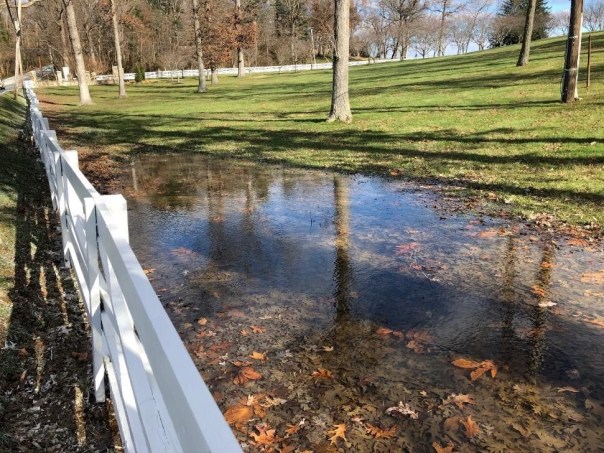

In general, red, black, chestnut and white oaks don’t tolerate poorly drained soils. Trees can tolerate some reduction in root health, as long as temperatures remain cool, water demands aren’t high, and adequate time is allowed for root regeneration. As a root system loses the ability to support the tree’s water needs, dieback will occur especially in the upper branches.
When the high summer temperatures began this season in mid-July and the low rainfall extended into this fall these conditions accelerated the loss of tree vigor and resulted in sudden browning of tree leaves and canopy dieback. Compromised tree health often allows pathogens such Armillaria and Hypoxylon to invade, which further accelerates dieback and death. In addition, opportunistic insects such as Ambrosia Beetles and Two-lined Chestnut Borer, will attack tree trunks and continue tree demise.

There are a few positive steps that may alleviate some tree stress. It is very difficult to reverse decline in stressed oaks so select trees that still have green foliage and irrigate near their bases during this period of high drought stress. Even minimal amounts of water can help recovery and prevent drought stress before winter dormancy. Practices that open up compacted soils to increase drainage and raise soil oxygen levels (e.g., vertical mulching) will often help as well.
As we continue to receive information about dying oaks across the state, we still have many unanswered questions. We will continue to collect data on tree species, age, and pest occurrence, in coordination with other agencies across Maryland.
By Dr. David L. Clement, Principal Agent, University of Maryland Extension, Home & Garden Information Center and Dr. Karen Rane, Director, University of Maryland Plant Diagnostic Laboratory