Q&A: Some insects have a lot of gall

Maple Eyespot Gall, caused by a native midge (tiny fly) that occurs throughout the state. Photo: M. Talabac

Q: What on Earth is going on with this maple leaf? I saw it on a wild tree while taking a walk down a neighborhood path, but wonder if itโ€™s something that can spread to nearby gardens.

A:  This is a great example of a gall, which is a tissue deformity on a plant caused by either insects, mites, fungi, bacteria, or nematodes. Usually galls cause swelling or weird projections on leaves or plant stems, but sometimes the more obvious feature is a color change like this.

The activities of the organism responsible creates chemical changes in the leaf tissue, redirecting tissue formation to suit its needs. For instance, insect-made galls give the larvae their own little house to feed in while being protected from most predators or harsh weather. (Impressively, tiny parasitoid wasps, little bigger than a dash on this page, still find their prey inside these structures and interrupt their life cycle. Isnโ€™t that amazing?)

Despite how drastic galls may look to us, they donโ€™t cause much harm to their host plants, which can be trees, shrubs, or perennials. Oak trees are renowned for harboring many kinds of eye-catching galls, some of which become most noticeable when they fall out of the canopy onto our lawns or gardens. See if you can find anything living inside those swollen red or brown lumps or balloon-like pockets on leaves. A wise bird or other insect may have beaten you to it, though, or the culprit is long gone and already flew away as an adult before the plant jettisoned the injured leaf.

If an eyesore, you can clip off heaviest infestations of leaf galls on witchhazel (caused by insects), azaleas (fungus), oak saplings (usually insects), and any other easy-to-reach plant. Keep in mind that the unaffected portions of those leaves are still functioning to feed the plant, so donโ€™t remove too much growth. Otherwise, I suggest you leave them alone and just marvel at the intricacies of the natural world. Gall-forming insects can feed songbirds and donโ€™t risk the health of the plant. As with any organism, populations wax and wane over time and galls might be prevalent one year and nearly absent the next.

At the Home and Garden Information Center, we have several web pages with more information about galls, including Shade Tree Galls and Eyespot Galls on Trees.

By Miri Talabac, Horticulturist, University of Maryland Extensionย Home & Garden Information Center. Miri writes the Garden Q&A for The Baltimore Sun. Readย more posts by Miri.

Have a plant or insect question? University of Maryland Extension has answers! Send your questions and photos toย Ask Extension.

Q&A: Why do my hollies and other evergreens have brown and pale leaves?

holly with leaves showing sections of brown and pale color
Winterburn symptoms on holly. Photo: David L. Clement, University of Maryland Extension

Q: Several of our evergreens (different kinds) have brown or pale, bleached-looking leaves. Do they have a disease already, and can anything be done? Is it preventable in the future?

A: Most likely itโ€™s winterburn, especially since most infectious diseases wonโ€™t cause symptoms this early and seldom impact several unrelated plants to the same degree. Winterburn is an abiotic disorder or injury โ€“ abiotic translates to without (a-) life (biotic) โ€“ meaning the condition has a non-living cause. Abiotic plant disorders are environmental, and causes include wind, water, temperature, and soil pH. In comparison, biotic factors would include insects, mites, fungi, or bacteria.

No treatment is recommended because the damage has been done, but winterburn is rarely a serious threat to a plantโ€™s long-term health. As new growth resumes, the plant will eventually shed the damaged leaves. If itโ€™s too much of an eyesore, you can selectively trim away the worst of it this month. Causes for winterburn typically involve a combination of cold temperatures, wind, and exposure to sun. Any autumn pruning that results in tender regrowth is priming a plant for winterburn, which is one reason itโ€™s not recommended.

Why are cold-hardy evergreens damaged? Leaves โ€œbreatheโ€ through tiny pores on their surface, and this gas exchange also allows water vapor to leave the leaf. Moisture leaves our bodies the same way โ€“ picture foggy breath on a cold day. Breezy days, especially in winterโ€™s drier air, speeds-up this evaporation, as can the sunโ€™s weak warmth. Meanwhile, during cold snaps, moisture in the surface layers of soil freezes, which prevents roots from absorbing it. Since the plant cannot replenish all of the moisture itโ€™s losing, the leaf tissue starts to essentially freeze-dry. A thaw wonโ€™t reverse the damage because the cells have been injured, just like skin with frostbite. (Unlike our skin though, which can heal to an extent, leaf tissue canโ€™t repair itself.)

Broadleaf evergreens are more vulnerable to winterburn than needled evergreens because the leaf surface area and evaporation potential is so much greater. Younger plants also have greater vulnerability because they are still establishing roots. This is the main reason itโ€™s risky to plant evergreens late in the fall. Cherry laurel, boxwood, holly, rhododendron, camellia, and southern and sweetbay magnolias are common winterburn victims in our area. Plants kept in containers are also susceptible because their roots dry faster and experience more drastic temperature swings than they would in the ground.

The only actions you can take to minimize winterburn risk is to site evergreens out of the brunt of winter winds and to periodically monitor their root zones for moisture, irrigating when dry during a warm spell. Plants overwintering in pots can be sheltered a bit near a wall or windbreak, but donโ€™t bring them inside as the interruption of dormancy may detriment their health.

Learn more and see additional photos on the Home & Garden Information Center website: Winter Damage on Landscape Plants.

By Miri Talabac, Horticulturist, University of Maryland Extensionย Home & Garden Information Center. Miri writes the Garden Q&A for The Baltimore Sun.ย Read more byย Miri.

Have a plant or insect question? The University of Maryland Extension has answers! Send your questions and photos toย Ask Extension.

Add winter interest to your gardens

Blah.  Blah.  Blah.

As you look out your windows onto a wintery scene are you missing the colors, shapes, and forms of your summer garden?ย 

No need.ย If you want to be delighted rather than depressed with your views, plan now to add some winter interest to your garden with color, texture, and form.

Crape myrtle’s exfoliating bark adds textural interest. 

Letโ€™s start with texture. Adding plants with interesting bark textures ratchets up the โ€œwowโ€ factor in a landscape.ย Personal favorites are the shaggy bark of river birch and the mosaic bark of crape myrtles. Both have striking multiple trunks and crape myrtles range from 3 to 30 feet to fit any landscape. Other trees have smooth bark, furrowed bark or bark like an elephantโ€™s trunk. Mix it up. The excellent book, โ€œDirrโ€™s Hardy Trees and Shrubs,โ€ includes bark photos in each plant profile.

With needles short or long, spiky, clustered or drooping, evergreen trees boast appealing texture. Seeing Norway spruceโ€™s kimono sleeves dusted with snow makes you really, really want one. 

But trees arenโ€™t the only plants that tout texture. Think shrubs, ornamental grasses, and perennials. I canโ€™t walk by a leatherleaf viburnum without stroking its coarse, deeply veined leaves.ย Ditto for hollyโ€™s glossy leaves.ย 

The seed heads of ornamental grasses and perennials also can add striking texture. The snow-capped seed heads of coneflowers and Brazilian verbena look especially fine. 

Now, letโ€™s pop some color into your winter garden.ย Youโ€™ll find it in the crimson branches of red twig dogwood and the berries of hawthorns, hollies, and winterberries. But red isnโ€™t the only color you can cultivate.ย 

Winterberry adds bright color to the winter landscape

Some junipers tinge purple in the winter or hold onto their summer blues.ย Tan ornamental grasses contrast well with snow and add movement when stirred by the wind.

Crabapples dangle yellow, orange, and red fruits while viburnums show off berries of red, purple, black, or blue.ย And most evergreens are, well, green.

Mother Nature stocks her palette with softer colors.ย Grey rocks sport green lichen.ย Wood ages from brown to grey.ย Use natural materials to add color and beauty to walkways, benches, fences, and accents.ย 

Suffuse your garden with your favorite colors.ย In the European garden Kiftsgate, the owners carefully placed splashes of bright blue. It adorns a bench, garden gate, and more to perfect effect.ย So grab your paintbrush.ย 

Now, letโ€™s talk form.ย Mixing shapes creates a well-designed landscape, but those shapes are most noticeable in winter when deciduous trees have dropped their leaf dresses. What do the bare bones of your landscape tell you?ย Look for shapes โ€“ round, square, triangle, oval, pillar, vase, and teardrop โ€“ and add whatโ€™s missing.ย 

If your landscape is filled with lollipops โ€“ round balls on sticks like maples โ€“ then add something layered and wider like a dogwood, triangular like a spruce, or columnar like an arborvitae. Weeping forms improve every garden.

When garden designers tell us to plan for the view, they mean the views from both the inside and outside.ย  So look out your windows and imagine what you want to see. Then make it happen.

By Annette Cormany, Principal Agent Associate and Master Gardener Coordinator, Washington County, University of Maryland Extension. This article was previously published by Herald-Mail Media. Read more by Annette.

This article was previously published by Herald-Mail Media.


Save the date! On March 9, join together with fellow University of Maryland alumni, faculty and staff, students, and volunteers for an extraordinary day of giving back. Make a contribution to Home and Garden Information Center Fund for #GivingDayUMD!

Winter Pruning with Andrew Ristvey – The Garden Thyme Podcast

Although it may be cold and dreary outside, itโ€™s the perfect time to take inventory of your deciduous trees and shrubs to see which plants would benefit the most from pruning. In this month’s episode, weโ€™re sitting down with Extension Specialist in Commercial Horticulture, Dr. Andrew Ristvey. Dr. Ristvey is giving us the ins and outs of winter pruning.ย 

We also have our:ย 

  • Bug of the Month  (Winter Stoneflies) at 37:30
  • Garden Tips of the Month at 45:55
  • Native Plant of the Month ( American holly)  at   49:00

Here are some great resources to learn more about pruning: 

 If you have any garden-related questions please email us at  UMEGardenPodcast@gmail.com or look us up on Facebook.

The Garden Thyme Podcast is brought to you by the University of Maryland Extension. Hosts are Mikaela Boley- Senior Agent Associate (Talbot County) for Horticulture, Rachel Rhodes- Agent Associate for Horticulture (Queen Anneโ€™s County), and Emily Zobel-Senior Agent Associate for Agriculture (Dorchester County). Theme Song:  By Jason Inc


Save the date! On March 9, join together with fellow University of Maryland alumni, faculty and staff, students, and volunteers for an extraordinary day of giving back. Make a contribution to Home and Garden Information Center Fund for #GivingDayUMD!

Q&A: Winter gardening tasks

Q: Is there any outdoor garden task this time of year that I may be forgetting to do? Iโ€™ve foregone a fall clean-up for the benefit of overwintering wildlife, and the lawn and veggie garden are โ€œasleepโ€ for the season.

A: There are a few things that are good to accomplish during the dormant season. Yard tools like pruners, loppers, shovels, spades, and mower blades are best stored clean, sharpened, and oiled. There may be local businesses that offer sharpening services, but you can also do it yourself with a metal file or sharpening stone or rod.

Ideally, sharpen mower blades annually so the turf doesnโ€™t have the added stress of ragged, torn leaf blades which can be more vulnerable to infection. A steel wool scrubber or a wad of sandpaper can take off early stages of rust and caked-on sap before you focus on the blades of pruning tools and shovels. Good-quality hand pruners can usually be disassembled for easier maintenance, and lightly wiping with oil afterwards helps lubricate the metal and resist rust. Linseed oil (or vegetable oil in a pinch) can be rubbed into wooden tool handles to protect them from aging.

Check on the location of pesticide containers and protect them from extreme temperatures (including freezing). Always store them away from human and animal food and well-secured from children and pets. Products you rarely use should be dated (if you recall when you bought or opened them) since they may only have a useful shelf life of a couple of years. Old pesticides can be disposed of by looking for household hazardous waste collection sites near you.

If you have staked any new plantings, check their ties to make sure the plants still have wiggle-room and bark isnโ€™t being abraded. Stakes that have been in place for six to twelve months can be removed; theyโ€™ve either done their job by now or werenโ€™t working in the first place. (Staking is actually not often needed, but at the very least itโ€™s key to let a staked plantโ€™s trunk sway in the breeze so stabilizing root growth and trunk thickening are stimulated.)

Similarly, if you left ID tags tied to any plants, remove them and any other plastic or elastic nursery tags before they damage the stems. Otherwise, any material that gets embedded in expanding growth will be impossible to remove and could cause branch decline in the future if it interferes with sap flow. Alternatively, tags may disintegrate over time and fall off, which means youโ€™ll have lost your plant name. Tags will be easier to spot now on deciduous plants. Keep a record of the plant ID another way โ€“ a garden diagram or journal, or written on a stake at the plantโ€™s base โ€“ as variety-specific features might impact care advice or future troubleshooting.

Lastly, if youโ€™re overwintering hardy plants in containers, consider using โ€œpot feetโ€ or โ€œpot risersโ€ to raise the potโ€™s base off decking or pavement by an inch or two. This lets excess moisture clear the drainage holes so it doesnโ€™t freeze into an ice dam, which would risk flooding roots. Any sturdy material where you can find several pieces the same height would suffice, but you could also purchase them in an array of materials, often in packs of three or four โ€œfeetโ€ per pot.

By Miri Talabac, Horticulturist, University of Maryland Extension Home & Garden Information Center. Miri writes the Garden Q&A for The Baltimore Sun. Read additional articles by Miri.

Have a plant or insect question? The University of Maryland Extension has answers! Send your questions and photos to Ask Extension.

Tips for using garden evergreens for holiday dรฉcor

Using evergreen cuttings to decorate the home offers an easy way to incorporate different textures, shapes, and aromas. Evergreens add a touch of simplicity, elegance, and nostalgia to holiday dรฉcor. They can be used easily on doors and entryways, as garland, or centerpieces. Cutting materials from your own landscape can provide a thrifty option.   

Here are a few tips for making evergreens a beautiful addition to your holiday dรฉcor. 

  1. If cutting from your own landscape, be cautious not to cut too much. Pruning in the early winter is generally not recommended unless it is to remove diseased or damaged material. It wonโ€™t hurt a well established plant to trim off a few branches, but try not to cut anything from newly installed plants. Check out this factsheet for additional information on pruning evergreens. 
  2. Caution! Several critters are overwintering on evergreens so once they get warm in your home, they will become active. These uninvited guests can cause surprise and panic from those not expecting them this time of year. If you find spiders, etc., you can put them outside.
  3. Keeping evergreens cool and hydrated will extend how long they stay fresh and beautiful. Place the ends of cut branches into water.  
  4. Often mixing different types of evergreens is a fun way to add unique smells, shapes, and texture to your home. 
  5. Shorter needled (hemlock/spruce) plants tend to lose their needles faster than longer needled species.
  6. Evergreen boughs are easy to stick into seasonal planters before the soil freezes. Be warned that if the branches freeze in the soil, they will be impossible to remove until it thaws. 
  7. Donโ€™t forget to gather interesting seed pods, ornamental grasses, pine cones, etc. These add additional interest and natural beauty.

Some favorite cuttings include Junipers, Arborvitae, Holly, White Pine, Rhododendron, Boxwood, Lavender, and Rosemary.  If you have a live Christmas tree, be sure to repurpose those trimmings as well.

wreath made with grasses, seed pods, evergreens, and a bow
Here is a wreath base made from dried ornamental grass. Also, ornamental grass seed heads, Monarda seed heads, pine cones, and mixed evergreen cuttings are included. Photo: A. Bodkins
wreath made with Juniper and lamb's ear leaves
This wreath uses cuttings of native Eastern redcedar and leaves of lambโ€™s ear. Photo: C. Carignan
door swap made with evergreens, pinecones, and a bow
Door swag. Photo: A. Bodkins

As you gather your materials and get ready for crafting, remember that:

  1. Sharp pruners give a clean cut that will help increase the life of your branches and prevent premature needle drop. Guidance on sharpening pruning tools can be found here. 
  2. Use green floral wire to put cut branches together. It blends in well and is easy to work with. It is widely available at craft stores and low in cost. 
  3. Repurpose metal clothes hangers for inexpensive frames for swags/wreaths/garland. 
  4. Swags are often simpler and easier than a wreath to make and require less material, but provide a nice garnish for your entryway. Think of making a bouquet and then turn it upside down to get an easy door swag.
  5. If youโ€™re placing cut evergreen stems into a container, use clean water and clean containers to prevent fungal and bacterial growth.
  6. Keep arrangements out of direct light and as far away as possible from the heat source.
  7. Misting cut evergreens can help extend their beauty.
  8. Using cut evergreens outside the home will help them last the entire season.
  9. Ribbon with wired edges is easier to work with for beginner bow makers. 

You can create many beautiful decorations by working with nature! Be creative and enjoy the gifts that your garden continues to give all year round. And itโ€™s never too early to start thinking about garden plant additions for 2022! Think about items you could use in future holiday decorations or another season’s decor. 

By Ashley Bodkins, Senior Agent Associate and Master Gardener Coordinator, Garrett County, Maryland, edited by Christa Carignan, Coordinator, Home & Garden Information Center, University of Maryland Extension.ย See more posts byย Ashleyย andย Christa.

Q&A: Can you recommend plants that provide food for birds?

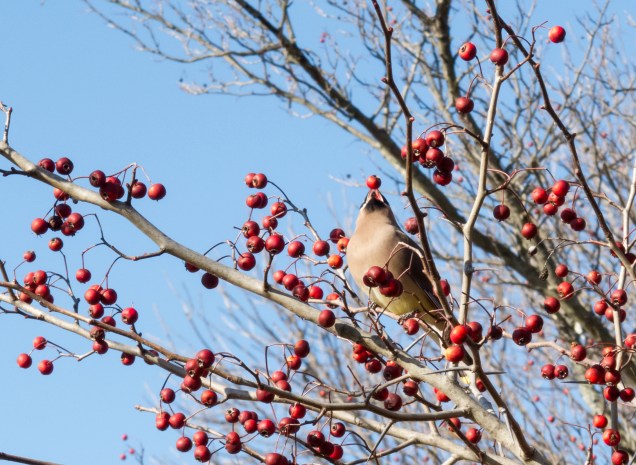
Cedar Waxwing dining on a Green Hawthorn berry. Photo: Miri Talabac

Q: This summerโ€™s mysterious bird illness has me thinking…Iโ€™ve become more interested in birds during the past two years and would like to attract them to my yard with plants. Are there favored recommendations?

A: Bird-attracting landscaping definitely beats out bird feeders as the preferable way to bring these beauties into yards for easier viewing as a safer environment than a communal feeder. (While youโ€™re at it, look into ways to discourage window strikes since plants, like feeders, could increase encounters with glass.)

Plant recommendations are going to be incredibly varied because the diet of birds is so varied, both across species and throughout the year. Site conditions in your garden will narrow down what may be an overwhelming list of choices. Here are some general tips:

  • Plant as much variety for which you have room.
  • Plant to provide food for insects and the birds will follow.
  • When looking at berry or seed production, consider productivity for each season.
  • Try to focus on native plants only, since birds will deposit their seeds beyond your landscape.

To pick a timely category – late-ripening berries – there are some notably popular species. Highly-ranked contenders for both resident and southbound migrant birds include Viburnums, Dogwoods (trees and shrubs), Spicebush, Virginia Creeper, Eastern Redcedar, Magnolia, Black Tupelo, Hackberry, Sassafras, Bayberry, Sumac, Hollies, and Hawthorn.

Cornellโ€™s All About Birds web library plus local Audubon Societies are good resources for more thorough information on individual species diet, habitat preferences, and plant suggestions for both foraging and nesting.

By Miri Talabac, Horticulturist, University of Maryland Extension Home & Garden Information Center. Miri writes the Garden Q&A for The Baltimore Sun.

Have a plant or insect question? University of Maryland Extension has answers! Send your questions and photos to Ask Extension.