Dragonflies come in every color of the rainbow and some pretty jazzy combinations. Photo by Joan Willoughby
Dragonflies are amazing insects. Their aerial acrobatics are impressive as is their ability to control pests from mosquitoes to biting flies.
And oh their beauty when shimmering over a garden or pond! Over 5,000 species dress themselves in everything from basic black to electric blue, tasteful stripes to Rorschach ink blots.
Dragonflies first cruised the skies 300 million years ago with 2-foot wingspans. They were among our first winged insects.
Since then they’ve perfected their flying skills. They can move up, down, sideways and backwards, hover and reach speeds of 30 miles per hour. One species migrates 11,000 miles including an ocean crossing.
Several evolutionary adaptations make dragonflies exceptional hunters.
Their head is almost all eyes with over 30,000 facets, allowing them to see nearly 360 degrees. Each of their 4 wings is controlled independently, giving them enviable maneuvering abilities.
Dragonflies and their damselfly cousins comprise the insect order Odonata meaning “toothed ones.” Watch them hunt and you’ll understand why.
They grab prey in flight using spines on their long legs. Then they use their serrated mandibles to tear them apart and eat them, often while flying. It’s the original dinner to go.
Dragonflies’ eyes have 30,000 facets, allowing them to see nearly 360 degrees. Photo by Joan Willoughby
Dragonflies can zero in on one insect in a swarm and follow it with uncanny accuracy thanks to a neural bundle that connects with a flight center in their thorax. They make minute adjustments and – bam – it’s over before that bug knew what hit it.
A Harvard University study showed that dragonflies successfully capture 90 to 95 percent of the prey they pursue.
Mosquitoes, flies, gnats, aphids, bees and other insects may be on the menu. While dragonflies are generalists, they help to control pests and can eat hundreds of mosquitoes a day.
A dragonfly’s life starts in the water. A male dragonfly patrols pond edges looking for food and friendship. When he finds a receptive female, they connect in a heart-shaped flying configuration known as a “mating wheel.”
Is anyone else hearing the theme song from “The Dating Game?”
The female lays her eggs on the water or aquatic plants. They hatch in about a week, becoming aquatic nymphs or naiads.
Dragonflies use plants in and around ponds for perching and egg-laying. Photo by Joan Willoughby
Juvenile dragonflies are as voracious as adults, eating mosquito and other insect larvae, crustaceans, tadpoles, fish, and even other dragonfly young.
Nymphs plod along until dinnertime. Then they blast water through their abdomens to become jet propelled. An extendable jaw snaps forward like a frog’s tongue and nabs unsuspecting prey.
Naiads molt many times during their 2 or more years underwater. Then they crawl out of the water onto a plant or stone and split out of their skin to emerge as adult dragonflies.
Dragonflies need clean water and stable oxygen levels, making them good indicators of a healthy ecosystem. Everything we do to help keep our waterways clean helps dragonflies.
To do more, add a pond or water feature to your landscape. Include some clear surface area and varied plants in and out of the water. Dragonflies will return the favor with natural pest control and beauty on the wing.
By Annette Cormany, Principal Agent Associate and Master Gardener Coordinator, Washington County, University of Maryland Extension. This article was previously published by Herald-Mail Media. Read more by Annette.
Firefly resting on butterfly milkweed flowers. Photo: Pixabay
This summer I have witnessed more fireflies than I’ve ever seen. Each evening gracing our fields and pasture, it is truly unbelievable to see thousands of beautiful and magical flashes of light as night falls. My 4 year old absolutely loves to catch and release the fireflies. It’s wonderful to see the pure delight these stunning beetles bring to both children and adults.
Even more interesting is the fact that these critters are beneficial to our lawns and gardens! They not only provide splendor, but the larvae, which are nocturnal too, spend the majority of their life crawling along the soil surface consuming many harmful garden pests, such as slugs, snails, and cutworms. It takes at least two years for their lifecycle to be complete.
Fireflies are beetles in the Lampyridae family with at least 200 species from 23 genera in North America. Did you know that different species exhibit unique flash patterns, which are not a display for our benefit, but are used to help them attract a mate?
The light that we see is the result of a complex chemical reaction that occurs in the insect’s abdomen. According to the University of Minnesota, the light they produce is a form of luminescence, the emission of light by a substance that has not been heated. There are many ways that organisms accomplish bioluminescence, and the mode that fireflies use is well-understood. Oxygen combines with a substance called luciferin, calcium, and adenosine triphosphate (ATP) in the presence of the enzyme luciferase. The whole reaction takes place in special cells called photocytes. The rhythm of the flashing varies between species and may serve to distinguish males and females from one another.
So what is your preference: firefly or lightning bug? Whatever you decide, be sure to enjoy and appreciate not only their beauty, but also their contribution to helping keep pesky critters in check in our yards and gardens!
By Ashley Bodkins, Senior Agent Associate and Master Gardener Coordinator, Garrett County, Maryland, University of Maryland Extension. See more posts by Ashley.
Take a look at these two videos from Harford County Master Gardeners full of information about the native monarch caterpillars and tussock moths that feed on native milkweed plants.
In seasonal regions such as Maryland, nature goes through cycles, with some seasons reserved for growing and reproducing, and others for resting and waiting for conditions to get better. One of the groups of organisms that in my opinion represent clearly those changes in seasons are butterflies, which go through extreme modifications in their bodies and ecologies to closely match the changing seasons. Today’s post is going to explore two beautiful butterfly species that we can find right here in Maryland: the common Black Swallowtail and the beautiful but imperiled Baltimore Checkerspot.
First Things First: The Life Cycle of Butterflies
The life cycle of butterflies is fascinating and complex, and in our region is usually tightly linked with changes in season. Image: Kids Press Magazine
Before going into details about these butterflies, I think it is important to explain how these organisms develop because their life cycles are usually tightly related to our seasons. Caterpillars have indeed pretty special and fascinating life cycles. In these insects, a female lays eggs on the preferred host plant of the species. This way, the first larva (a tiny caterpillar) that emerges from that egg will not need to move far to feed on its favorite and most nutritious plant.
Once larvae hatch they start feeding on plant material, becoming bigger as they eat. Because insects such as butterflies are covered with a special hard ‘skin’ called an exoskeleton (this is really an external skeleton!) that gives them support and structure, every time the caterpillar gets too big, the exoskeleton becomes too tight (imagine a kid outgrowing a T-shirt). At that point, the caterpillar breaks the old exoskeleton and grows a new larger one in which it can fit.
While going through these ‘changes of skeleton’ (called molts), the caterpillar is able to grow until it is large enough to make their last change: pupation. At this stage, the very large caterpillar is ready to become an adult. For this, the caterpillar will molt a last time and become a pupa, which is the form that builds the cocoon in which the last body changes happen before the adult butterfly emerges.
As one can see, because the life cycle of butterflies has so many stages, there are many chances for things to go wrong during their development, which can also explain some annual fluctuations in butterfly populations. For example, if a wave of particularly cold or hot weather happened during one of the stages at which the caterpillars are sensitive (e.g., pupa, first instars), we may not see many butterflies later in the season. The same is true if there are important disease outbreaks, if predation was particularly high earlier in the season, if the host plants were not as abundant as other years, or if insecticides were applied close to some of the preferred host plants.
Now that we have a better idea of how the life cycle goes, let’s take a look at what our two species do and how they differ in their food preferences, life cycles, and how that affects how we can promote their presence in our surroundings.
Black Swallowtails
Even though it may seem obvious to some, let me start by saying that this species gets its name from the shape of its hind wings, which look like the pointy tails of swallows. Black Swallowtails (Papilio polyxenes)are common butterflies in our region and are present across the whole eastern USA.
In Maryland, this species has between two and three generations per year, with the first generation(s) of a season reaching adulthood within the season, and the last one spending the winter in pupal phase and emerging as an adult the following spring. (Check this other blog to learn more about butterflies in the winter: Where are all the pollinators?)
Like all butterflies, Black Swallowtails are specialized on what they feed. What defines what makes a plant yummy or not to the caterpillars are the chemical compounds the plant carries. In fact, plants have evolved to produce different chemical compounds that protect them against the multitude of herbivores that exist. Black Swallowtails in particular have evolved to tolerate the chemical compounds present in plants of the parsley family (Apiaceae). It is for this reason that these caterpillars can be found in your garden feeding on carrot, parsley, or dill leaves. Adults (butterflies) are usually seen collecting nectar from flowers such as clover, milkweed, and thistles.
Black Swallowtails can have several generations per year, feeding on plants of the carrot family, and finally emerging as beautiful adults either in the same or the following season. Photos: eggs (wikiCommons), larva (PINKE), pupa (Woodleywonderworld), adult (J. Flanery).
Black Swallowtails are currently considered to be a species that is not particularly at extinction risk. However, to maintain their populations it is recommended that open grasslands with plants that serve as caterpillar hosts are present. Interestingly, because they are so common in our area, they can be easily reared indoors, something that is really fun and can be a great summer project for kids (and adults!).
Baltimore Checkerspot
If Maryland has a state dessert, I feel it’s only fair that it also has a state insect! The Maryland state insect is the exquisite Baltimore Checkerspot (Euphydryas phaeton), which was chosen because its colors remind us of those of the Maryland flag. In our area, Baltimore Checkerspots are not as common as Black Swallowtails, and, unlike Swallowtails, have only one generation per year.
Their diets are also significantly more specialized than those of the Swallowtails: young caterpillars feed exclusively on white turtlehead, on which their eggs are laid. While later on in their development they are able to feed at least partially on alternative plants, white turtleheads are required for them to survive the early caterpillar stages.
Finally, unlike most butterflies in our region which spend the winter as pupae, this species spends its winter as a caterpillar and pupates only in the spring. The caterpillars of this species are super cute and they always remind me of the Dust Bunnies of the movie “My friend Totoro”. Adults of this species feed on milkweeds, dogbanes, and wild blackberries.
Baltimore Checkerspots go through different developmental stages, hatching on their preferred host, and feeding on them as caterpillars, before entering pupal phase and finally emerging as adults. Photos: eggs (NABA.org), larva (wikiCommons), pupa (4.bp.blogspot.com), adult (S. Snyder).
Unfortunately, even though these beauties are our state insect, they are currently imperiled in our area. The reasons for this have to do with changes in land use, which led to less white turtleheads being available to the caterpillars both because less natural habitats are present and because the deer populations are so large that they eat most of the host plants!
If you would like to try to contribute to these butterflies’ populations, you can plant white turtleheads in your yard, but in particular support conservation actions already happening in Maryland, such as the Baltimore Checkerspot Recovery Team.
By Anahí Espíndola, Assistant Professor, Department of Entomology, University of Maryland, College Park. See more posts by Anahí.
Bumblebees often can be seen feeding at the flowers of foxglove beardtongue (Penstemon digitalis), which blooms from late May through June. Photo: C. Carignan
We all want to protect pollinators and it seems that the best way to do that is to have a lot of flowers so they can feed on them. But if you’ve ever checked a seed catalog or visited a plant nursery, you may be overwhelmed by all the options. How do you choose what to plant? In today’s post we will chat a bit about the why’s of these choices and we’ll share some resources that may be useful next time you’re trying to make those decisions.
Each pollinator species is unique
As all species in the world, each pollinator species has unique reproductive, nutritional, and habitat requirements to survive. For example, a bee that nests in the early spring needs food and habitat that will be different from those of another bee that nests in the summer, or of a butterfly that emerges from its metamorphosis in late spring. For an early-spring bee it will be key that flowers are available early in the season. Those will be of no help to a summer bee. Likewise, a late spring butterfly will be able to enjoy the nectar from flowers that were not available to the early-spring bee.
Along with the timing of emergence, each pollinator is unique in its anatomy and sensorial abilities. For example, long-tongued bees can reach the nectar of flowers that may be too deep for short-tongued bees. Similarly, because of their extremely long mouth parts, hummingbirds and butterflies usually can access very tubular flowers that are just out of reach for other pollinators.
It’s not only the shape of the mouth parts of the pollinators that will play a role in what flowers they can feed on. Their general body shape and physical abilities will also define this. For instance, butterflies can’t regulate their flight as well as hoverflies or bees do, and because of this, when they visit flowers they need to have large surfaces on which to land, while bees and hoverflies may not really need them.
Swallowtail butterfly on butterfly weed (Asclepias tuberosa). Photo: UME Home and Garden Information Center
Finally, different pollinators have different sensorial abilities, with some being able to see some parts of the light spectrum that others may not. On this, butterflies and hummingbirds can see many different colors including UV light, bats that pollinate are blind, and bees have a broad spectrum of light vision but can’t differentiate many of the colors we can.
So now you may be asking yourself why I am talking about all of this. How does this relate to the topic of this post: how to help pollinators with flowers? Bear with me, I’m getting there!
How should I choose what to plant to help pollinators?
As you may be guessing by now, because each pollinator has slightly different life requirements, if you want to help as many pollinators as possible, your best shot is trying to diversify your garden or flower bed. I like to think of this as if I were holding a dinner party at my house and I want to have as many of my friends enjoy the food.
If I know that some of my friends are vegan, lactose intolerant, or allergic to nuts, I will make sure that they find something to eat at my table. If I don’t have anything for them, they will be hungry and sad, and they will also probably decline any future dinner invitations from me (how sad is that!?). So, I like to think about these pollinator plantings as a party I am hosting for a whole season, and where I will make sure that all my little friends always have something to eat so they come back next time I invite them over!
A diverse flower garden includes flowers of many different colors and shapes and will have different plants in flower throughout the season. Photo: Carol Norquist
The key to attract the most pollinators is diversifying our gardens! Ideally, the choice of plants should include different flower colors, shapes, and sizes available throughout the season. This means that there will be always several different types of flowers blooming at the same time, even though no one plant may be flowering throughout the season. Along with this, if one is trying to attract specific pollinators that have very specific food requirements (for example, oil-bees, monarchs), one would also have to make sure that the pollinators’ required food is also present (take a look at this recent post to learn more: Why do pollinators visit flowers?)
Another aspect to consider when deciding what to plant is the fact that native pollinators usually get appropriate nutrition at the right time of their life cycle if they feed on plant species that are also native to the area. For this reason, if one wants to help pollinators, native plant species are usually recommended, and in particular, avoiding invasive exotic species is key. In fact, invasive species, in addition to not providing ideal food for native pollinators may also displace native plant species, reducing even more the diversity of your flower bed and the pollinators who will visit it. Finally, this also means that a “good” flower mix for pollinators from Europe is probably not going to be ideal for Maryland pollinators.
This perennial flower garden includes a variety of species that bloom at different times throughout the growing season. Photo: C. Carignan
But then, what should I do?
There are so many things to think about! This is truly a brain twister, right? Luckily for you (and me) many biologists, ecologists, and conservation specialists have been thinking about this for a while. Today, floral mixes have been created that are appropriate to different regions of the United States. In the state of Maryland, the Department of Natural Resources has created a neat list of species you can plant depending on the conditions on your land. The Xerces Society has also put together a list for plants appropriate for different states. Alternatively, if you would like to just favor specific pollinators, you can target their preferred plants. For finding seeds and starts for these plants, take a look at this great resource the Maryland Native Plant Society has put together!
By Anahí Espíndola, Assistant Professor, Department of Entomology, University of Maryland, College Park. See more posts by Anahí.
Carpenter bee (Xylocopa virginica) on an Eastern redbud tree. Photo: Allen Szalanski, Bugwood.org
A sure sign of spring is the emergence of carpenter bees. Have you seen the perfectly circular small holes that these bees chew into wood? I mean honestly, I have trouble drawing a perfect circle freehand, much less chewing one!
Adult carpenter bees spend the winter hanging out in their nesting site, just waiting for the first signs of spring when they will emerge, find pollen for food, and mate. Nesting sites/holes are most often seen under the eaves of buildings, particularly on unpainted wood. Every spring, we have carpenter bees infesting the eaves of our barn.
Holes made by carpenter bees. Photo: Ashley Bodkins
People often confuse carpenter bees for bumble bees, but there are some distinct differences between these two types of bees, including nesting locations. Bumble bees live in a social hive whereas carpenter bees are solitary, and a carpenter bee has an abdomen that is shiny black, not hairy.
Carpenter bees are native pollinators, are not aggressive, and are only noticeable in late spring-early summer. They are mostly found around structures made of wood, or around facia trim, beams, etc.
Male carpenter bees often cause alarm when they dive-bomb and fly erratically around humans that approach nesting sites, but in actuality, these bees are bluffing as they lack a stinger and are harmless. They can be identified easily by the white spot on the front of their heads.
The male carpenter bee has a distinct whitish pattern between the eyes. Photo: David Stephens, Bugwood.org
Only female bees have a stinger, which is a modified egg-laying device (ovipositor). Female carpenter bees are docile and are reported to sting only if handled, but a female carpenter bee can sting more than once.
Carpenter bees do not consume wood, but they do create their nesting sites in wood. They feed on pollen and nectar and are important plant pollinators. Their large size allows them to pollinate some flowers that are unsuitable to smaller bees.
Carpenter bees are important native pollinators. Note the shiny black abdomen, a characteristic that differentiates them from bumble bees. Photo: Ansel Oommen, Bugwood.org
Female carpenter bees use their strong jaws (mandibles) to chew a perfect circle entrance hole and make a small chamber that will become her home. The entrance is a little less than a half-inch wide, close to the same diameter as her body. These channels that she chews are perpendicular to the grain of the wood. Then they will turn about 90 degrees and excavate along the wood grain for 4 to 6 inches to create a gallery (tunnel). It takes approximately 6 days to bore one inch into the wood.
Female carpenter bees build several cells within each tunnel and each cell contains one egg and enough food for the larva that will hatch. The food, called bee bread, is a mixture of pollen and plant nectar. She places the food into the tunnel, lays a single egg on it, and builds a partition in the tunnel with cemented wood particles. Each tunnel contains 6 to 10 cells.
Control of carpenter bees may be desired if there is significant damage to wooden structures. But be aware, carpenter bees do not cause major damage like termites, and again, they are important native pollinators.
If control is desired, you can apply a registered insecticide into the entrance holes. Then the holes should be sealed thoroughly with wood putty or caulking compound. If possible, filling the entire tunnel system with a sealant can also be effective. All exposed wood surfaces should be painted or varnished and sealed. When managing carpenter bees, it may be helpful to treat and seal entrance holes during the early morning or late evening when bees are less active. Additional management options are offered by West Virginia University Extension.
By Ashley Bodkins, Senior Agent Associate and Master Gardener Coordinator, Garrett County, Maryland, and Christa K. Carignan, Coordinator, Home and Garden Information Center, University of Maryland Extension. See more posts by Ashley and Christa.
Ashley’s daughter with her bug book. Photo: A. Bodkins
A few months ago, my daughter was gifted The Bug Book, by Sue Fliess. It highlights many insects and has wonderful, very detailed pictures, with few words, which makes my bug-loving 4-year-old quite happy. It quickly became one of our favorite bedtime books. There are several different beetles pictured and mentioned in the book, which made me think about the amazing and complex group of thousands of species of beetles that are classified as “ground beetles”, so named because they are found living and occupying the surface of the ground.
Did you know that ground beetles are beneficial in your garden? These critters might be hard to see as they are good at hiding and staying out of site. A very beautiful and common ground beetle you might be able to spot this spring is the bright green, Six-Spotted Tiger Beetle. For additional information about this and other common beetle species found in Maryland, visit the Home and Garden Information Center’s page about predatory beetles.
The Six-Spotted Tiger Beetle is on of the common types of ground beetles found in Maryland. Photo: David Cappaert, Bugwood.org
All beetles are in the insect order of Coleoptera, which is the largest order in the animal kingdom! Coleoptera refers to the hardened front wings which protect the membranous hind wings held underneath. Within this large order are thousands of different families, which include everything from lightning bugs, wood boring beetles, ladybird beetles, cucumber beetles, and also the family of Carabidae, which is where the beneficial ground and tiger beetles fall in the classification.
Ground beetles range in size from 1/8 of an inch to over 1 inch and can be brown, black, or metallic green or blue in color. Often these are the critters that you see scurrying away when you pick up a rock or item that has been sitting on the ground.
They are most active at night and are responsible for eating anything from snails to slugs, root-feeding insects, as well as weed seeds. They are generally referred to as being opportunistic feeders, which means they will consume a variety of items as they come across them. It is estimated that ground beetles can consume up to their body weight daily in food.
Some interesting research that is outlined in a Penn State fact sheet, Ground and Tiger Beetles (Coleoptera: Carabidae), says that ground beetles consume weed seeds from agriculturally important weeds, such as common ragweed, common lambsquarter, and giant foxtail (Lungren 2005). Their preference for different types of weed seeds could be linked to oil content and size of seeds, which limits which varieties they can move easily. The research points to the fact that these beetles would not be able to eliminate a weed species, but rather help to change the number of seeds in a certain area and give other plants more of a chance to receive the needed light, nutrients, or water.
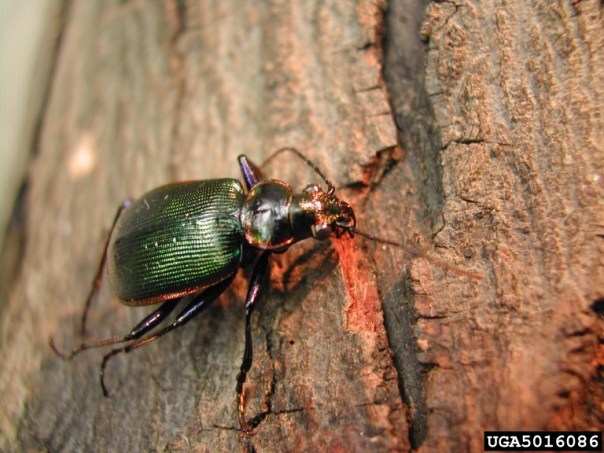
Caterpillar Hunter Ground Beetle (Calosoma wilcoxi). Photo: Pennsylvania Department of Conservation and Natural Resources – Forestry , Bugwood.org
These amazing critters can live in many different ecosystems, and some species are specific to certain habitats. They go through a complete metamorphosis with four life stages including egg, larva, pupa, and adult. They typically have one generation per year. One female can produce anywhere between 30 to 600 eggs!
You can do your part to help promote this group of beneficial beetles in your garden by not tilling the entire garden at one time or providing areas of protection during a tillage event, with a protected area or walkway that is covered in mulch, or perhaps by planting a strip of pollinator plants or perennial herbs that would benefit all beneficial insects. These protected areas provide much needed moisture, food sources, and habitat. Of course, in order to protect all our ground dwelling beneficial insects, you should avoid applying soil insecticides.
By Ashley Bodkins, Senior Agent Associate and Master Gardener Coordinator, Garrett County, Maryland, and Christa K. Carignan, Coordinator, Home and Garden Information Center, University of Maryland Extension. See more posts by Ashley and Christa.