A few years ago during the early spring, my brother, mother, and I noticed several quarter-sized, brownish-colored egg cases in our high tunnel. Our research taught us they were gifts from black and yellow garden spiders, Argiope aurantia. These spiders are also called yellow garden orb-weavers, writing spiders, or zipper spiders. This made sense, as the tomato vines are trellised to 8 feet high and provide the perfect environment for these magnificent arachnids to spin large circular webs, high off the ground, which contain a highly visible, zig-zag pattern in the center that is called a stabilimentum.
Four black and yellow garden spider egg masses in the back of the high tunnel frame were laid in the fall of 2019. The spider webbing provides protection from predators. Each egg case contains hundreds of baby spiders. Photo: Ashley Bodkins
We assumed that the eggs had hatched the previous fall and opted to not bother them and go about cleaning up and preparing for the new growing season. Little did we know, each egg case contained hundreds of baby spiders just waiting to make their escape, which happened later that spring and left our high tunnel completely overrun with spiders!
Fortunately, these black and yellow garden spiders are beneficial in a vegetable garden. Spiders prey on all kinds of insects including flies, cucumber beetles,brown marmorated stink bugs, and sometimes even butterflies. Black and yellow garden spiders are not aggressive towards people — although, that does not mean they are not a bit intimidating, especially when you run your face smack dab into the beautiful web while picking tomatoes!
Orb-weaver spiders spend their days sitting in their perfectly shaped webs, or nearby on the ground, waiting to catch an unassuming insect, which is immobilized, killed, and wrapped in silk to be consumed later. They are most active in the cover of the night and are great additions to your garden!
A black and yellow garden spider makes an orb web about a meter wide. The zigzag silk in the center is called the stabilimentum. Photo: David Cappaert, Bugwood.org
Webs will begin showing up in mid-summer and remain until the first frost. In our high tunnel, they are protected from most of the wind and rain that could normally damage a web. In your yard and garden, look for egg masses in secluded areas that you don’t visit very often, usually located several inches off the ground, maybe camouflaged with tall grass, at the edge of a woods line, or perhaps under bucket rims or plant containers.
Black and yellow garden spider egg mass from the fall of 2019 camouflaged in tall grass. Photo: Ashley Bodkins
As you begin cleaning up your yard or garden this spring, be on the lookout for egg masses of all types and in particular these amazing black and yellow garden spider egg cases. Be forewarned, there are probably hundreds of spiders just waiting to make their exit. From my experience, wherever the spiderlings exit they will live for the next 1-2 years. If you don’t want them in the area where they are located, gently pick up the egg case and move it to an area where they can thrive.
Embrace the beautiful cycle of life and be ready to capture pictures of some beautiful spiders in your garden this year. All types of spiders are predators and considered beneficial in the garden! Check out more information on spiders on the Home & Garden Information Center website.
This year the University of Maryland Extension Master Gardener Grow It Eat It program is celebrating the little creatures that help us grow what we like to eat! Whether they are pollinating our plants or devouring pests, we couldn’t grow much to eat without the help of beneficial insects and arthropods.
By Ashley Bodkins, Senior Agent Associate and Master Gardener Coordinator, Garrett County, Maryland, University of Maryland Extension
Thanksgiving is a time to gather with loved ones and usually involves first preparing and then ingesting a lot of delicious goodies. Each family has recipes and traditions related to Thanksgiving, and even foreigners (like myself) may join in and create new traditions. Independently of who we are and our origin, the meals we prepare include a number of common foods: cranberries, pumpkins, sweet potatoes, pecans, and potatoes.
For this year’s Thanksgiving, I want to take us on a trip to recognize and thank nature and some of our little winged friends, without whom we would not be sharing all that deliciousness with our loved ones. Plus, after reading this you will know some cool fun facts you can share with others during your Thanksgiving meal!
Photos: Wikipedia Commons, Lotherington
Cranberry Sauce
Cranberries are the fruits of a plant closely related to blueberries and huckleberries, which all are native to North America. Like blueberries and huckleberries, cranberries need pollinators to produce fruit. The reproductive organs (anthers – where pollen is produced, and carpels – where the ovules are hosted) in a cranberry flower mature at different times, which means that a flower can’t self-pollinate and needs a pollen vector to produce fruit.
As you may know, no pollination means no fruits, and no fruits means no cranberry sauce. Luckily, nature provides and pollinators are around! We know today that several different bees visit cranberry flowers, with bumblebees being some of the best pollinators. Some other wild bees (for example, mining bees, Andrena) also contribute to the pollination of this plant, and honeybees can pollinate as well but not as efficiently as bumblebees and other native bees.
Photos: Wikipedia Commons
Pumpkin Pie
Pumpkins, squashes, and zucchini are all closely related vegetables that also require pollinators to produce fruit. Unlike cranberries, pumpkin plants produce separate and distinct female and male flowers. Because in these plants the female and male reproductive organs are physically in different parts of the plant, pollination (and thus fruit production) requires a pollen vector. Again, we would have no pumpkin pie if our pollinator friends were not around!
So, who pollinates pumpkins? Pumpkins have very specialized pollinators that do the best job at pollinating. In the US, this specialized pollinator is the squash bee Peponapis, which feeds their larvae a strict diet of squash pollen. Furthermore, unlike many other bees, both the males and females of the squash bee pollinate, since mating happens in the flower. Even though the squash bees are by far the best pollinators of pumpkins, other bees (including honeybees) can occasionally visit and pollinate the flowers… but really it’s these little cuties that we need to thank for all the delicious pumpkin!
Photos: Wikipedia Commons
Pecan Pie
Like pumpkins, pecan plants can’t automatically self-pollinate and need a pollen vector to produce the yummy nuts we eat. This is not only because their female and male flowers are separated spatially on the plant (like they are for pumpkins); they also flower at different times of the year on the same plant.
To be pollinated, the female flowers of a pecan plant need to receive pollen from the male flowers of another plant which is flowering at the same time. For this reason, pecan flowers need a vector of pollination, which here is not an insect but the wind! Pecan flowers are indeed adapted to wind pollination, displaying hanging bunches that shake with the wind, releasing and catching a lot of the pollen in the air.
Photos: Steven Depolo, Wikipedia Commons
Sweet Potatoes
The part of the sweet potato plant that we eat during Thanksgiving is the tubers, which are roots. And since what we eat is not a fruit, pollinators have no role to play for this Thanksgiving ingredient… at least not directly. But the sweet potato plant still needs pollinators to produce seed and breed, because their flowers are unable to be successfully pollinated by the same flower’s pollen.
Pollinators are then really important for the successful maintenance of the genetic diversity of this plant. Sweet potatoes belong to the morning glory family, and as its name suggests, flower in the morning hours. They are pollinated by many different types of bees (from large bumblebees and carpenter bees to smaller bees such as sweat bees), which visit the flowers for nectar and pollen.
Photos: Ernesto Andrade, Beesearch.org
Mashed Potatoes
As for sweet potatoes, the part of the potato plant we eat is not the fruits but the tubers. Pollinators are not needed for obtaining these tubers, but the plant requires pollinators to be able to breed and maintain genetic diversity. Since they are in the same family (the nightshades), potato flowers look similar to those of tomatoes and eggplants.
Like in those other vegetables, pollinator visits, and more specifically something called ‘buzz pollination,’ needs to occur for successful pollination. In this type of pollination, the insect visits the flower and buzzes loudly, which shakes the flower, releasing the pollen, which they then transfer to a different flower during their next visits. Among these buzzy bees, bumblebees and mining bees (Andrena) are very efficient at pollinating potatoes.
[VIDEO: Buzz pollination of a bumblebee on a potato flower. Note how the pollen is released from the anthers — the four yellow long organs — and sticks to the bee abdomen where the stigma — the female flower organ in the middle of the flower — rubs the bee abdomen where it collects the pollen and gets pollinated. Video by thyreodon.]
Happy Thanksgiving!
By Anahí Espíndola, Assistant Professor, Department of Entomology, University of Maryland, College Park
Leaving fallen leaves, plant twigs, and wood in your landscape can help pollinators survive the winter. Photo: Anahí Espíndola
Even though I love the heat of summer, I have to admit that fall makes me happy in a different way. I like the trees that turn into beautiful colors, the crisp air, quiet nights, and the days that slowly become shorter and make me want to drink tea and eat cookies. There is however one thing that makes me a little sad about fall, and it’s that all those beautiful pollinators I love so much are now gone! But are they? Actually, have you ever asked yourself where pollinators go in the fall? Well, thanks for asking — today is your lucky day! In today’s blog post we will talk about what happens to pollinators in the fall, and what we can all do to continue helping them during this quiet time.
When the season reaches an end, pollinators find themselves in a hard spot. They could hopefully collect food (nectar, pollen, etc.) during the spring and summer, but now all the flowers are gone and decisions need to be made if they are to survive until next year. When the season reaches an end, pollinators have basically two options to make sure they or their progeny survive until the next season: migrate for the winter, or stay and protect themselves against the cold.
How to Help Pollinators in the Fall
#1 – Let them go!
Some famous pollinators migrate. You may be familiar with the impressive and beautiful Monarch butterfly migration, which happens every year, and which allows Monarch populations that are far North reach latitudes where the climatic conditions are more benevolent to their survival. Other less famous pollinator migrations are those of hummingbirds, which also migrate to less harsh conditions at the beginning of the fall.
The best thing to do to help migratory pollinators is to help them migrate! This may sound a bit counterintuitive but providing plant resources for migrant pollinators for too long can be a bad idea, because that may make them stay in the region for longer, expose them to parasites for longer, and not reach their final destinations in time.
Let’s take the Monarchs as an example. Monarch caterpillars feed on milkweed, and there are both native and non-native species of milkweed they can develop on (Figure 1).
Figure 1 – Monarchs can develop on many species of milkweed. Non-native milkweed such as the tropical milkweed (Asclepias curassavica; left) can hinder their migration. Favoring native milkweed species (such as the common milkweed; right) is a way to help Monarchs stay safe in the winter.
The native milkweeds naturally start drying out by the end of summer. This changes the chemistry of the plant and “tells” the caterpillars that the end of the season is coming. This is one of the triggers for the caterpillars to start transforming into adult butterflies. Without that trigger from the host plant, the caterpillars continue feeding. This is what happens when they develop on non-native milkweeds that stay green for longer. In fact, caterpillars that develop on those non-native species become adults later in the season, and when they finally emerge, it is too late in the season and they are unable to migrate and make it to the next spring. One of the best ways to protect these migrants is to let them finish their natural cycle and leave in time (I know it’s hard to see them leave!), which in the case of Monarchs requires favoring planting native milkweeds over their non-native counterparts.
#2 – Let them diapause!
Most of the pollinators in our region, however, are adapted to spend the winter right here. Where are they? As I mentioned in another blog post, the vast majority of pollinators in our area are insects. Insects can’t move, fly, or feed if the temperatures are too low. To deal with very low temperatures, insects in temperate regions like ours enter a physiological stage called diapause.
During this stage, the insect physiological rate is reduced and all development is put in a pause until conditions are more favorable. Even though we usually think about these stages when the season comes to an end for us (the fall), it is interesting to note that many of our pollinators reach this stage at the beginning of the summer and they maintain it until the following spring. The practical consequence of this is that if we want to protect pollinators, we don’t just need to provide food for them; we also need to make sure that wherever they decide to spend their diapause is safe from disturbances.
So, how to do this? First, it’s important to realize that each pollinator species enters diapause at different times and places and at different developmental stages (e.g., larva, pupa, adults). Our native bees diapause in nests (solitary or communal), which can be built in different places, depending on the species. The majority of our native bees are ground-nesting bees and they can enter diapause as early as the beginning of the summer and as late as the fall. For nesting, these bees usually prefer loose soils such as those that are sandy or rocky (Figure 2). Making sure that we are not disturbing the ground in places where we see nests will be key for them to survive until the following year. Practically speaking, this means that if you see bees digging holes in the ground of your garden, you may not want to till that part of it.
Figure 2 – The Rufous-Chested Cellophane Bee (Colletes thoracicus) establishes nests in the ground. They can be identified by the mounds left around their entrances. These bees are solitary and non-aggressive, so if you see them nest, don’t disturb that area and rejoice in the bees’ return next spring! Photo by CsabaVadasz.
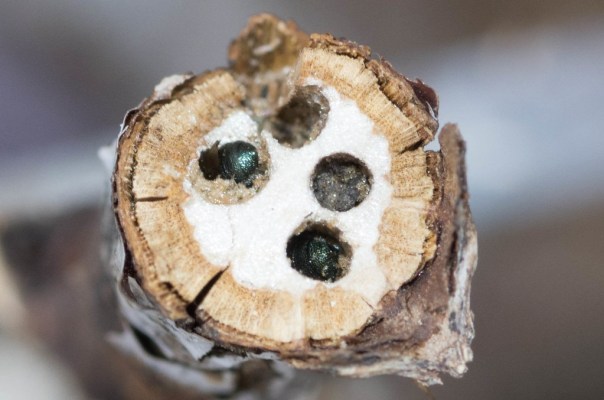
The second most common place for bee nesting is in cavities. These cavities can be plant twigs and branches, cracks in rocks or walls, or even, in some regions of the world, empty snail shells! If you would like to help these bees in your garden or yards, just leave the remains of all your dry plants through the winter. Chances are that some bees have chosen your dry plants as a place to set their nest (Figure 3). These bees also are the ones that like nesting in homemade bee hotels, and it is really fun to see them emerge early in the spring from the little tubes.
Figure 3 – Some bees nest in twigs and branches, like these nimble Ceratina Bees (Ceratina strenua) which have chosen a raspberry branch as a perfect place to raise their progeny. Waiting until the spring to clean your dry raspberry branches is a good way to keep these bees protected throughout the winter. Photo by Terry Miesle.
Other bees prefer to build their nest completely above ground. You may have seen little mud “amphoras” or other structures made of little rocks that hang from walls. If you see these nests close to your house, try to not disturb them and keep an eye on them next spring!
Other pollinators, like moths and butterflies, diapause in leaf litter, on wood, or in the ground. They usually do so by enveloping themselves in dry leaves, by digging themselves in the ground, or by attaching their chrysalis onto sticks and branches (Figure 4). To protect these pollinators, you can leave parts of your yard or garden soil undisturbed, keeping at least some of your dry leaves on the soil.
Figure 4 – Some moths and caterpillars diapause in cocoons, such as this Black Swallowtail (left; photo: Megan McCarty) or this Polyphemus moth (right; photo: Leckie Seabrooke). Note how the moth has enveloped itself in dry leaves.
Finally, some moths and butterflies diapause as adults, hiding in wall cracks or small orifices. In these cases, it can be hard to spot them before it’s too late. To avoid that, you can observe around your garden or yard (and around the house) to try to find them. This way, you will know what places you should not disturb when you are doing yard or garden work.
Do you love dried figs as much as I do? Well then, thanks to tiny wasps are in the order! In fact, through their evolutionary history, fig trees established a pollination system that is among the most fascinating that exist. Even though we eat only a very small number of them, there are hundreds of fig species, and each one is pollinated by one or a few species of tiny wasps from a family called Agaonids.
Dried and fresh figs. Photo: Pixabay
These wasps are specialized in pollinating fig flowers, with a type of pollination interaction called ‘nursery pollination’. In this type of pollination, the wasps offer the service of pollination in exchange for a place to raise (‘nurse’) their offspring. But how does this work?
Let’s start by saying that a fig is like a sunflower that has been turned into itself, with all their tiny flowers facing to the inside of the fig. Some of these flowers are only female (those will make seeds), and some are only male (they offer pollen).
When visiting figs, the female wasps enter and find the female flowers. Using their long ovipositor (their organ for laying eggs), they lay one egg in it. After doing so, they take some of the pollen they previously collected on the male flowers of a different fig and they actively push pollen into the flower. While doing so, they make sure that the female flower is pollinated, and that the flower tissues grow and mature, which is what their offspring will eat while they develop inside the flower. When the offspring emerges from what was the flower, they reach to the male flowers and collect pollen, after which they leave the fig and start searching for a different one to start the cycle again.
Fig fruit. Photo: Pixabay
Now, you may be thinking that this system can’t work. If the offspring eats all the female flowers (where seeds are!), then the plant has none left for their reproduction! You are right!
Well, it turns out that the plants have found a way around. Among all the female flowers available to the wasps for their egg-laying, some are short and sterile, and some are long and fertile. While the short ones are the ones that wasps can develop in, the long ones will not lead to any larval development.
The female wasps can’t know which one is long or short, so they just try to lay eggs and pollinate all the female flowers. Only some of their offspring will survive. By doing this, the plant sacrifices some flower tissue in exchange for the pollination of all the fertile flowers.
If nobody cheats, both the plant and the wasps benefit from the interaction, with the wasps having a safe place for some of their larvae to develop, and the plants having a safe means for pollen transfer and seed production. Isn’t pollination fascinating?
Fig wasps entering the fig through the fig ‘entrance’ – the ostiole (left). Female fig-wasps laying eggs within the figs (center) and later emerging from the sterile female flowers (right).
And to end this blog today, let me tell you a story. It turns out that most fig species are tropical and subtropical, and thus there are not many fig species native to the continental US. However, we love figs, and thus farmers from California decided to try to produce figs there since the climate is very appropriate for fig tree growth. These fig trees that we eat are from varieties of the species Ficus carica, originally from the Mediterranean/Middle East.
At the end of the XVIIIth Century, farmers in California were trying to produce figs, but with little to no success. Eventually, researchers realized that those cultivated figs did not produce fruit if the flowers had not been pollinated. Wasp pollinators were needed to accomplish that. By the end of the XIXth century, the wasps associated with Ficus carica in their native Mediterranean range were imported and introduced into the USA. Figs containing larvae of the wasp species were then left in baskets close to the planted fig trees, letting the females emerge from the figs and pollinate the cultivated Californian trees. After doing this, the fig production picked up, and today a similar technique is still used in those varieties of figs that need pollination for fruit set (for example, the Smyrna and Calimyrna varieties). Today, California is the world’s third top fig producer. Talk about the economic value of pollinator wasps!
By Anahí Espíndola, Assistant Professor, Department of Entomology, University of Maryland, College Park
Besides being super important for controlling pests, since most of them are predators, wasps also can contribute to pollination. In some cases, that pollination is so specialized that plants won’t be able to set fruit if the wasps are not around! But don’t let me get ahead of myself… let’s start from the beginning. What are wasps and how to distinguish them from bees?
Is this a wasp or a bee?
Are you confused about the differences? That’s normal! It’s because bees and wasps are closely related and, in the same way that we tend to look like our close relatives, wasps and bees look similar as well. Like bees, wasps have a lot of diversity, displaying different shapes, sizes and colors. Also like bees, wasps can be social (like hornets or yellow jackets) or solitary (like those that make little mud vases or that dig small burrows in the ground).
Some wasps from Maryland, which can be sometimes seen visiting white/yellowish flowers. Left: Mason Wasp, Pseudodynerus quadrisectus (photo M. McMasters); center: Ringed Paper Wasp, Polistes annularis (photo: Kieschnick); right: Potter Wasp, Eumenes
Taxonomically, there are two groups of wasps: those that have a wasp waist, and those that don’t. Because the former are the ones that we usually refer to when we think of wasps, let’s focus on those. When we think about those wasps, wasps tend to be less hairy than most bees and tend to fly with their legs extended. The legs of bees are usually wider than those of wasps, and while they fly one can see bees rubbing their legs with one another to transfer pollen, while this will not be the case with wasps. Finally, most social wasps fold their forewings when they are at rest, which makes the wings look long and thin.
General morphological differences between wasps and bees. Wasps tend to have thinner legs and are less hairy than bees. Wasps also tend to bend their wings longitudinally when at rest.
What do wasps pollinate?
Wasps are involved in different types of pollination interactions, with many being generalists (they visit many different types of flowers) and some very specialized (involving only a very small number of plants).
Generalist wasps
Even though the vast majority of wasps are predators (they prey on your garden pests!), they also need to supplement their diets with sugar, which is eaten by adults but is also required for the proper development of the offspring. For this reason, many solitary and social wasps visit flowers and collect nectar throughout the flowering season, but in particular during the fall, when other sources of sugar become harder to find. During those visits, they often enter in contact with the flower anthers (the flower part where pollen is presented), and thus passively collect and then transfer pollen when they visit another flower.
Most of these wasps have very short tongues, so they are only able to obtain nectar from flowers that are not too deep. Further, most of these wasps can’t see red colors but can see UV light. Because of all this, most flowers wasps visit are open and not too deep, and white- or yellow-colored. If you would like to attract and observe these pollinators and biological control agents, you can plant flowers of the Apiaceae family (carrot and parsley family) and you won’t be disappointed!
Specialized wasps
In addition to generalist wasp pollinators, there are some very specialized wasps that only pollinate specific types of plants. Next month, we’ll take a closer look at specialized wasps and the ones in particular that are essential for pollinating some delicious fruits — figs!
By Anahí Espíndola, Assistant Professor, Department of Entomology, University of Maryland, College Park
Gardeners, naturalists, researchers, conservationists, politicians — everybody talks about pollinators these days. It seems that pollinators need our help and we need to help them help us. However, it is really hard to protect something that we don’t fully know. So let’s take a look at our insect pollinators, how and when to look for them, and how to tell them apart.
Bees
Bees are one of the most important groups of pollinators. Aside from the well-known non-native honeybee, bees are very diverse in terms of size, ecology, and coloration. In our area, bees range from very small (like our metallic sweat bees) to large (like our carpenter bees and bumblebees), and display different colors and even metallic shines. Bees can be recognized because they have two pairs of wings, ‘elbowed’ antennae, and usually hairy legs and bodies. Bees fly and visit flowers both during daytime and dawn, and can be seen on flowers of different colors (e.g., pink, purple, blue, white, yellow).
Butterflies have ‘conflictual’ relationships with their preferred plants: while in their caterpillar stage they feed on the leaves and stems, they pollinate flowers in their adult butterfly stage. Maryland butterflies span different sizes, colors, and shapes. You may be familiar with the impressive Monarchs, who feed on milkweed and are able to migrate hundreds of miles, our very own state insect the rare Baltimore Checkerspot, or the beautiful swallowtails. Because of their special mouth shape with a rolled ‘tongue’, butterflies prefer flowers that have long tubes. Butterflies are diurnal and are usually attracted to red, orange, yellow, purple and mauve flowers.
Moths are relatives of butterflies, but from a pollination perspective, they differ because the majority of them are active at dusk and into the night. Like butterflies, moths have long tongues that they use to collect nectar from flowers, and thus their preferred flowers are somewhat tubular. Moths can be small or large, but the vast majority of them are attracted to flowers that bloom in the evening, produce strong and sweet scents, and are usually whitish. While some pollinating moths are fair fliers, the impressive hawkmoths can hover and are easy to recognize because they are very hairy and fly like hummingbirds. Even though most moths are nocturnal (active at night), some hawkmoths are diurnal (active during the day), such as hummingbird moths.
Snowberry Clearwing. Photo: Thibaud Aronson
Hoverflies
I hope that after reading this, you will appreciate these little guys as much as I do. Despite hoverflies contributing to a VERY large part of the pollination of both crops and wild plants, they are unfairly overseen, so let’s set the record straight! Hoverflies are relatively small (about half-an-inch). They are flies and thus have only one pair of wings that they carry openly as a ‘T’. Hoverflies often are confused with bees and wasps because many of them have yellow stripes on their abdomens. However, it is relatively easy to tell them apart because they have two wings (versus four in wasps and bees), they hover and make very fast movements when they fly, they usually have huge eyes, and their antennae are very short. Hoverflies are diurnal pollinators and prefer white, yellow and greenish flowers.
Virginia Flower Fly. Photo: John FlanneryMargined Calligrapher. Photo: Jesse Rorabaugh
Beetles
Certain families of this very large group of insects visit and pollinate flowers while feeding on pollen. Beetles that pollinate can be minute to large. One can recognize them because of the hard ‘shield’ that covers their backs and the usual hair that covers at least part of their bodies. Beetles can be active during the day and night hours and prefer flowers that are greenish, white and relatively dull. In Maryland, most of our pollinator beetles are soldier and longhorn beetles. Next time you are around flowers, I invite you to take a close look and I am sure you will have no trouble finding these guys!
Yellow-horned Lepture. Photo: John FlanneryGoldenrod Soldier Beetle. Photo: Mark Nofsinger
This is definitely a pollinator but I still don’t know what it is!
Have you found an insect on your flowers, but you can’t figure out what it is? There is a great tool to identify it, and it is just one picture away! This magical tool is a phone app called iNaturalist. After taking a picture of the insect in question you can upload it to the app and submit it for identification. This app will let you know what is likely to be the species you have seen. It also will let other users like you learn from your observations and help you identify them. Also, besides letting you visually search for observations close to you, the app/website is simple to use, and the users are friendly and helpful. To learn how to use this app/website, refer to this very good tutorial on iNaturalist.
By Anahí Espíndola, Assistant Professor, Department of Entomology, University of Maryland, College Park
Multicolored Asian lady beetle adult. Photo: Jon Yuschock, Bugwood.org
To keep in the spirit of Halloween, I wanted to talk about a beneficial insect with orange and black coloration. The first to come to mind is the multi-colored Asian lady beetle, Harmonia axyridis. Both the coloration and the timing (now) that they move into homes and other structures have also earned this beetle the name “Halloween beetle”.
The multi-colored Asian lady beetle is the most common lady beetle I observe in managed and natural ornamental environments. The multi-colored Asian lady beetle is native to eastern Asia and was brought to the U.S. in 1916 to control aphids in food crops. At first, they did not establish well. Around 1988, an established population was found in a natural habitat. Since then, they have adapted very well and are now found throughout the U.S.
Adults of are highly variable in color and spot pattern. Their body color ranges from a pale orange to bright red, both with and without spots, and if there are spots their number can vary. One diagnostic feature for all multicolored Asian lady beetles is a dark patch in the shape of an “M” just behind the head on the pronotum. The juvenile stages or larvae are mostly black but with two lateral orange stripes on the middle segments of their abdomen. These larvae resemble tiny, short-snouted alligators with long legs. The larvae take a week or two to develop and then transform into pupae. Within a few days, the adults will emerge from the pupal skin and resume their hunt for aphids or other prey items.
Multi-colored Asian lady beetle larvae. Photo: Joseph Berger, Bugwood.org
Multi-colored Asian lady beetle adults are generalist predators that have been reported to consume more than 250 aphids each day and the larvae may eat more than 1,500 during their development. Multi-colored Asian lady beetles also will consume scales, a diversity of beetles and caterpillars. They are also omnivorous and feed on nectar and pollen from plants. They are highly beneficial when it comes to reducing populations of aphids. If you don’t spray your roses (or other aphid infested plants) with pesticides, these predators really can do their job well and suppress a pest population.
Not all good beetles are good all the time. In the fall months, as the weather cools, hundreds to thousands of multi-colored Asian lady beetles begin moving indoors to hunker down for the winter. At this time, multicolored Asian lady beetles are referred to as nuisance pests. In addition to their high numbers in buildings, they also produce a defensive compound that has a bad odor which makes them a little nastier when disturbed indoors. The best method to control multi-colored Asian lady beetle as nuisance pests is to prevent them from getting in the first place. Anything that can seal openings in homes will help in their control.
By Paula Shrewsbury, Ph.D., Associate Professor and Extension Specialist, University of Maryland, Department of Entomology. This article was published originally in the University of Maryland TPM/IPM Weekly Report, October 5, 2018.