Welcome back to Beyond Broccoli (earlier parts here) where in this final edition we will finally get around to talking about broccoli (and its flowering friends).
Imagine you’re strolling through your vegetable garden in June (maybe a warmer June than we just had) and you notice that a lot of the brassica crops you planted in the spring look like this:
In fact, they are bolting. It’s a response to heat and other stresses; the plant will go to flower and then (assuming the flowers are successfully pollinated) will produce seed. Reproduction means, for the plant, that it’s been successful and can die happy. Of course for the gardener it doesn’t always mean success. We might have wanted that mizuna to produce lots more edible leaves before bolting. But before you yank out the plant and toss it on the compost pile, do me a favor. Snip off that little cluster of flower buds and eat it.
Imagine the perfect summer day. What are you doing? For most people reading this blog, I’m guessing it involves being outside in your yard—maybe working in the garden, reading in a hammock, or sharing an al fresco lunch with family and friends. Sounds idyllic! But, then, the dreaded whine, the too-slow slap, and the ensuing itchy bite left behind by a mosquito. On repeat. It’s enough to drive many of us indoors, even on the perfect summer day.
More mature readers may think to themselves “I don’t remember it being this bad when I was younger!” and you’re probably right. You are almost certainly being bitten by a relatively new invader called the Asian tiger mosquito (scientific name: Aedes albopictus) that was first observed in Maryland in 1987 and has adapted to thrive in urban and suburban areas. Named for its striped legs, the tiger mosquito is capable of spreading viruses such as dengue, West Nile, and zika. It is aggressive, and, unlike most other mosquito species that feed at dawn and dusk, it seeks its blood meals during the day.
An Asian tiger mosquito (Aedes albopictus) larva [left] and female adult [right]. Photo credit: Ary Farajollahi, Bugwood.org
One survey found that the tiger mosquito’s biting rate is 10 times higher than what Virginia residents were able to tolerate. In another, 61% of residents surveyed in the Washington, DC area reported that being bothered by mosquitoes caused them to change their behavior to avoid taking walks, gardening, or participating in other outdoor activities. So, if you’re hiding inside on a sunny day, you’re not alone.
What to do? Avoid them? Deter them with citronella candles? Swat them one by one?
The most effective action you can take to reduce the mosquito population in your yard is to cut them off at the source—their larval habitat. After a protein-packed blood meal, female mosquitoes lay their eggs in water-holding containers. Once flooded, the eggs hatch into an aquatic larval stage; after roughly a week of feeding on microbes in the water, the larvae develop into pupae and then emerge in a couple of days as the adults you know and hate.
If you’re committed and persistent in eradicating places for mosquitoes to breed, a practice known as source reduction, you can reduce the number of mosquitoes in your yard. For successful source reduction, follow the four “E”s:
Eliminate
The first step is to eliminate every water-holding container from your yard that you can. Throw away pieces of trash. Drill holes in the bottom of the tire swing. Store kids’ toys, wheelbarrows, watering cans, etc. in a shed or garage, under a deck, or on a covered porch. The tiger mosquito can breed in as little as one teaspoon of water, so be thorough in your search!
Exchange
Next, consider exchanging containers that cannot be eliminated. Swap an open rain barrel for one with a lid. Substitute corrugated extension spouts with splash guards, open chutes, or flat extensions at a downward angle. Trade lawn chairs with solid seats that allow water to pool with slatted chairs that do not.
Empty
Be vigilant about regularly emptying any water-holding containers that cannot be eliminated or exchanged—ideally twice but at least once weekly. Replace the water in pet bowls. Dump out flower pot saucers. Shake out tarps.
Emaciate
This one sounds weird, but stay with me. There may be standing water on your property that would be undesirable or impossible to eliminate, exchange, or empty, such as a bird bath, pond, or structural element (a common one I see in urban environments is the remainder of metal fence posts that were sawed off rather than torn out after the removal of a chain-link fence). For these sources, you can emaciate mosquito larvae with Bacillus thuringiensis subspecies israelensis, or bti for short; when larvae eat this normally soil-dwelling bacterium, the toxins released by the bti paralyze their gut, causing them to starve to death. A brutal way to go for mosquito, black fly, or fungus gnat larvae but harmless to other insects, pets, and people. Bti can be purchased online or at most garden centers—a common brand to look for is Mosquito Dunk®.
Adhering to the four “E”s of source reduction can help prevent mosquito infestations on your property so you can enjoy those perfect summer days!
But what about mosquitoes on your neighbors’ properties?
Bonus action: Encourage
Encourage your neighbors to practice source reduction as well! Devoted source reduction in your own yard may not protect you if your neighbors are harboring abundant larval habitat. Tiger mosquitoes don’t tend to fly far, especially when resources are plentiful, but depending on how close you live to your neighbors, they may cross into your yard. Local mosquito populations are best controlled when the entire community participates.
Bonus bonus action: Entice
Want to do even more? Perhaps you’re feeling a little vengeful from summers past? Entice mosquitoes into a larval habitat trap. You can purchase or DIY something called a Gravid Aedes Trap, or GAT for short, that targets species in the Aedes genus, like the tiger mosquito. Standing water inside the trap encourages gravid, or pregnant, female mosquitoes to lay their eggs, but a mesh cover above the water prevents any mosquitoes in the next generation from escaping. The clear sides around the dark funnel top confuse the females who enter, making it likely they’ll be stuck, too—especially if you add sticky paper or cover the inner walls with cooking spray or oil to coat their wings. This makes the GAT a double-kill trap, affecting two mosquito generations at once. Just be sure to check the trap regularly to ensure that water is present but below the netting. University Park, MD created a community-wide mosquito control program in their town and created a helpful PDF document for GAT deployment.
Gravid Aedes Traps. Image credit: Biogents
By eliminating, exchanging, and emptying water-holding containers in your yard and emaciating mosquitoes in remaining larval habitat (plus encouraging your neighbors and enticing egg-laying female mosquitoes!), you can once again enjoy your summer outside. Easy, brEEzy, bEautiful, mosquito sourE rEduction. Happy mosquito hunting!
By Sarah Rothman, PhD Candidate in the University of Maryland Department of Environmental Science and Technology. Sarah is studying the relationship between non-native mosquitoes and plants across socioeconomic gradients. Learn about the EcoHealth lab at www.leisnham.org. After graduating, she hopes to work in the public sector conducting ecological research and outreach on topics related to invasive species, restoration, and environmental justice.
Plants that are used as ground cover can provide great services throughout the landscape as they can fill in areas that might otherwise be left bare or covered in mulch. Ground covers can be used to help reduce maintenance chores by preserving moisture and preventing weeds.
If you are looking for a ground cover plant, consider adding a native ground cover. Non-native ground covers and vines can be the plants of nightmares, as the characteristics that we like about them (aggressive, can take over weeds, need little care once established, etc.) are often the characteristics that make them terrible offenders when they escape into natural areas. A great field guide on this exact topic is Plant Invaders of Mid-Atlantic Natural Areas.
Since it’s prime planting season in Maryland, here I highlight three herbaceous plants that are often used as ground covers that can quickly take over. For a more detailed list of some of the other ground covers that are concerning, check out this webpage, Invasive Vines and Groundcovers.
English ivy (Hedera helix). Photo: M. Talabac, University of Maryland Extension
English ivy (Hedera helix) is sometimes just called “ivy” or “European ivy”, which reiterates the point that it is not a plant that is native to the United States. This evergreen, vining plant is one that you should be aware of as it can take over areas through the spread of seeds and through underground stems. It thrives in shade, is drought tolerant, and once established, it creates a thick, dense mat of foliage that can outcompete many perennials. It’s even been reported that it can damage homes/walls where it grows up and even penetrates the bark on living trees and strangles them. A study done in February of 2021 found that there are at least 5,000 trees in Takoma park could be lost because of English ivy. English ivy also serves as a reservoir for bacterial leaf scorch, a disease in maples, oaks, and elms.
Periwinkle (Vinca minor) close-up of purple flowers (left), and spreading along a staircase in Great Falls Park (right). Photos: M. Talabac
Periwinkle is a common plant that many people will recognize by its attractive shiny green leaves and purple-white flowers. There are actually two types, Vinca minor and Vinca major, unfortunately, both are considered invasive species and spread quickly vegetatively by root pieces (digging) and rooting at tips and nodes that contact the ground.
The third plant is bishop’s weed or goutweed (Aegopodium podagraria). Once established, this plant easily gets out of hand and is very difficult to remove. It is on the Maryland Department of Agriculture’s list of plants considered for regulation. Joyce Browning with the University of Maryland Extension in Harford County recently posted a video about bishop’s weed.
Remember that you can help mitigate the negative effects of invasive plants on local ecosystems by not adding them to your landscape. However, if you already have some of these plants, you can also manage them correctly by keeping them contained in certain areas and eliminating their spread into natural areas. Never place yard trimmings into natural areas, and remove the seeds before they can be spread by wind, rain, and/or animals. As you are adding plants to your landscape, please check out these great resources for non-invasive plant suggestions:
Everyone can help in the fight against invasive plants! Check the University of Maryland Extension website for an Introduction to Invasive Plants in Maryland and more information on how to reduce them. The absolute best way is to just never plant or introduce them into your landscape.
By Ashley Bodkins, Senior Agent Associate and Master Gardener Coordinator, Garrett County, Maryland. Read more posts by Ashley.
Roseslug sawfly damage on rose. Photo: UME/Ask an Expert
Q: My rose leaves have white spots and holes in them. What causes this and how do I treat it? Is there a natural remedy that does not involve powerful chemicals?
Answer: It looks like your rose has symptoms of sawfly damage. Check the undersides of the leaves and look for tiny green larvae that look like little worms or caterpillars. These are the juvenile stage of an insect called roseslug sawfly.
Roseslug sawflies are neither slugs nor flies. They belong to the same order of insects as wasps, bees, and ants (Hymenoptera). Adult female sawflies use their unique ovipositor (egg-laying part) to saw a small slit in a leaf or stem where they lay their eggs. When the eggs hatch, the larvae feed on the leaf surfaces and cause an etched or scratched appearance. Some roseslug larvae chew through the leaves entirely. Damaged foliage turns brown and curls up as the season progresses.
In Maryland, there are three species of roseslug sawflies that cause damage to roses: the bristly roseslug sawfly, the roseslug sawfly, and the curled rose sawfly. Most of the feeding activity on roses in Maryland is seen in May and June, but some sawfly larvae can continue to be active until fall. Other insects, such as Japanese beetles, also cause chewing damage on rose foliage (typically in June-July).
Browning and leaf curling from rose slug sawfly damage. Photo: UME/ Ask an Expert
The best way to manage roseslug sawflies without chemicals is to monitor your plant(s) for damage symptoms early in the season (start looking in May) and manually remove any larvae (squish them or pick them off and discard them). A forceful spray of water from a garden hose targeted toward the leaf undersides can also get them off. Once dislodged, they cannot climb back up into the plant. Horticultural oil and Spinosad also work well against sawflies. Read and follow the product label instructions for the correct application procedures.
Two sawfly larvae are present on the undersides of rose leaves. Photo: C. Carignan
Predatory insects and birds help to manage sawfly populations naturally. Adding more flowering plant diversity to your landscape will provide food and habitat for beneficial animals that in turn help to reduce future pest problems.
Rose shrubs usually recover from sawfly damage eventually, as long as they are not struggling from other ailments or stressors such as drought.
Rosie Defoliators | Bug of the Week, University of Maryland, Department of Entomology
By Christa Carignan, Maryland Certified Professional Horticulturist, Coordinator, University of Maryland Extension Home & Garden Information Center. Read more by Christa.
Have a plant or insect question? University of Maryland Extension’s experts have answers! Send your questions and photos to Ask Extension.
In this month’s episode of The Garden Thyme Podcast, we are excited to celebrate National Pollinator Week ( June 19-25, 2023)! A pollinator is any animal that visits flowering plants and moves pollen from flower to flower, which helps plants reproduce, making fruits and seeds. In North America pollinators include bees, butterflies, moths, flower flies, beetles, and wasps. Worldwide, approximately 1,000 plants grown for food, beverages, fibers, and spices need to be pollinated by animals.
We also have our:
Native Plant of the Month – Beardtongues (Penstemon digitalis and P. hirsutus) ~16:40
Bug of the Month – Fig wasps (Agaonidae sp.) ~21:18
The Garden Thyme Podcast is brought to you by the University of Maryland Extension. Hosts are Mikaela Boley, Senior Agent Associate (Talbot County) for Horticulture; Rachel Rhodes, Agent Associate for Horticulture (Queen Anne’s County); and Emily Zobel, Senior Agent Associate for Agriculture (Dorchester County).
Growing up in Argentina I remember the summer nights coming home from visiting my grandparents in the country, and looking out into the darkness of the fields, briefly lit up by fireflies. I remember that even though the drive was long (for my child-time perception), I was always looking forward to it and wanted it to never end… Those lights were so magical! How was it even possible that small little insects could create such a whimsical view?
I grew up and moved to other places where fireflies were not present… until I moved to Maryland. My first summer here (and all the following summers, really), I would look forward to those night lights, and then sit outside and just watch them again and again. The excitement I had when traveling back from my grandparents’ is still fresh in me, and I wonder every time at the little insects, no matter how many times I have seen them. In today’s post, I wanted to share some cool resources that will help you find another excuse to continue watching them, learn to recognize the different species and protect them through a variety of ways.
Fireflies from here
North America harbors a very large number of species of fireflies. Among the over 150 species present across the continent, about 15 are known to occur in Maryland (on iNaturalist you can see more details). Although most species prefer relatively humid conditions (e.g., close proximity to creeks or moist areas), they all differ by when they are actively producing light (for example, dusk vs. the night) or their flashing patterns (you can learn a lot more about their biology and behavior from Mass Audubon).
Several species are known to be present in Maryland. Photo: inaturalist.org
Love watching fireflies?
Today, the diversity, ranges, and even conservation status of many fireflies in North America are not well understood. This is problematic because studies appear to show that many species may be declining. However, without clear information on where the different species occur and when they are active, it is really hard to know whether species are likely in need of conservation or not. However, given how large the continent is and how fireflies appear to be present in many regions of the country, it is challenging for scientists to get this information efficiently… or is it?
To address this need, some groups of scientists started a set of projects that rely on what we call citizen science. Here, citizens from around the country can voluntarily sign up, go outside in the evening and watch for fireflies, and then submit their observations to the projects. Anybody can participate in these projects, so we can all actually help the scientists help the fireflies, just by taking part in the studies! The projects that are currently happening in our area are slightly different in scope. Let’s see what each one is trying to do.
This project receives both incidental observations (e.g., you were walking and saw a firefly) and information from structured surveys that are geographically restricted to specific targeted areas (one of which includes most of Central and Eastern Maryland). This project is also seeking to gather information in particular about specific species that are suspected to need conservation or need more data in that particular region. Although participation in incidental observations is simpler than in one of the targeted surveys, both are really useful to the scientists. Either way, the project offers a lot of resources to learn how to identify fireflies and will also help you confirm the identifications once they have been submitted. For both participation types, one has to register and create an account, so all submissions can be properly identified and databased. To get to know about this project, and access its resources, visit the Firefly Atlas website.
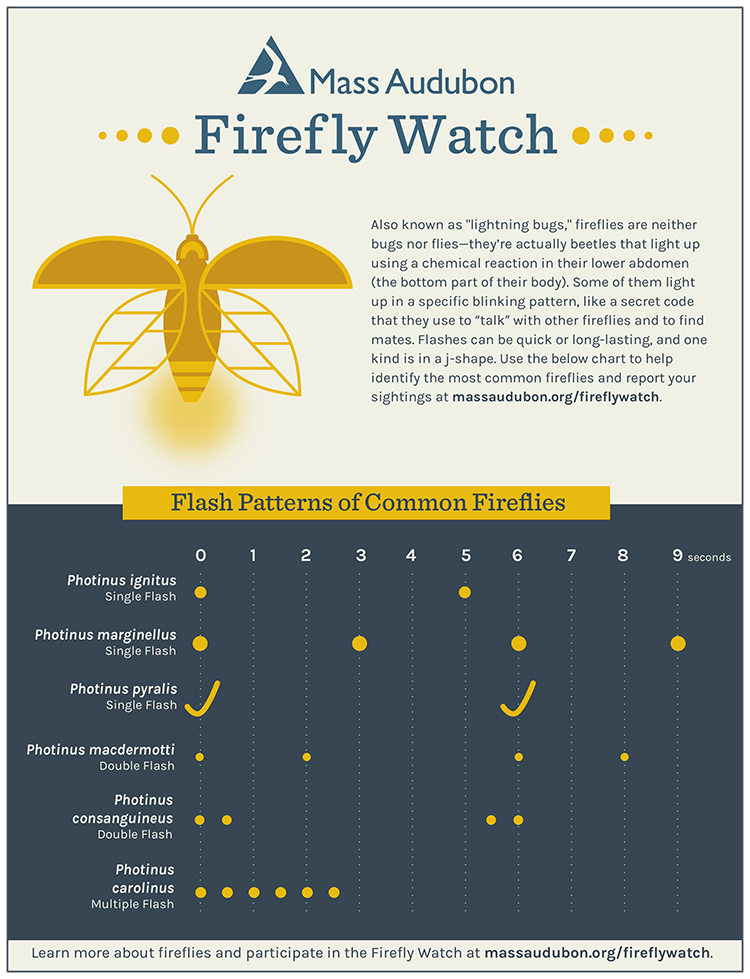
This project seeks to understand the population trends of fireflies and the potential reasons for those changes. This project is open to anybody who would like to participate and receives observations from any region of North America. Participants engage in performing 10-minute-long surveys once a week during the firefly season. These observations can be done from anywhere (e.g., your backyard, a forest) and even not seeing any fireflies is useful information! To participate, interested people need to create an account, and then become familiar with the number of flash patterns that they may encounter (a neat chart is shared to learn this). Finally, they need to implement a very easy-to-do protocol and submit their results. To earn more about how to participate, check out the Firefly Watch website.
I want to help the fireflies, but I don’t have the time or ability to take on these projects
Although many things are left to understand about firefly biology, scientists already know that some threats exist. If we want to help them, and while we learn more about their ecologies and needs, we can do so by acting to address these threats in our everyday lives.
As for other insects and biodiversity, habitat loss and pesticide use are important threats to their survival. Increasing the diversity of habitats in our green spaces and choosing non-pesticide solutions when possible are great ways to help them! Another threat that is particularly important for fireflies is light pollution. Because fireflies use light to communicate with each other, if we have a lot of lights on during the night, we can prevent them from finding each other, interfering with their reproduction and thus reducing their ability to sustain their populations. Turning off all unessential lights (e.g., accent lights, light strings) present in our green spaces at night can go a long way, while even saving us some money.
By Anahí Espíndola, Assistant Professor, Department of Entomology, University of Maryland, College Park. See more posts by Anahí.
Anahí also writes an Extension Blog in Spanish! Check it out here, extensionesp.umd.edu, and please share and spread the word to your Spanish-speaking friends and colleagues in Maryland. ¡Bienvenidos a Extensión en Español!
Patent-leather beetle on a rotting log. Photo: M. Talabac
Q: I found several of these beetles in an old decaying stump and am concerned for my healthy trees. Will they attack live trees?
A: No, these beetles feed on rotting wood and the fungi decaying it, and they pose no threat to other trees. Several common names are given to them: Patent-leather Beetle, Bess Bug, and Horned Passalus.
These insects have a rare life history in that they live in groups and provide parental care for their larvae, feeding them pre-chewed rotting wood, likely for over a year while the young mature slowly.
The feature I find the most entertaining about them is their ability to squeak. Both adults and larvae can stridulate, which means they use one body part to rasp against another to create noise. The purpose of this is probably to communicate with each other. Cricket chirping and katydid calling are forms of stridulation, but in the case of these beetles, it produces more of a high-pitched sound akin to a person making “kissy” noises at a pet.
Interestingly, Iowa State University’s BugGuide web page for Bess Beetles speculates that the “bess” part of its name might derive from baiser, French for “to kiss.” (Or it’s derived from the fact that their forward-facing jaws can pinch, though I’ve never been bothered and I pick up these beetles every time I see them because they’re fun to find. “Petting” them sometimes makes them stridulate, which is always endearing.)
Wood-recycling insects like these are great to have around and rarely if ever pose a risk to healthy plants. Not only do they get those old stumps and logs out of the way for free (even though it can take a while), but both they and the fungi they work with are a means to make the old tree’s nutrients available again to the rest of the ecosystem.
By Miri Talabac, Horticulturist, University of Maryland Extension Home & Garden Information Center. Miri writes the Garden Q&A for The Baltimore Sun and Washington Gardener Magazine. Read more by Miri.
Have a plant or insect question? The University of Maryland Extension has answers! Send your questions and photos to Ask Extension. Our horticulturists are available to answer your questions online, year-round.