Plant Love & Compatibility: A Valentine’s Tribute to Pollination

February is Valentine’s month, but also that of starting to feel impatient about gardening and all the yummy veggies and fruits that will come through the season. Those two things (Valentine’s, and fruits and veggies) are actually really connected, and in today’s post, we will dive into how that is so. 

Valentine’s and fruits and veggies are connected? I don’t get it…

Have you asked yourself how those fruits you see are formed? In fact, this has a lot to do with love (well, plant love) and partner compatibility… quite a bit like Valentine’s couples! Like humans, plants have special organs they use to reproduce, which are all in the flowers (Figure 1).

flower parts
Figure 1. A flower has all the plant’s reproductive organs.

When plants reproduce, their offspring are their seeds. Until here all is nice and good, however, a plant’s problem is that because it can’t move, if all the seeds it produces were to just to fall right under it, the mother plant would soon be surrounded by her offspring, which would then compete with each other and herself. To deal with this problem, and because plants are cool, they have evolved some super-smart strategies to help their seeds be dispersed: fruits! (Figure 2)

beans and apples
Figure 2. Fruits allow plants to disperse their seeds. Some fruits can be fleshy like in apples, or dry like in almonds, while some are able to explode and propel the seeds into the air like in beans.

In wild plants (and many cultivated ones), the fruit is the packet that will carry or disperse the seeds, and among all fruits, the fleshy ones are actually a ‘bait’ for seed dispersers. In fact, these fleshy parts are usually sweet and nutritious, and thus attract animals that eat this ‘seed packet’ (often along with the seeds). However, because an animal’s digestive system is built the way it is, eating the fruit will usually also mean dispersing the seeds in a different place, when those seeds leave the animal’s body. So, you see, plants having offspring and fruits are directly related, like Valentine’s and my veggies and fruits!

Oooh… so, plants can only make fruit if there has been pollination?

Making a fruit requires a lot of energy from the plant (think about all those sugars and colors that go into that delicious tomato!). This means that it usually is the case that fruits will only form if pollination has happened and seeds have formed. So, if one wants a garden to produce fruits and vegetables, it is very likely that pollination and seed formation will need to happen for it to be productive.

Plants produce seeds and are pollinated in many different ways (see this blog post for examples), but it is pretty common that plants will produce more seeds and larger fruits if they receive pollen from a plant individual that is distantly related. In fact, as for many animals, crossing among too closely-related individuals can lead to genetic diseases and poor health. And this is why pollinators are so important; they allow pollen from different individuals to be transferred among plants of the same species and allow for healthy seeds.

Is this why I sometimes need many similar plants to produce fruit?

Yes! Many groups of plants have developed reproductive strategies that advantage fertilization by pollen from plants that are more distantly related over those from themselves or a very closely-related individual. We say that these plants need cross-pollination for producing seeds (and fruit).

On the other hand, there are some plants that are able to make fruits while receiving pollen from themselves or from closely-related individuals. Because these plants are equally exposed to the health problems associated with producing seeds with a closely-related individual, they have developed other strategies that can help them reduce the occurrence of such an event; for example, their seeds can disperse very long distances.

What are the plants that need cross-pollination?

Apples, pears, almonds, pistachio, some cherries, apricots, figs, and paw-paws are all plants that need to receive pollen from another plant of the same species to make fruits. Further, note that for many of these plants it is not just sufficient to have another plant of the same species; this plant has to be of a different variety and has to be present at a relatively short distance.

Unlike those mentioned above, tomatoes, bell peppers, eggplants, grapes, currants, raspberries, and gooseberries can self-pollinate, and thus do not require other surrounding plants of the same species to produce fruits.

Many plants are able to produce fruit by self-pollinating but are far more productive if they are cultivated along with other plants of the same species. This is the case of blueberries, huckleberries, and persimmon.

Finally, some plants, like kiwi, have male and female flowers on different individuals. In these species, although the only fruit-bearing individuals are the female plants, the fruit will only form if a male is present close by.

To help disperse their seeds, some plants have evolved pretty extreme strategies! 

By Anahí Espíndola, Assistant Professor, Department of Entomology, Universit of Maryland, College Park. See more posts by Anahí.

Helen’s Flower Hails Pollinators

common sneezeweed flowers
Helenium autumnale. Photo: Beverly Turner, Jackson Minnesota, Bugwood.org

Helen’s flower is an underdog when it comes to native plants. It is not as well known or as popular as butterfly milkweed, bee balm, or black-eyed Susans — but perhaps it’s time for its day in the sun. It makes a nice addition to a pollinator garden.

Helenium autumnale is the species name of this North American native perennial plant. It goes by the (somewhat unfortunate) name of “common sneezeweed” because dried parts of the plant were formerly used for making snuff to induce sneezing. As an ornamental garden plant, it is not known to prompt sneezes from pollen dispersal (it relies on insects for pollination) and I prefer to address it by its lovelier common name, Helen’s flower… or just plain Helenium.

Wild Helenium autumnale boasts cheerful yellow button-like flowers tended by a skirt of turned-down petals in late summer to fall. Its natural habitat in Maryland includes swamps and moist riverbanks, so in your garden, it will like a location where it has some regular soil moisture. It can grow in full sun or partial shade and stretches in height from 2 to 5 feet tall. The flowers support a variety of pollinators such as bees, wasps, syrphid flies, butterflies, and beetles.

A wide variety of cultivars of Helenium are now available. They range in color from bright canary yellow to orange and crimson and various combinations in between. Many of the cultivars tolerate drier soil and have a more compact habit.

Mt. Cuba Center in Delaware conducted field trials of 44 Helenium species and cultivars from 2017 to 2019. They evaluated plants for their habit, vigor, disease resistance, floral display, and pollinator visits.

helenium flowers in a garde
Helenium flowers in a garden, “The warm glow of early Autumn” by hehaden, Flickr

Given the high interest in pollinator gardens right now, I was curious about their observations of pollinator visits in particular.

The native Helenium autumnale had the most observed pollinator visits (162), while the cultivar H. ‘Zimbelstern’ came in second (151). Both of these had excellent powdery mildew resistance as well. Other cultivars such as Helenium autumnale ‘Can Can’ and H. ‘Tijuana Brass’ also had excellent ratings for these two characteristics. The best performers in the study overall (considering all the characteristics evaluated) were ‘Kanaria’, ‘Zimbelstern’, and ‘Can Can.’

The native Helenium autumnale had the most observed pollinator visits (162), while the cultivar H. ‘Zimbelstern’ came in second (151).

For all the details and results of the evaluation, read the report online.  

If you plan to start (or add to) a pollinator garden this spring, do consider adding Helen’s flower if you have a moist site in full sun or partial shade. Mt. Cuba’s report provides good information on plant care, including staking and pruning tips and recommendations for managing the two most common diseases — powdery mildew and aster yellows.

To purchase plants, check the Maryland Native Plant Society’s website for spring native plant sales and nursery sources.

Visit the Home & Garden Information Center website for additional resources on native plants and gardening for pollinators.

By Christa K. Carignan, Coordinator, Digital Horticulture Education, University of Maryland Extension Home & Garden Information Center. Read additional posts by Christa.

Serpentine Soils Are Anything But Barren: They Support a Unique Grassland Habitat

I have never been to the African grasslands, where lions, zebras, elephants, and wildebeests seem to be in continuous danger. I have, however, been to a Maryland habitat that few people know about, and that, even though lion-, zebra-, elephant- and wildebeest-less, reminded me strongly of those African savannas.

This habitat I am talking about is the Serpentine Grasslands (or Barrens) of the Eastern United States. If you have never heard of them, fear not! Hopefully, by the end of today’s post, you will know a bit more about them and you’ll even try to go visit the few remains that still exist of this beautiful but endangered habitat of our region.

Serpentine Barren Grassland
Fig. 1 – The Serpentine Grasslands of Maryland at Soldiers Delight. Photo: U. Weber.

As you may have guessed from its name, Serpentine Grasslands or Barrens are prairies where the dominant plants are grasses. This is all good, but if they are grasslands, why are they also called Barrens, you may be asking yourself. The answer to that question is what in my opinion makes these habitats so fascinating; something that is also hidden in the other part of their name: “Serpentine”. Indeed, the word Serpentine refers to the type of soil these grasslands are on.

Serpentine soils form on a type of bedrock called serpentinite. This type of rock only exists in places where tectonic plates come into contact, fold, and volcanic activity occurs. This happened in our area about 480 million years ago when the Appalachian Mountains formed. Because of this, there is now an arc of serpentinite present in the Maryland-Pennsylvania area, parallel to the mountains.

Serpentine Soil
Fig. 2 – The Serpentine Grasslands have usually bare soils that have a greenish tint, due to the serpentinite they originate from. Photo: A. Espíndola.

Serpentinites are rich in many metals and other compounds that make the soils that form on top of them relatively toxic and unfriendly to many plants. Because not many plants can grow on these soils, not much soil is retained and the ground ends up being rocky. Because of this characteristic, places with these soils are not very fertile, and, when the Europeans arrived in the area, they started referring to them as ‘barren’, since they were not only infertile, they also had no timber on them. However, even though they were referred to as barrens, many plants do grow on these thin soils, and actually, many of Maryland’s rare flower plants and grasses are adapted to grow in this habitat!

Indeed, the Serpentine Grasslands of Maryland and Pennsylvania are some of the unique places where it is possible to find, for example, the rare moss pink, serpentine aster, or the sandplain gerardia (Fig. 3). It is also home to several endangered and rare species of butterflies and moths such as the Dusted or the Cobweb Skipper (Fig. 4).

Even though the plants and butterflies present in this habitat are relatively well-studied, we still know very little about what other organisms live in the grasslands. To remediate this, in my lab at the University of Maryland in College Park, we are working on trying to understand better what species of insects are present in the area.

Plants of the Serpentine Barron
Fig. 3 – Many rare plants are present in the Serpentine Grasslands of the Eastern US. For example, the moss pink (left; Photo: J. Gallagher) and the sandplain gerardia (right; Photo: A. Espíndola).

For the moment, we are focusing on insect pollinators, and our first works indicate that the plants growing in these grasslands are pollinated not only by bees but also by hoverflies, showing how important these lesser-known pollinators may be to sustaining a very rare habitat of our region. (Take a look here to learn more about hoverflies as pollinators.

The Serpentine Grasslands had not always been rare and endangered. Indeed, serpentine soils extended for quite an area in the Maryland-Pennsylvania region. So, what happened to this habitat that made it so rare today? Ecologists and historians can help us with this.

Like many habitats dominated by grasses, Serpentine Grasslands need fire to sustain themselves. In the absence of fire, pines and red cedars from the surrounding areas start establishing in the grasslands and compete with the grasses and all the rare plants, making the once grassland become an encroached pine forest. When the Europeans first arrived in our region, documents said that there were Serpentine Grasslands that extended for at least 130,000 acres. Today, Serpentine Grasslands occupy about 1.6% of that area.

These grasslands were managed as hunting grounds by several tribes (Susquehannock, Shawnees, Lenape Delaware), who burned them regularly to maintain the grasses and attract large herbivores to hunt. These tribes had complex systems of rights over these lands, which they shared with neighboring tribes as needed. Records show that these extensive grasslands were extremely rich in fauna. There were myriad birds species (mentioned in some records to ‘have darkened the sky’ when migrating!), wolves, bears, cougars, deer, and buffalo roaming these regions!

European colonizers quickly realized that these grasslands were great land for cattle and hunting, and thus started settling and claiming the native tribes’ lands. However, the new inhabitants did not continue the practice of burning, which led to the habitat starting to degrade and finally becoming less appropriate for cattle and cropping.

Eventually, these lands were relegated as ‘useless’ lands and were thus prime land for building or just reinvaded by pines and other trees, which were used for timber. I sometimes try to imagine what these lands — today just 30 minutes away from my house — may have looked like with those large fascinating animals living right here.

Dusted Skipper
Fig. 4 – The Serpentine Barrens are the habitat for several rare moth and butterfly species, such as the Dusted Skipper (Photo: A. Wells).

Today, the Serpentine Barrens are protected and managed with fire in several parts of the state. A large part of these protected lands are not open to the public. However, we are lucky that some places are indeed accessible to the public and can be visited throughout the year.

The largest remnant of Serpentine Grasslands on the Eastern Coast of the US is west of Baltimore, in the Soldiers Delight Natural Environment Area. Another public land where some remains of Serpentine Grasslands are still visible is in Northern Baltimore, at Lake Roland.

I am lucky enough that I can visit and work in these fascinating places. If you have never been to them and would like to see these local jewels, take me up on the invitation and consider hiking some of their trails. The spring and summer are gorgeous on these lands, and who knows, you may be lucky enough to see one of those rare beauties that still live there!

By Anahí Espíndola, Assistant Professor, Department of Entomology, University of Maryland, College Park

Please Pass the Cranberry Sauce and Give Thanks for Pollination

Thanksgiving is a time to gather with loved ones and usually involves first preparing and then ingesting a lot of delicious goodies. Each family has recipes and traditions related to Thanksgiving, and even foreigners (like myself) may join in and create new traditions. Independently of who we are and our origin, the meals we prepare include a number of common foods: cranberries, pumpkins, sweet potatoes, pecans, and potatoes.

For this year’s Thanksgiving, I want to take us on a trip to recognize and thank nature and some of our little winged friends, without whom we would not be sharing all that deliciousness with our loved ones. Plus, after reading this you will know some cool fun facts you can share with others during your Thanksgiving meal!

cranberry sauce and the bumble bee that pollinates cranberries
Photos: Wikipedia Commons, Lotherington

Cranberry Sauce

Cranberries are the fruits of a plant closely related to blueberries and huckleberries, which all are native to North America. Like blueberries and huckleberries, cranberries need pollinators to produce fruit. The reproductive organs (anthers – where pollen is produced, and carpels – where the ovules are hosted) in a cranberry flower mature at different times, which means that a flower can’t self-pollinate and needs a pollen vector to produce fruit.

As you may know, no pollination means no fruits, and no fruits means no cranberry sauce. Luckily, nature provides and pollinators are around! We know today that several different bees visit cranberry flowers, with bumblebees being some of the best pollinators. Some other wild bees (for example, mining bees, Andrena) also contribute to the pollination of this plant, and honeybees can pollinate as well but not as efficiently as bumblebees and other native bees.

pumpkin pie and a bee that pollinates pumpkins
Photos: Wikipedia Commons

Pumpkin Pie

Pumpkins, squashes, and zucchini are all closely related vegetables that also require pollinators to produce fruit. Unlike cranberries, pumpkin plants produce separate and distinct female and male flowers. Because in these plants the female and male reproductive organs are physically in different parts of the plant, pollination (and thus fruit production) requires a pollen vector. Again, we would have no pumpkin pie if our pollinator friends were not around!

So, who pollinates pumpkins? Pumpkins have very specialized pollinators that do the best job at pollinating. In the US, this specialized pollinator is the squash bee Peponapis, which feeds their larvae a strict diet of squash pollen. Furthermore, unlike many other bees, both the males and females of the squash bee pollinate, since mating happens in the flower. Even though the squash bees are by far the best pollinators of pumpkins, other bees (including honeybees) can occasionally visit and pollinate the flowers… but really it’s these little cuties that we need to thank for all the delicious pumpkin!

pecan pie and pecan tree flowers
Photos: Wikipedia Commons

Pecan Pie

Like pumpkins, pecan plants can’t automatically self-pollinate and need a pollen vector to produce the yummy nuts we eat. This is not only because their female and male flowers are separated spatially on the plant (like they are for pumpkins); they also flower at different times of the year on the same plant.

To be pollinated, the female flowers of a pecan plant need to receive pollen from the male flowers of another plant which is flowering at the same time. For this reason, pecan flowers need a vector of pollination, which here is not an insect but the wind! Pecan flowers are indeed adapted to wind pollination, displaying hanging bunches that shake with the wind, releasing and catching a lot of the pollen in the air.

sweet potatoes and a bee that pollinates the flowers
Photos: Steven Depolo, Wikipedia Commons

Sweet Potatoes

The part of the sweet potato plant that we eat during Thanksgiving is the tubers, which are roots. And since what we eat is not a fruit, pollinators have no role to play for this Thanksgiving ingredient… at least not directly. But the sweet potato plant still needs pollinators to produce seed and breed, because their flowers are unable to be successfully pollinated by the same flower’s pollen.

Pollinators are then really important for the successful maintenance of the genetic diversity of this plant. Sweet potatoes belong to the morning glory family, and as its name suggests, flower in the morning hours. They are pollinated by many different types of bees (from large bumblebees and carpenter bees to smaller bees such as sweat bees), which visit the flowers for nectar and pollen.

mashed potatoes and a bee that pollinates potato flowers
Photos: Ernesto Andrade, Beesearch.org

Mashed Potatoes

As for sweet potatoes, the part of the potato plant we eat is not the fruits but the tubers. Pollinators are not needed for obtaining these tubers, but the plant requires pollinators to be able to breed and maintain genetic diversity. Since they are in the same family (the nightshades), potato flowers look similar to those of tomatoes and eggplants.

Like in those other vegetables, pollinator visits, and more specifically something called ‘buzz pollination,’ needs to occur for successful pollination. In this type of pollination, the insect visits the flower and buzzes loudly, which shakes the flower, releasing the pollen, which they then transfer to a different flower during their next visits. Among these buzzy bees, bumblebees and mining bees (Andrena) are very efficient at pollinating potatoes.

[VIDEO: Buzz pollination of a bumblebee on a potato flower. Note how the pollen is released from the anthers — the four yellow long organs — and sticks to the bee abdomen where the stigma — the female flower organ in the middle of the flower — rubs the bee abdomen where it collects the pollen and gets pollinated. Video by thyreodon.]

Happy Thanksgiving!

By Anahí Espíndola, Assistant Professor, Department of Entomology, University of Maryland, College Park

Where are all the pollinators?

Yard in the fall with leaves on the ground
Leaving fallen leaves, plant twigs, and wood in your landscape can help pollinators survive the winter. Photo: Anahí Espíndola

Even though I love the heat of summer, I have to admit that fall makes me happy in a different way. I like the trees that turn into beautiful colors, the crisp air, quiet nights, and the days that slowly become shorter and make me want to drink tea and eat cookies. There is however one thing that makes me a little sad about fall, and it’s that all those beautiful pollinators I love so much are now gone! But are they? Actually, have you ever asked yourself where pollinators go in the fall? Well, thanks for asking — today is your lucky day! In today’s blog post we will talk about what happens to pollinators in the fall, and what we can all do to continue helping them during this quiet time.

When the season reaches an end, pollinators find themselves in a hard spot. They could hopefully collect food (nectar, pollen, etc.) during the spring and summer, but now all the flowers are gone and decisions need to be made if they are to survive until next year. When the season reaches an end, pollinators have basically two options to make sure they or their progeny survive until the next season: migrate for the winter, or stay and protect themselves against the cold.

How to Help Pollinators in the Fall

#1 – Let them go!

Some famous pollinators migrate. You may be familiar with the impressive and beautiful Monarch butterfly migration, which happens every year, and which allows Monarch populations that are far North reach latitudes where the climatic conditions are more benevolent to their survival. Other less famous pollinator migrations are those of hummingbirds, which also migrate to less harsh conditions at the beginning of the fall.

The best thing to do to help migratory pollinators is to help them migrate! This may sound a bit counterintuitive but providing plant resources for migrant pollinators for too long can be a bad idea, because that may make them stay in the region for longer, expose them to parasites for longer, and not reach their final destinations in time.

Let’s take the Monarchs as an example. Monarch caterpillars feed on milkweed, and there are both native and non-native species of milkweed they can develop on (Figure 1).

Tropical Milkweed
Figure 1 – Monarchs can develop on many species of milkweed. Non-native milkweed such as the tropical milkweed (Asclepias curassavica; left) can hinder their migration. Favoring native milkweed species (such as the common milkweed; right) is a way to help Monarchs stay safe in the winter.

The native milkweeds naturally start drying out by the end of summer. This changes the chemistry of the plant and “tells” the caterpillars that the end of the season is coming. This is one of the triggers for the caterpillars to start transforming into adult butterflies. Without that trigger from the host plant, the caterpillars continue feeding. This is what happens when they develop on non-native milkweeds that stay green for longer. In fact, caterpillars that develop on those non-native species become adults later in the season, and when they finally emerge, it is too late in the season and they are unable to migrate and make it to the next spring. One of the best ways to protect these migrants is to let them finish their natural cycle and leave in time (I know it’s hard to see them leave!), which in the case of Monarchs requires favoring planting native milkweeds over their non-native counterparts.

#2 – Let them diapause!

Most of the pollinators in our region, however, are adapted to spend the winter right here. Where are they? As I mentioned in another blog post, the vast majority of pollinators in our area are insects. Insects can’t move, fly, or feed if the temperatures are too low. To deal with very low temperatures, insects in temperate regions like ours enter a physiological stage called diapause.

During this stage, the insect physiological rate is reduced and all development is put in a pause until conditions are more favorable. Even though we usually think about these stages when the season comes to an end for us (the fall), it is interesting to note that many of our pollinators reach this stage at the beginning of the summer and they maintain it until the following spring. The practical consequence of this is that if we want to protect pollinators, we don’t just need to provide food for them; we also need to make sure that wherever they decide to spend their diapause is safe from disturbances.

So, how to do this? First, it’s important to realize that each pollinator species enters diapause at different times and places and at different developmental stages (e.g., larva, pupa, adults). Our native bees diapause in nests (solitary or communal), which can be built in different places, depending on the species. The majority of our native bees are ground-nesting bees and they can enter diapause as early as the beginning of the summer and as late as the fall. For nesting, these bees usually prefer loose soils such as those that are sandy or rocky (Figure 2). Making sure that we are not disturbing the ground in places where we see nests will be key for them to survive until the following year. Practically speaking, this means that if you see bees digging holes in the ground of your garden, you may not want to till that part of it.

Ground nesting bees
Figure 2 – The Rufous-Chested Cellophane Bee (Colletes thoracicus) establishes nests in the ground. They can be identified by the mounds left around their entrances. These bees are solitary and non-aggressive, so if you see them nest, don’t disturb that area and rejoice in the bees’ return next spring! Photo by CsabaVadasz.

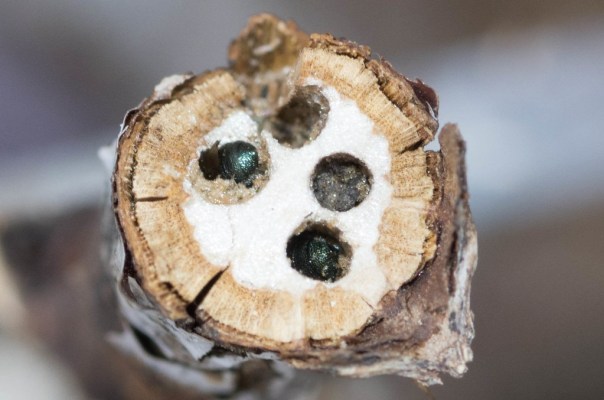
The second most common place for bee nesting is in cavities. These cavities can be plant twigs and branches, cracks in rocks or walls, or even, in some regions of the world, empty snail shells! If you would like to help these bees in your garden or yards, just leave the remains of all your dry plants through the winter. Chances are that some bees have chosen your dry plants as a place to set their nest (Figure 3). These bees also are the ones that like nesting in homemade bee hotels, and it is really fun to see them emerge early in the spring from the little tubes.

Bees nesting in twigs
Figure 3 – Some bees nest in twigs and branches, like these nimble Ceratina Bees (Ceratina strenua) which have chosen a raspberry branch as a perfect place to raise their progeny. Waiting until the spring to clean your dry raspberry branches is a good way to keep these bees protected throughout the winter. Photo by Terry Miesle.

Other bees prefer to build their nest completely above ground. You may have seen little mud “amphoras” or other structures made of little rocks that hang from walls. If you see these nests close to your house, try to not disturb them and keep an eye on them next spring!

Other pollinators, like moths and butterflies, diapause in leaf litter, on wood, or in the ground. They usually do so by enveloping themselves in dry leaves, by digging themselves in the ground, or by attaching their chrysalis onto sticks and branches (Figure 4). To protect these pollinators, you can leave parts of your yard or garden soil undisturbed, keeping at least some of your dry leaves on the soil.

Black swallowtail butterfly chrysalis and polyphemus moth cocoon
Figure 4 – Some moths and caterpillars diapause in cocoons, such as this Black Swallowtail (left; photo: Megan McCarty) or this Polyphemus moth (right; photo: Leckie Seabrooke). Note how the moth has enveloped itself in dry leaves.

Finally, some moths and butterflies diapause as adults, hiding in wall cracks or small orifices. In these cases, it can be hard to spot them before it’s too late. To avoid that, you can observe around your garden or yard (and around the house) to try to find them. This way, you will know what places you should not disturb when you are doing yard or garden work.

For more information on this topic, check out Where Do Maryland’s Butterflies Overwinter? and Bewitching Butterflies and Moths with Fall and Winter Habitat.

By Anahí Espíndola, Assistant Professor, Department of Entomology, University of Maryland, College Park

The Buzz on Pollination Is Not All About Bees: Wasps Are Pollinators Too!

Last time we talked about pollinators (see Is This a Pollinator? Five Types of Pollinating Insects You Can Find in Maryland), we received some questions about wasps. Do they also pollinate? If they do, what do they pollinate? So, let’s talk about wasps!

Besides being super important for controlling pests, since most of them are predators, wasps also can contribute to pollination. In some cases, that pollination is so specialized that plants won’t be able to set fruit if the wasps are not around! But don’t let me get ahead of myself… let’s start from the beginning. What are wasps and how to distinguish them from bees?

Is this a wasp or a bee?

Are you confused about the differences? That’s normal! It’s because bees and wasps are closely related and, in the same way that we tend to look like our close relatives, wasps and bees look similar as well. Like bees, wasps have a lot of diversity, displaying different shapes, sizes and colors. Also like bees, wasps can be social (like hornets or yellow jackets) or solitary (like those that make little mud vases or that dig small burrows in the ground).

Wasps in Maryland
Some wasps from Maryland, which can be sometimes seen visiting white/yellowish flowers. Left: Mason Wasp, Pseudodynerus quadrisectus (photo M. McMasters); center: Ringed Paper Wasp, Polistes annularis (photo: Kieschnick); right: Potter Wasp, Eumenes

Taxonomically, there are two groups of wasps: those that have a wasp waist, and those that don’t. Because the former are the ones that we usually refer to when we think of wasps, let’s focus on those. When we think about those wasps, wasps tend to be less hairy than most bees and tend to fly with their legs extended. The legs of bees are usually wider than those of wasps, and while they fly one can see bees rubbing their legs with one another to transfer pollen, while this will not be the case with wasps. Finally, most social wasps fold their forewings when they are at rest, which makes the wings look long and thin.

bee versus wasp
General morphological differences between wasps and bees. Wasps tend to have thinner legs and are less hairy than bees. Wasps also tend to bend their wings longitudinally when at rest.

What do wasps pollinate?

Wasps are involved in different types of pollination interactions, with many being generalists (they visit many different types of flowers) and some very specialized (involving only a very small number of plants).

Generalist wasps

Even though the vast majority of wasps are predators (they prey on your garden pests!), they also need to supplement their diets with sugar, which is eaten by adults but is also required for the proper development of the offspring. For this reason, many solitary and social wasps visit flowers and collect nectar throughout the flowering season, but in particular during the fall, when other sources of sugar become harder to find. During those visits, they often enter in contact with the flower anthers (the flower part where pollen is presented), and thus passively collect and then transfer pollen when they visit another flower.

Most of these wasps have very short tongues, so they are only able to obtain nectar from flowers that are not too deep. Further, most of these wasps can’t see red colors but can see UV light. Because of all this, most flowers wasps visit are open and not too deep, and white- or yellow-colored. If you would like to attract and observe these pollinators and biological control agents, you can plant flowers of the Apiaceae family (carrot and parsley family) and you won’t be disappointed!

Specialized wasps

In addition to generalist wasp pollinators, there are some very specialized wasps that only pollinate specific types of plants. Next month, we’ll take a closer look at specialized wasps and the ones in particular that are essential for pollinating some delicious fruits — figs!

By Anahí Espíndola, Assistant Professor, Department of Entomology, University of Maryland, College Park

Pollinators and Food Gardens

The Food and Agriculture Organization of the U.N. estimates that at least 75% of the world’s food crops depend, at least in part, on pollinators. Honey bees and a host of native bees, beetles, and butterflies are essential for pollinating vegetable and fruit crops on farms and in gardens across Maryland. For example, we would have no cucumbers, squashes, muskmelons, or pumpkins without bees.

Squash bees pollinate all cucumber family crops. Photo credit: Jim Jasinski, Ohio State University Extension; bugwood.org
Squash bees pollinate all cucumber family crops.
Photo credit: Jim Jasinski, Ohio State University Extension; bugwood.org

It takes 8-12 bee visits to fertilize enough ovules (baby seeds) to produce full-size fruits. Gardeners get smaller, fewer, and misshapen fruits when bees are unavailable to pollinate some other crops like eggplant, okra, pepper, strawberry, raspberry, blackberry, and blueberry.

Bumblebee drinking nectar from a basil flower. Photo credit: Jon Traunfeld
Bumblebee drinking nectar from a basil flower.
Photo credit: Jon Traunfeld

What can I do?

  • Plant lots of flowering plants (annuals and perennials, especially native species) in borders around, or in, your food garden. Choose plants with a variety of flower color, shape, and size with different flowering times, to provide nectar and pollen through the growing season. Include herbs in your vegetable garden (earlier blog post on anise hyssop and tulsi basil)
  • There are many vegetable, fruit, and herb plants that don’t require bee pollination to produce the edible part(s) that humans are most interested in. But the nectar and pollen in the flowers of these plants (e.g., arugula, broccoli, radish, cilantro, and basil) may be valuable for pollinators.
  • Place a shallow saucer or container of water in your garden with gravel or pebbles for insects to rest on while drinking (change the water twice per week).
  • Avoid using pesticides (including organic pesticides, like pyrethrins, known to be toxic to pollinators). If spraying is necessary, make the application when pollinators are least active (early morning or early evening), don’t spray when flowers are open, use short-residual insecticides that are least harmful to bees


Honey bee getting water from a blueberry flower.  A variety of native bees assist also assist in pollination. Photo credit: Jason Gibbs, Michigan State University
Honey bee getting water from a blueberry flower.
A variety of native bees assist also assist in pollination.
Photo credit: Jason Gibbs, Michigan State University


Resources:

Pollinators vital to our food supply under threat- FAO news release: http://www.fao.org/news/story/en/item/384726/icode/

Attractiveness of Agricultural Crops to pollinating Bees for the Collection of Nectar and/or Pollen- USDA: https://www.oisc.purdue.edu/pesticide/pdf/crops_pollinated_usda_rpt_2015.pdf

How to Attract and Conserve Pollinators and Natural Enemies in Your Garden- HGIC: https://extension.umd.edu/hgic/topics/how-attract-and-conserve-pollinators-and-natural-enemies-your-garden


By Jon Traunfeld, Extension Specialist