This is the first article in a four-part series about the ins and outs of gardening under lights, both for newcomers curious about a different way to grow plants and for more experienced growers who want to build on their understanding of lighting options.Read on for the second, third, and fourth parts of the series.
A variety of plants growing under an LED light indoors. Photo: Miri Talabac
Why use lights for plants?
It’s sensible to think, “why provide artificial light for indoor plants? Isn’t natural window light enough?” After all, natural light is certainly what the plants get when growing outside. If you’re fortunate and have sun-soaked windows in your home, you may have little need for artificial lighting. Anyone who has insufficient window light or who otherwise can’t utilize their windows for growing plants, though, would benefit from giving their plants brighter conditions.
We’ll address this in more detail in upcoming posts, but light levels play a significant role in keeping plants healthy, vigorous, and looking their best. Plant lights give you more control over this aspect of plant care.
Who benefits from using plant lights?
Anyone who doesn’t have ideal natural-light conditions for their plants would benefit from using plant lights (also called “grow lights”). You don’t have to be a tropical plant aficionado to make use of them, and anyone with an available power outlet can try it. Setups can be as simple or as complex as you’d like. Seed-starting enthusiasts can produce more robust seedlings, and anyone trying to overwinter a lemon tree, some herbs, an aloe, or patio tropicals could have more vigorous plants if their winter slog could be brightened with some extra light.
Christmas cactus are popping up everywhere. They’re lovely living gifts that enliven holiday décor and add beauty year-round. If you like floral irony, this is your plant. Even though they are fleshy succulents, they originated not in arid regions but in the rainforests of Brazil where they drape themselves over tree branches as epiphytes.
Arching stems give Christmas cactus – and this Thanksgiving cactus – handsome structure when not in bloom. Photo credit: Washington County Master Gardener Lauri Ricker
As with many tropical plants, Christmas cactus delivers a double dose of drama. The first is the strong architectural form of arching stems made up of a series of scalloped pads. But it’s their cascading flowers in pink, salmon, red, or white that are the real showstoppers. Stacked layers of swept-back petals with prominent stamens, they are very oh-la-la. They also have a long bloom time, flowering from two weeks to two months.
Heavy blooms are a hallmark of Christmas cactus and its cousin, this Thanksgiving cactus. Photo credit: Washington County Master Gardener Wilma Holdway.
Also long is their lifespan. They can live for decades, often becoming family heirlooms. I once received cuttings from a plant started by a – ahem – mature friends’ grandfather. This caused a commotion at airport security. What IS that thing on the x-ray? And yes, the kindly man let me keep my cuttings once I showed them to him and shared their story.
Christmas cactus has beautiful cascading blooms. Photo credit: Washington County Master Gardener Leora Smith
Care is fairly basic. They like bright indirect light, not full sun. Keep the soil slightly moist. Mist regularly or put the pot on a dish of moist gravel to boost humidity.
Christmas cacti need cooler temps and less water to nudge them to bloom again. They need a chill to give you a thrill.
Master Gardener friends report that the natural drop in temperature and day length in fall is enough to encourage buds indoors. Others let their cactus summer outside in light shade, keeping them out until fall temperatures drop to 50 to 55 degrees. Regardless of how you stimulate flowering, resume regular care when buds form. After your cactus finishes blooming, give it a cooler rest period and less water for two months.
And yes, Christmas cactus has many cousins including Thanksgiving cactus and Easter cactus, all named for the times they bloom. Mine never consulted calendars and bloomed as they liked.
How can you tell which cactus you have? Easter and Thanksgiving cactus have pointed edges on their leaves while Christmas cactus leaves have more rounded scalloped edges.
Thankfully, Christmas cacti are a snap to propagate, so they are easy to share. Just break off a stem at a joint, slip into well-drained soil and keep the soil moist. It will root in a few weeks.
I love a good story, and these plants have several. My favorite is a Brazilian legend that tells of a poor boy in the jungle who prays repeatedly for a sign of Christmas. One day he awakes surrounded by colorful flowers on the tips of cactus. And so the cactus became a symbol of answered prayers.
So Christmas cacti are a symbol of hope. With their long lives, colorful blooms, ease of care, and sharing, they make wonderful gifts for friends, family, and your very own green thumb.
Annette Cormany, horticulture educator, University of Maryland Extension – Washington County
It’s well known that atmospheric carbon dioxide (CO2) is one of the leading causes of climate change and that plants play a role in mitigating its impact by taking in carbon dioxide and releasing oxygen. But did you know that even the smallest gardens can make a difference? Container gardens can be effective ways for adding plants to the ecosystem, nurturing pollinators and other beneficial insects, and even providing food for your table.
A container garden with mixed perennials and annuals provides beauty, food, and habitat. Photo: Pat Wilson
High above Columbia’s Wilde Lake at the Residences at Vantage Point, long-time gardener Barbara Schuyler continues the gardening that was her passion when she and her wife Pat Wilson lived on a rural property. More than 90 containers of shrubs, annuals, perennials, and vegetables grace two balconies that face west and south.
Barbara’s approach to container gardening
Shrubs and perennials comprise a significant part of the garden. Hardy perennials winter over and are especially effective at drawing down carbon dioxide. Some of the perennials, like the orange butterfly milkweed (Asclepias tuberosa) pictured below, are natives. Native plants are well-suited to our climate, require less care than imported species, and support native insects. Barbara’s native plants also include lots of Rudbeckia, some Echinacea, and several Heuchera.
Native butterfly milkweed (orange flowers) combines beautifully with the blue-theme flowers. Photo: Barbara Schuyler
In addition, each year Barbara and Pat decide on a theme and collect annual seeds to plant when the temperature warms up each spring. Last year, the blue flower theme provided a consistent backdrop for the foliage and flowers of other plants.
She uses regular potting soil and each spring spreads the old soil on a tarp to remove roots and debris and returns it to the pots with a portion of fresh potting soil added.
Her collection of containers is eclectic and includes salad tables for vegetables, wine barrels, ceramic and plastic pots. A container exchange in the building helps many patio gardeners find pots that meet specific size and decorative needs. Reusing and sharing materials can help reduce CO2 associated with buying and shipping new products. She also tried felt bags but was not pleased with the results.
Photo: Christine Hipple
Watering 90 containers with a watering can during dry spells would be a major challenge, so Barbara purchased a garden hose sink adapter to allow her to connect a lightweight flexible hose to the kitchen sink.
One big advantage of balcony gardens is that deer can’t get to them, though she has seen a squirrel or two.
Benefits
Visiting her garden every morning is a joy in itself. It provides Barbara the opportunity to be present with her plants, be aware of their needs, and appreciate what they offer throughout the seasons.
Even at this extreme height, pollinators are attracted to and supported by the garden. Three species of bees, several types of moths, and even a few monarchs have been spotted.
Lettuce and arugula do well in pots, and along with cherry tomatoes provide healthy super-local produce — yet another reduction in their carbon footprint. One lesson Barbara’s learned about cherry tomatoes is not to crowd them. Plant just one to a large pot and prune assertively to be sure the energy goes into making tomatoes rather than excess foliage and that there’s sufficient air circulation.
Growing some food at home is fun and helps reduce the carbon footprint of food transport. Photo: Barbara Schuyler
While there’s some level of physical work involved, container gardening is within the reach of nearly everyone – no matter your available space, skill level, physical abilities, or budget. Start small. Share stories, plants, and pots with other gardeners, and enjoy the benefits for yourself, your community, and the planet!
Are you taking any steps in your garden to help mitigate and adapt to climate change? Have a story to share? Let us know! Leave a comment or contact us.
By Christine Hipple, University of Maryland Extension Master Gardener, Howard County, Maryland
Most of us plan our gardens each year with abundant annual vegetables to harvest and enjoy. There are, however, several perennial vegetables you may want to consider adding to the mix, some familiar and others, perhaps, less so.
Perennial vegetables have some attractive benefits: they tend to be low maintenance, are generally easy to cultivate, high-yielding, and often more pest and disease resistant than their annual brethren. On the downside, they can be slow to establish and, if they do succumb to disease, will often need to be removed.
One critical consideration in planting perennial vegetables is location. These are perennials and once established some will not be easy to relocate or, as in the case of sunchokes, to eradicate, so site them thoughtfully. And be certain to clear away any perennial weeds before planting.
Following are just a few selections for Maryland, ones I have personal experience growing. The most comprehensive and enlightening reference by far is Eric Toensmeier’s Perennial Vegetables (2007, Chelsea Green Publishing), which offers a fascinating window into the many options available for our area.
Rhubarb (Rheum rhabarbarum)
Yes, rhubarb is a vegetable although we use it more like a fruit, sweetened in pies and sauces. (An annual rhubarb crisp endeared my neighbors to me!) It is the stalks we cut and use as the leaves and even though much of the flower heads are toxic to people and animals.
Root crowns should be sited in full sun with ample space (plant 3 feet apart) as the clumps can grow to be 3-5 feet wide. Rhubarb really prefers cold climates and our Zone 7 is about as far south as it will grow happily. A heavy feeder, it is good to provide extra nutrients with compost annually. Once mature, the attractive large-leafed clumps can be divided for propagation, which should be done every few years to re-energize the plant. Two or three plants will keep you in pies (but try it in savory stews and soups, too). Some growers recommend removing the showy flower stalks once they open. To harvest, twist or cut the stalk at the base and be certain to remove all of the leaves. Rhubarb will die to the ground in winter and in early spring you will see its lovely red buds swelling up from the earth. And you will know it is spring!
Ramps (Allium tricoccum)
Here it is, an easy-to-grow shade-loving vegetable that also happens to be delicious! Often referred to as wild leeks, ramps are native to eastern and central North America. These early spring bulbs have wide leaves compared to most onions, growing to about 10” long. They die back with the coming of summer.
Ramps are found in the wild in moist deciduous forests. They prefer rich, moist soil, much like woodland humus, and form small clumps that can slowly spread to form large colonies. Harvest the whole plant leaving some bulbs for next year, or simply harvest some leaves. The smallish bulbs are like onions or garlic, the leaves like scallions or leeks.
Ramps are being over-harvested in the wild. This is yet another good reason to start your own colony (and move some into that forested land nearby).
Sunchoke (Helianthus tuberosus)
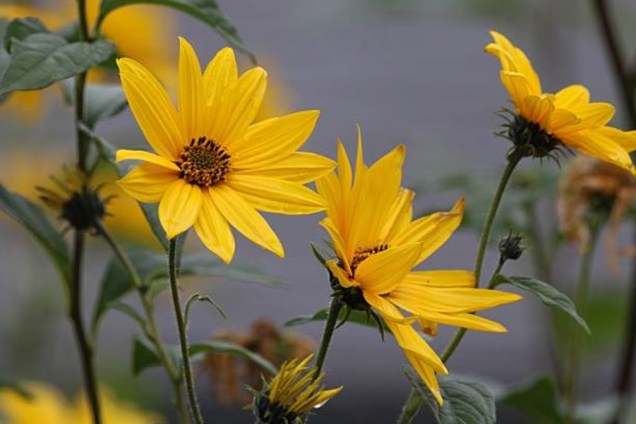
Also known as Jerusalem artichoke (although neither an artichoke or from Jerusalem, go figure). These edible tubers are native to northeastern North America. Sunchokes grow 6-10 feet tall with cheery sunflower-like blooms in full sun or light shade. If sited in a wind prone area they will need support, or you can prune them back by a third to encourage bushier growth.
Sunchokes are very productive. Some varieties have knobby tubers while others are smoother (and easier to clean). They are sweet to the taste and rather nutty when roasted. Anything you can do with potatoes you can probably do with sunchokes. Harvest annually leaving some pieces of tubers with eyes 1-3 feet apart for next year’s crop. The flavor is best after a hard frost. A word about inulin: sunchoke tubers are high in inulin, a type of starch, which is not digestible by humans and can cause gas. Some people do not tolerate it well. Inulin does increase the ability to absorb calcium.
Here is where caution is required! Left to their own devices sunchokes will form large colonies – they are best treated like a mint using containing methods. I grew mine in a large raised bed and they gave me more tubers than I could use and a glorious mass of tall yellow flowers.
Cardoons (Cynara cardunculus)
Found in the wild all along the Mediterranean, cardoons are more popular as a food crop in Southern Europe and North Africa where they are native. They are related to globe artichokes but are grown for the edible stalks rather than the flower heads, which taste like artichokes and are used like celery. Their dramatic spiny silvery foliage and beautiful thistle-like flowers, however, have earned them a place in many gardens. Perhaps as architectural interest in a border? Bonus: Deer won’t touch them.
Cardoons do best in full sun and well-drained soil, although they tolerate some light shade. Start them from seed 6-8 weeks before the last frost and transplant them after the last frost date. The first year they can grow 3-5 feet tall and 3 feet wide, so plan some space. Plants have about a five-year productive life span. They can be divided in spring.
For eating, the stalks are usually blanched (protected from sunlight), to make them more tender and easier to cook, in the fall. This is done by tying the plant into a bundle and wrapping it with cardboard or newspaper to 18 inches then leaving it alone for a month. Hill up the soil around the stems. Cut the stalks off at ground level. Alternatively, you can harvest just some of the fleshy leaf stalks. Clean the leafy bits from the stalk (it will look like a celery stalk), peel away the outer skin, and parboil them before using them in recipes to mitigate any bitterness.
Asparagus (Asparagus officinalis)
Last on this list but probably the most widely known and loved perennial vegetable: asparagus. This edible shoot is a native of Eurasia but has naturalized throughout North America.
Asparagus can live for 15 years and longer, so situate it thoughtfully. (I well remember helping my dad pull out an ancient asparagus bed as a kid. Suffice to say it involved a tractor and chains.) It requires full sun and good drainage. Annual applications of compost or well-rotted manure keep it productive and plentiful water all season will keep it happy. It is easy to grow from seed but generally, year-old rooted crowns are planted in early spring to speed the time to harvest. Plant them 15-18 inches apart in wide beds or rows, with 4-5 feet between rows. All male varieties will not seed (females have berries) and tend to be more productive and disease-resistant. A broad selection of asparagus is available including lovely purple varieties (white spears are blanched).
Spears develop from the underground crowns in early spring. Do not harvest at all in year one and harvest lightly in years two and three. Spears should be snapped off or cut at 6-8 inches. After 8-10 weeks let the spears grow. They will form a lovely, tall, fern-like frond. After frost, the foliage will turn yellow, and at that point, it can be cut down to 2 inches. Asparagus can have a number of pests and diseases. Purchase resistant varieties, keep patches weeded and remove all foliage after frost for best prevention.
These are but a few of the interesting options available to you!
It’s fall, the air is starting to get crisp, you are walking and you see these strange trees. You are sure that they are trees, yet they have these fruits that look like tomatoes… but they are on a tree. What are those fruits? They look so attractive with that wonderful orange… should you harvest them? Should you eat them? Are they any good? What IS this? In today’s post, I want to (re)introduce you to these plants and their fruits, and hopefully the next time you see them you will have answers to all those questions and will know what to do. 😉
In the fall, persimmon trees are recognized for their many orange fruits that look like tomatoes! Photo: P. Tain.
What are these orange fruits?
These fruits are what here in the USA we call persimmons (from the Powhatan word “pichamin”). Persimmons are the fruits of a group of trees that belong to the same family as ebony, and that can be found on a number of continents, including North America. Among all the persimmon species that exist, a number of them are edible, producing fruits in late fall. In the USA, there are two persimmon species that produce edible fruits, and one of them is native to right here in Maryland: the American persimmon (Diospyros virginiana).
Although the wild American persimmon still grows in our forests and was well-known by native Americans, who used its hardwood, consumed the fruits, and introduced them to the European colonists (see some Native American legends involving persimmons here), the American persimmons we see cultivated in orchards come from selected lines. Indeed, varieties of American persimmons have been selected, and many cultivars of American persimmons can be purchased and grown in gardens and orchards to produce fruit. Besides the American persimmon, there are also other species available for purchase, in particular the Oriental persimmon (D. kaki), which is very well-known in Europe.
The American persimmon tree harbors fruits that turn orange, soft, and tend to fall when they are ripe. Photo: W. Pollard.
Although American and Oriental persimmons are edible both raw and cooked (see here for some recipes), it is important to note that the fruits are very astringent prior to ripening, meaning that they have to be ripe for them to be palatable. The level of ripening is usually shown by the coloration of the fruit (ripe fruits are orange), its softness (ripe fruits become soft to the touch), and their voluntary falling from the tree while not rotten. It is often said that persimmons need to go through a frost in order to ripen. This is in fact not accurate: unripe persimmons will simply rot after a frost; ripe persimmons will not rot after a frost and will in fact start slowly drying out, which will make them become sweeter. This may have led people to assume that frosts actually lead to ripening, while the frost will not help in the ripening of any fruit that was not already ripe at the moment of the frost.
Is it true that I need to plant more than one persimmon tree to have fruits?
The short answer is mostly no. American persimmon trees are what we call dioecious plants. This means that each plant will either harbor female flowers (which will become fruits) or male flowers (which will provide pollen for pollination and will not produce fruits). The first consequence of this is that if one plants or encounters a male plant, it will be impossible to ever harvest fruits from it. The second consequence of this is that a female persimmon flower needs to receive pollen from a male plant in order to produce seeds (and reproduce). In most wild forms of American persimmons, pollination is also required for fruit production.
American persimmon trees display small and delicate white flowers, which are either female or male. Photo: M. Beziat.
That being said, female plants of most selected cultivars of American persimmons can actually produce fruit without pollination. If they do not receive any pollen, these female flowers will still develop into fruits, which will not harbor any seeds and which will be fully edible. If one were to plant these cultivars in their garden or orchard, fruit production would not be restricted by female flower pollination.
But does that mean persimmons do not need pollinators?
Not really. Wild persimmons still need pollinators to transfer pollen from the male to the female plants. So who are these pollinators? In fact, we know relatively little about wild persimmon pollination. In terms of flowering time, American persimmons flower between May and June, and their flowers are small and white (and cute!). Floral visitors have not been extensively studied, but there is at least one study describing a large variety of wild bees (e.g., sweat bees, bumblebees, leaf cutter bees) visiting their flowers. From this respect, persimmons play a role in sustaining this group of pollinators and will benefit from their pollination services.
Persimmons also support other insects including many lovely moths from our region, such as Luna moths – top – and Regal moths – bottom). Photo: Askalotl, C. McClarren and A. Reagol, M. Clock-Rust.
Although not pollinated by them, persimmons also support other types of insects (and sometimes pollinators): moths! In fact, persimmon leaves are the favorite food of caterpillars of many native moths. In particular, Luna moth and regal moth (besides many others) caterpillars prefer persimmon leaves. It appears then that persimmons do not just feed us with their delicious fruits, but also feed many of these beautiful native moths, allowing for them to maintain their populations in our area!
By Anahí Espíndola, Assistant Professor, Department of Entomology, University of Maryland, College Park. See more posts by Anahí. Anahí also writes an Extension Blog in Spanish! Check it out here, extensionesp.umd.edu, and please share and spread the word to your Spanish-speaking friends and colleagues in Maryland. ¡Bienvenidos a Extensión en Español!
Earlier this week, I finally took all the pepper plants out of my community garden plot, in anticipation of a predicted frost. It’s ridiculous that I was still harvesting peppers in November, but this is the world we live in.
The final plant to go was a variety called Aconcagua, which I bought seed for and planted for the first time this year. It’s a sweet fryer-type from Argentina that’s described as growing up to three feet tall and producing fruit up to a foot long. I didn’t get quite those results, though I will admit that I didn’t plant it in the best location in my plot (lots of thistle competition). It was, for sure, a big pepper plant, with fruit frequently at least six inches long, with a fresh fruity taste that was great in salads or fried.
Here’s my last harvest (in November, again! From one plant!).
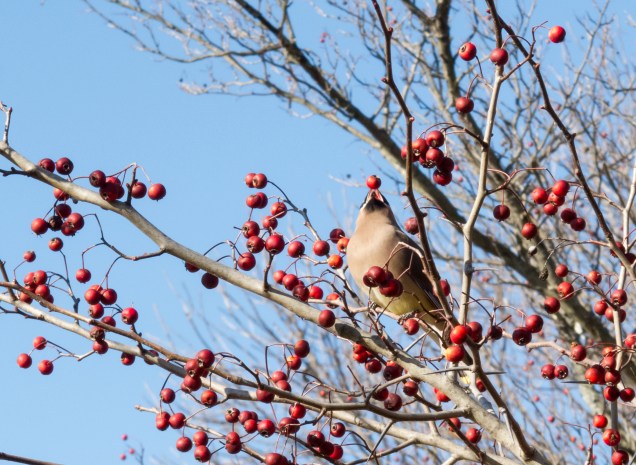
Cedar Waxwing dining on a Green Hawthorn berry. Photo: Miri Talabac
Q: This summer’s mysterious bird illness has me thinking…I’ve become more interested in birds during the past two years and would like to attract them to my yard with plants. Are there favored recommendations?
A: Bird-attracting landscaping definitely beats out bird feeders as the preferable way to bring these beauties into yards for easier viewing as a safer environment than a communal feeder. (While you’re at it, look into ways to discourage window strikes since plants, like feeders, could increase encounters with glass.)
Plant recommendations are going to be incredibly varied because the diet of birds is so varied, both across species and throughout the year. Site conditions in your garden will narrow down what may be an overwhelming list of choices. Here are some general tips:
When looking at berry or seed production, consider productivity for each season.
Try to focus on native plants only, since birds will deposit their seeds beyond your landscape.
To pick a timely category – late-ripening berries – there are some notably popular species. Highly-ranked contenders for both resident and southbound migrant birds include Viburnums, Dogwoods (trees and shrubs), Spicebush, Virginia Creeper, Eastern Redcedar, Magnolia, Black Tupelo, Hackberry, Sassafras, Bayberry, Sumac, Hollies, and Hawthorn.
Cornell’s All About Birds web library plus local Audubon Societies are good resources for more thorough information on individual species diet, habitat preferences, and plant suggestions for both foraging and nesting.
By Miri Talabac, Horticulturist, University of Maryland Extension Home & Garden Information Center. Miri writes the Garden Q&A for The Baltimore Sun.
Have a plant or insect question? University of Maryland Extension has answers! Send your questions and photos to Ask Extension.