September To-do Lists Nudge Gardeners

Winter squash is ready for harvest now.  Photo:  Home & Garden Information Center

I know. I know. You’re tired after a long season of gardening. Especially with all that heat we had. But there are still a few things to tick off your fall to-do list.

Have you planted your garlic yet? Now’s the time. Nestle cloves into the soil through the end of October for harvest next July. Get tips here: Growing Garlic in a Home Garden.

Even if your vegetable garden is looking ragged, keep harvesting. My cucumbers finally gave up the ghost, but I’m still getting enough tomatoes and basil for Caprese salads.

I just harvested butternut squash, too. The rind was finally hard enough not to dent with my fingernail, so they were ready. I’ll cure them for a week in a warmer room, then store them in my cooler basement. Learn more: Growing Winter Squash in a Home Garden.

And yes, I’ve started to remove spent and scruffy vegetable plants, clearing the bed of fallen fruits, leaves, and stems. And no, it’s not just because I’m a neatnik.

Soilborne diseases are the most common cause of vegetable problems. Those plant bits can harbor fungal spores which can reinfect plants year after year. 

So I’m ruthless in removing plant debris. I compost healthy plant parts, but bag and trash anything that has had disease issues.

After cleanup, I add compost. It feeds the soil, adds organic matter, improves drainage, holds nutrients, attracts earthworms, and suppresses disease. What’s not to love?

Buy compost or make your own. Mix leaves, grass clippings, kitchen scraps, and other organic materials into a pile. Stir it now and then, water it when it’s dry, and let it cook down into the best soil food ever. Learn: How to Make Compost at Home.

a gardener working on a compost bin
Master Gardener Gary Stallings turns compost in a teaching garden. Photo:  Shanon Wolf

This year I’ll top off my vegetable beds with an inch or two of compost to improve the soil and act as a winter mulch and weed blocker.  

Yes, weeds grow in winter. Winter annuals such as chickweed, henbit, and speedwell love bare soil, germinating in late summer and fall and returning vigorously in spring.

Don’t let them get a toehold. Cover bare soil with compost, mulch, or a cover crop.

Cover crops are all the rage, a classic farming technique that’s discovered new life in gardening circles. Sown from seed, they block weeds and slow erosion.

Best of all, cover crops feed and improve soil. Their deep roots mine nutrients and their leaves, stems and roots break down to add organic matter when they are turned into the soil in spring.

Many cover crops can be planted in the fall. Which is best for your garden? Find out here: Cover Crops for Gardens.

crimson clover
Crimson clover is an attractive cover crop that improves soil. Photo:  Home & Garden Information Center

After I tend to my vegetable beds, I dig and divide perennials. Most perennials should be divided every 3 years. Just lift a clump, cut it into sections, and transplant and water well.

Resist the urge to cut back your perennials in the fall. They provide crucial overwintering sites for pollinators and food for birds and other wildlife. Only cut back plants that had serious disease or insect issues.

Fall is a time to put a tidy bow on the gardening season, to lay to rest your beds after you squeeze out the last harvests. Feel the change in the air, breathe deeply, and enjoy the delicious ache of a job well done.

By Annette Cormany, Principal Agent Associate and Master Gardener Coordinator, Washington County, University of Maryland Extension.

This article was previously published by Herald-Mail Media. Read more by Annette.


Goldenrods: The Garden Thyme Podcast

goldenrods episode of The Garden Thyme Podcast

Gold and yellow hues are the undeniable colors of autumn. In this episode of The Garden Thyme Podcast, we discuss one of our favorite yellow-blooming perennial plants – goldenrod. With its pretty yellow flowers, long blooming seasons, and high wildlife value, what is not to love about these fantastic native plants? Mikaela also counts down her top pick of goldenrods for different gardens (~17:10). Her goldenrod bloom chart can be found here.

We also have our: 

  • Native Plant of the Month – Pawpaw (Asimina triloba) (~22:45)
  • Bug of the Month – Goldenrod Bunch Gall Midge  (~33:35)
  • Garden Tips of the Month (~39:15)

If you have any garden-related questions, please email us at UMEGardenPodcast@gmail.com or look us up on Facebook.

For more information about the University of Maryland Extension (UME) and these topics, please check out the UME Home and Garden Information Center.

The Garden Thyme Podcast is brought to you by the University of Maryland Extension. Hosts are Mikaela Boley- Senior Agent Associate (Talbot County) for Horticulture, Rachel Rhodes- Agent Associate for Horticulture (Queen Anne’s County), and Emily Zobel-Senior Agent Associate for Agriculture (Dorchester County).

Theme Song: By Jason Inc 

How Are Aquatic Plants Pollinated?

When we think about pollination, we tend to only think about terrestrial plants. However, a large number of plants are not and actually live fully or partially in the water. These plants also need to reproduce, and thus need to have their flowers pollinated to produce seed. How do they do it? In today’s post, I will try to give a (short) answer to that question, using some native plants as examples.

You may recall from previous posts, that flowering plants require pollination to be able to produce seeds and thus reproduce. Since we are terrestrial organisms ourselves, we tend to be more aware of other organisms and processes that share that trait with us, and pollination is no exception. However, there are lots of flowering plants that are completely or partially aquatic, and these plants also require pollination to produce seeds. Depending on the specific requirements of the plants in question, some of them may use different strategies for pollination.

Wind pollination

Many aquatic or semi-aquatic plants depend on wind to transfer pollen to the female reproductive structures. Especially under conditions distant from land, using wind as a means of pollen dispersal can be extremely advantageous. In fact, being distant from land tends to reduce the types and number of animals that can visit the flowers of aquatic plants. By depending more heavily on wind, these plants usually display light and abundant pollen that can be readily blown away and potentially deposited on the stigma of the female counterparts. A global evaluation of this indicated that about a third of all aquatic plants in the world are wind-pollinated.

In Maryland, an aquatic plant known to be wind-pollinated are watershields (Brasenia schreberi). This plant has non-showy flowers that display both anthers and stigmas. In order for the plant to promote cross-pollination (i.e., avoid receiving pollen from its own flowers), the flowers of these plants go through a complex blooming process that spans two days. This process involves on the first day the receptivity of the stigma (the female part that receives the pollen) and on the second day the maturation and release of the pollen grains. When the grains mature, they are swept by the wind and can reach stigmas from other flowers that are at that point going through their first flowering maturation step.

Animal pollination

It has been shown that a large number of aquatic plants are at least partially pollinated by insects or other animals. In fact, as is also the case in terrestrial plants, aquatic plants can sometimes use both wind and animals to transfer pollen, increasing the chances of some pollen eventually reaching the stigma. Animal-pollinated aquatic plants are pollinated by a large variety of organisms, but their identity will depend on the specific place where the plant is growing and the ability of the pollinator to reach the plant and even survive in that environment. For example, while large bees may be able to fly further away from land, smaller insects may mostly visit plants that are close to land.

A special case of insect pollination of a Maryland native is that of the arrow arum or tuckahoe (Peltandra virginica). The species belongs to the Araceae family and displays a stunning pollination system. As is often the case in this family of plants (see also the skunk cabbage example we talked about in a previous post), the maturation of the female and male flowers is linked to the production of specific aromas. In the case of the arrow arum, these smells attract small flies, and in particular individuals of Elachiptera formosa. These flies seek the flowers to mate, feed on pollen, and eventually lay eggs on the plant, making this an example of what is called nursery pollination (the plant receives a pollination service in exchange for providing a brood site for the pollinator). By moving along the flower, these tiny flies move pollen from the anthers to the stigmas. Some of this pollen may come from the same plant, but other pollen may come from a different flower already visited by the flies.

Water pollination

Finally, many aquatic plants display flowers that are either completely submerged or floating on the surface of water. These plants usually use water currents to disperse their pollen. As with wind, this dispersal is very inaccurate, which usually leads to the release of a large amount of pollen. These plants have either pollen that floats on water or remains attached to the anthers which float to the stigma.

aquatic plants with tiny white flowers on the surface of water
The American pondweed is one of our native species that uses water as their means of pollen dispersal. Note the very small white flowers that are placed on the surface of water. Photo: C. Fisher

A very common native from Maryland that displays this type of pollination is the pond- or waterweed (Elodea canadensis). This species native to North America displays flowers that have either anthers or pistils, but not both. The flowers with anthers are often displayed over the water, from where they release the pollen, which lands and then travels on its surface. By moving on the surface of the water, the pollen can reach the slightly submerged stigmas of the pistilate (female) flowers, which are held on flowers that float at the very surface of the water. Because such a dispersal can lead to large pollen loss, pollen release in this species is only done when the wind is light and the water current is low. This promotes a more “controlled” dispersal and increases the chances of the pollen effectively reaching the stigmas.

By Anahí Espíndola, Assistant Professor, Department of Entomology, University of Maryland, College Park. See more posts by Anahí.

Anahí also writes an Extension Blog in Spanish! Check it out here, 
extensionesp.umd.edu, and please share and spread the word to your Spanish-speaking friends and colleagues in Maryland. ¡Bienvenidos a Extensión en Español!

Q&A: Late Bloomers for the Garden

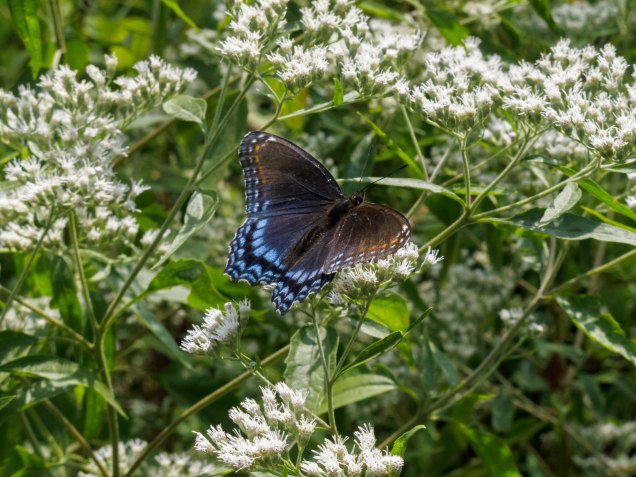
a red-spotted purple butterfly is feeding on nectar from a native Eupatorium plant with white flowers
Red-Spotted Purple butterfly on a native Eupatorium in September. Photo: M. Talabac

Q:  A lot of my new native plant garden beds contain species that bloom in spring and early/mid-summer. What can I add for pollinators that blooms late?

A:  Fortunately, there are numerous late-season nectar sources, though most are sun-loving species. They are very attractive to migrating Monarchs and any other butterfly on the wing in late summer and autumn, plus bees, wasps, beetles, flies, and plenty of other insects. Seed-eating birds also appreciate the food source once the seeds of those plants ripen by the end of the growing season; nature’s bird feeders.

Lots of late-flowering native plants are in the aster family, including: Ironweed (Vernonia); Goldenrods (Solidago and Euthamia); Asters (formerly genus Aster, now named Doellingeria, Eurybia, Ionactis, or Symphyotrichum); Cut-leaved Coneflower (Rudbeckia laciniata); Blazing-star (Liatris); Elephant’s-foot (Elephantopus); Beggarticks (Bidens); Wingstem (Verbesina); Helen’s Flower (Helenium); perennial Sunflowers (Helianthus); Climbing Hempvine (Mikania scandens); and the Eupatorium group (several common names and genera; Eupatorium, Eutrochium, Conoclinium, Ageratina).

Outside of the aster family, you can also consider Rosemallow (Hibiscus), Obedient Plant (Physostegia virginiana), Turtlehead (Chelone), Common Witchhazel (Hamamelis virginiana), Gentian (Gentiana), Tall Phlox (Phlox paniculata), Lobelia (Lobelia), and Flowering Spurge (Euphorbia corollata).

By Miri Talabac, Horticulturist, University of Maryland Extension Home & Garden Information Center. Miri writes the Garden Q&A for The Baltimore Sun and Washington Gardener Magazine. Read more by Miri.

Have a plant or insect question? The University of Maryland Extension has answers! Send your questions and photos to Ask ExtensionOur horticulturists are available to answer your questions online, year-round.

Pepper Report

Just a quick note from me (Erica) this month to report on some new pepper cultivars I’m growing. These include ‘Lesya’ sweet pepper, ‘Tam’ jalapeño, and ‘Escamillo’ frying pepper.

First, ‘Lesya.’ Wow, I’m in love with this one.

It’s a heart-shaped red pepper, about 3-4 inches long, thick-walled and super-sweet. Those thick walls make it great for roasting, but it can also be eaten raw or cooked other ways. It also just looks terrific growing on strong plants that don’t get leggy and seem pretty disease-resistant.

I bought seed for ‘Tam’ jalapeño because it’s supposed to be on the milder side, but with some spice to it, unlike the ‘Nadapeño’ heatless type I grew last year (which was kind of boring). The first thing I did with the fruits was to make them into refrigerator pickles (sliced), and those turned out pretty hot. So I thought I’d do a taste test comparing ‘Tam’ to other jalapeños. Please note, this was not a scientifically valid comparison; that would involve a lot more testers (instead of just me and my son), a lot more peppers, and many tests over time. Peppers can be more or less hot depending on the weather, the soil the plants are grown in, the genetics of particular plants, and probably lots of other factors.

Anyway, I picked a couple of peppers from the Derwood Demo Garden, and a ‘Tam’ from my own garden.

L to R: ‘Tam,’ ‘Lemon Spice,’ and ‘Jalafuego’ jalapeños

I’ll also note that picking the ‘Lemon Spice’ fully ripe made the comparison even less valid (but it’s so pretty!), and that I should have found a larger and more mature ‘Jalafuego.’ But onwards. Of the three, ‘Lemon Spice’ was definitely the hottest, nice and eye-watering. ‘Tam’ had practically no heat on first bite, and then it crept up on me, but it was definitely milder. ‘Jalafuego’ was weirdly mild as well; I suspect another fruit on another day would have knocked my socks off. So, nothing definitive, but I think if you want a milder jalapeño ‘Tam’ is worth trying.

Apparently this year some people, in some places, bought ‘Tam’ plants that turned out to be sweet banana peppers – all part of the great pepper seed mixup that you can read about on this Garden Professors blog post – but my seed (purchased from Sow True Seed, for the record) turned out to be the real thing.

Finally, this is my second year growing ‘Escamillo’ frying pepper, and I’m very satisfied.

It’s a nice meaty yellow pepper that can easily reach 6 inches or more, ripens up fast, has thick walls for good roasting, and is also great for frying or eating raw.

And that’s the pepper report!

By Erica Smith, Montgomery County Master Gardener. Read more posts by Erica.

Cicada Killer Wasps Are Scary But Good

a close-up view of a cicada killer wasp showing its light yellow and black striped abdomen
Cicada killer wasps are good pollinators who keep cicadas in check.
Photo: Dawn Dailey O’Brien, Cornell University

It’s big. It’s creepy. It’s the cicada killer wasp and it has some local folks worried. But it’s a good guy. Honest. 

Looking like yellowjackets on steroids, 2-inch-long cicada killer wasps are yellow and black and a bit intimidating. But it’s all a show. 

Unless you’re a cicada, you have no worries. These wasps help control the annual cicadas buzzing in our trees.

In fact, male cicada killer wasps don’t have stingers at all and females aren’t likely to sting unless you step or sit on one.

In addition to their ginormous size, cicada killer wasps worry folks because they do figure eights over lawns, looking like they are Up To No Good.

Nope. Those are just males establishing or defending territory. Boys will be boys. 

The dudes have been hanging out since July, scoping out territory while waiting for the ladies to arrive. Their manly posturing results in often spectacular wing-whirling combat, all bluster and bluff.  

Check out the video of a close encounter with University of Maryland entomologist Mike Raupp’s Bug of the Week feature.

Following a brief romantic interlude, the female cicada killer wasp digs a finger-sized nesting chamber in the ground, leaving telltale piles of excavated soil.

Then she climbs trees in search of the cicadas which she uses to feed her young. 

When she finds a cicada, she stings it to paralyze it, then flies the cicada down to the ground, dragging it to her nest. This is no mean feat since cicadas are much larger than she is. That’s one determined mama.

She stuffs the cicada into her nest, lays an egg on it, and seals the opening. When the egg hatches, the larva will chow down on the cicada which is, unfortunately, still quite alive. Ah, the circle of life.

Well fed, the larva will wrap itself in a case, pupate and stay underground before emerging as an adult next summer. 

Interestingly enough, female cicada killer wasps can choose the sex of their babies. If they give them one cicada as food, they turn out to be boys. Given two cicadas, they become larger females.

A female cicada killer wasp’s work is never done. As soon as she seals one nest, she makes a new one and goes cicada hunting again, helping to keep their population in check.  

See female cicada killer wasps in action in this Bug of the Week profile.

Cicada killer wasps also are good pollinators, moving pollen from plant to plant as they feed on nectar as adults.  

Cicada killer wasps congregate around some petunias.
Photo: John Lefebure

What should you do if you find cicada killer wasps in your yard? Not a thing. Tolerating them is best since they’re only around for a few weeks and are beneficial. Chemical controls are not necessary.

But if you’re bothered by the holes they make in your lawn, wet down the area with a sprinkler.  Cicada killer wasps don’t like to build nests in moist soil.

They also avoid nesting in dense lawns. So their nests are a clue that your lawn may need some beefing up.  

Cicada killer wasps may be big and a little scary looking. But I hope you’ve gained some appreciation for these fascinating insects and enjoy watching them dance over your lawn.  

By Annette Cormany, Principal Agent Associate and Master Gardener Coordinator, Washington County, University of Maryland Extension.

This article was previously published by Herald-Mail Media. Read more by Annette.


A Lawn Retrospective on the Summer of 2023: Looking Ahead to the Fall Season

Many lawns showed drought-stress symptoms in early summer. Photo: M. Talabac, University of Maryland Extension (UME)

It seems like ages ago, but during late spring and early summer we were in the midst of a long dry spell–and then things changed! Many areas in the region have seen more typical summer rainfall since late June. Since then, summer annual weeds and sedges were given new life with all of the wet conditions. For many homeowners, it has been a difficult summer keeping weeds like kyllinga, nutsedge, and crabgrass at bay during the wet, humid weather.  

University of Maryland research (and others) has indicated that the best way to deter crabgrass is to mow higher. Experiment plots mowed in the 3.5-to-4-inch range have consistently had less crabgrass invasion than plots mowed at 2 or 3 inches. While this late summer weather has led to a lot of crabgrass and sedge invasion, homeowners can take solace in the fact that relief is in sight as far as the calendar is concerned. Late August/early September is the perfect time of year to re-seed with cool-season grasses like tall fescue to undertake a full-scale renovation or a lawn “rejuvenation.”

First, let’s define a few terms:

Complete renovation involves killing the existing sod to bare soil and re-seeding or installing sod.

Overseeding involves using an aerator or de-thatcher to open up the turfgrass canopy and then applying seed to increase density and sustain the stand. 

Repairing bare spots involves raking up old debris by hand or loosening it with a de-thatcher, then seeding.

More detailed information on these techniques can be found on the University of Maryland Extension Lawn Renovation and Overseeding resource page.

How do you decide what to undertake? If your lawn is thin, overrun with crabgrass, has a high percentage of broadleaf weeds, or is an otherwise “unsalvageable mess” you would probably consider a full renovation. If your lawn is a little weak in places, but otherwise dense and relatively healthy, overseeding would be more appropriate. Ensuring good “seed to soil” contact and maintaining adequate moisture in the seedbed is critical for successful germination.

Another key element in lawn renovation and overseeding is seed selection. There are a number of varieties (cultivars) of tall fescue available, however, some have performed better than others in the UMD evaluation trials and these are listed as “recommended varieties” in UMD Extension Bulletin TT-77-Recommended Turfgrass Cultivars (PDF). Although these varieties may be difficult to find at “big box” stores, many local garden retailers seek them out to stock them, and homeowners can often purchase them from local landscape professional suppliers or find them online at sites like seedsuperstore.com.

By Geoffrey Rinehart, Senior Lecturer, Turfgrass Management, Institute of Applied Agriculture, University of Maryland. Read more articles by Geoff.