Insects: Our Most Under-Appreciated Neighbors

Why should I want bugs, insects, and creepy crawlies in my yard or green space?

Insects are an incredibly diverse group of organisms, with 91,000 described species in the United States and likely an equal number yet to be described by scientists. Only an exceedingly small fraction of these species ever have negative impacts on humans as “pests” (<1% of species). Often the overabundance of pest species is due to human agricultural and landscape practice choices. The vast majority of insects in shared spaces with humans like yards and parks are going about their own lives. In addition to being fascinating creatures deserving of habitat in their own right, they also often contribute to unnoticed but very important tasks that help humans, termed “ecosystem services.” The next time you see one of these critters in your yard, consider thanking them rather than smashing them.

What are ecosystem services?

Ecosystem services are benefits that humans gain from the environment. Examples of ecosystem services include water filtration, raw material production, erosion control, and pollination. Some ecosystem services, like the maintenance of atmospheric gasses (e.g. plants remove carbon dioxide and produce oxygen that humans breathe), are noticeable and directly impact our everyday lives. On the other hand, services like decomposition may go unnoticed because they indirectly affect us.  

Insects (and their arthropod relatives like spiders and earthworms) play vital roles in many ecosystem services. This is often due to insects interacting with plants in some way, though insects also provide food for many other animals. Below are some examples of the ecosystem services that insects contribute to.

Water filtration

Filter-feeding insects positively affect water quality because they remove particles of dead organic material. Insects retain many of the nutrients they filter out of the water, thus reducing the likelihood of algal blooms, their associated toxins, and dissolved oxygen “dead zones.” This is crucial because clean water provides habitat for other plants and animals like fish and amphibians. It also means less effort is required to purify water for human use. 

Types of insects that improve water quality:

  • Blackflies, mayflies, stoneflies, and caddisflies (Note: the underlined insect groups are not “true” flies in the taxonomic Order Diptera; they are part of other orders.) 

Other types of organisms that improve water quality:

  • Mussels, crayfish, snails

More information: Why Care About Aquatic Insects

an illustration of the diversity of insects in an aquatic environment
Source: https://www.nsf.gov/news/mmg/mmg_disp.jsp?med_id=66886&from=Many types of insects live in or near water. Caddisfly larvae, pictured bottom center, filter debris out of the water as they feed. Credit: National Science Foundation

Biocontrol

Biocontrol is when natural enemies are used to suppress pests and reduce the amount of damage they cause. Natural enemies are insects that are antagonistic to pest insects. There are three types of natural enemies: predators, parasitoids, and pathogens. Preserving natural enemy populations is crucial to reducing our reliance on pesticides because when natural enemies are active, pest outbreaks are less likely to occur in the first place. Predators need food all year, so they also need alternate prey available in order to prevent pest outbreaks. Pesticides eliminate beneficial insects in addition to pests, so they should be used only as a last resort.

Fun fact: Fireflies spend much of the year as larval predators belowground, feeding on pests like grubs in turfgrass yards. If no prey is available in yards, then there will be no display of adult fireflies in the summer.

Types of insects used for biocontrol:

Other types of organisms used for biocontrol:

  • Fungi, birds, amphibians, reptiles, and mammals

More information: Approaches to the Biological Control of Insect Pests.

small wasp parasitizes eggs of a pest insect
An adult samurai wasp lays eggs in a mass of brown marmorated stink bug eggs. Credit: Chris Hedstrom, CC BY-SA 2.0 DEED

Seed dispersal

Seed dispersal is when seeds are moved away from the parent plant. Seeds are moved when insects knock them off while feeding or when insects collect and then move seeds to a new location. Seed dispersal is important because it reduces resource competition between the parent plant and offspring plants. It also makes germination and seedling survival more likely, especially in arid climates. 

Types of insect seed dispersers:

  • Ants (most effective), beetles, wasps, thrips, and some moths

Other types of seed dispersers:

  • Fruit-eating animals (frugivores), such as some monkeys, lizards, and bats
  • Unwitting animal dispersers of sticky seeds like this

More information:

Seed Dispersal – The Australian Museum

The Conservation Physiology of Seed Dispersal

two ants carrying a seed
Two ants carrying a plant seed. Credit: Mark Chinnick, CC BY-NC-ND 2.0 DEED

Decomposition & nutrient cycling

Nutrient cycling and decomposition are two important processes that rely on one another. Nutrient cycling is when soil nutrients are taken up by plants, insects eat plants, and then those nutrients are reintroduced into the soil when dead insects and droppings are broken back down into nutrients via decomposition. Decomposer insects help clear dead animals and plants off the ground which would otherwise accumulate everywhere. They also help create soil texture and circulate nutrients back into the soil, which plant populations and productivity depend on.

Types of insect decomposers:

  • Many beetles, springtails, termites, wood cockroaches, and some fly larvae (maggots)

Other types of decomposers:

More information: Decomposers

a black shiny beetle on a log
An adult bess beetle crawls across a log. Bess beetles are important decomposers and return nutrients to the soil. Credit: Kelsey McGurrin, used with permission

Supporting food webs

Insects are a main source of protein and nutrition for many animals (and even some plants). They play a crucial role in transferring energy from plants to larger animals that eat insects like spiders, birds, frogs, fish, bats, foxes, opossums, and bears. This wide food base that they provide allows for functioning, stable ecosystems that are resilient to disruptions.

Fun fact: By weight, there are roughly 300 times more insects than humans on Earth.
There are so many animals that eat insects, but here are just a few examples:

  • Terrestrial bird species, in particular, feed their babies almost exclusively with insects, and if there are fewer insects, baby birds are less successful at fledging from nests.
  • Popular fish like salmon, bass, and trout eat insects, especially when they’re young.
  • Grizzly bears will eat tens of thousands of moths a day to prepare for hibernation.
two mockingbirds eating a praying matis
Northern Mockingbird adult feeding a praying mantis to a young bird. Credit: Becky Matsubara, CC BY 4.0 DEED

Pollination

Pollination is the transfer of pollen between flowers, resulting in flower fertilization and seed/fruit production. It is an unintentional consequence of pollinators going from flower to flower to feed themselves. Pollination is crucial for human survival, as 80% of plant-based foods and products rely on animal pollination. According to the USDA, pollinated crops are worth $18 billion in the US alone. Foods requiring pollination include apples, blueberries, chocolate, coffee, grapefruit, peaches, peppermint, sugarcane, tequila, and vanilla. 

Fun fact: beetles were likely the first insect pollinators– starting 200 million years ago!
Types of insect pollinators:

  • Bees, wasps, beetles, flies, ants, butterflies, and moths

Other types of pollinators:

  • Birds and bats

More information:

Pollination Basics

What is Pollination?

Why is Pollination Important?

Pollinated Foods

Blueberry Digger Bee pollinating blueberry flowers. Credit: Judy Gallagher, CC BY 2.0 DEED

By Yasmine Helbling, Kelsey McGurrin, and Karin Twardosz Burghardt, from the University of Maryland Department of Entomology, Burghardt Lab

And the Pollinator Prize Goes to… Hoverflies!

We hear a lot about pollinators these days, but most of the attention appears to always go to one group of them: bees. However, the diversity of pollinators expands way beyond this one group of insects, as we discussed in a previous post. In today’s post, I want to bring the spotlight to one of those non-bee pollinators, which I always feel stay in the background of our pollinator discussions and are massively underappreciated, despite their important role in our ecosystems. Come with me to give hoverflies the recognition they deserve.

What are hoverflies?

With over 100 species in Maryland, hoverflies (sometimes also called flower flies, or simply syrphids) are a group of flies that belong to a family of insects called Syrphidae. They are called hoverflies because they are very good fliers, able to quickly change directions or maintain their flying positions in very impressive ways. While their larval stages can have a huge variety of nutritional needs (some of which make them great biological control agents of pests), a very large number of the species are strongly associated with flowers as adults. In fact, the females require nectar and pollen consumption for their ovary development, making them depend strongly on floral resources for reproduction. For this reason, they act as important pollinators of many wild plants and crops, especially in temperate climates. Although not fully recognized by the general public, pollinating hoverflies have been shown to contribute globally to the pollination of over 70% of crops globally and about the same percentage of European wildflowers (few studies have evaluated the latter in North America)! You can learn more about this in this recent publication.

Hoverflies can be recognized by their large eyes, short antennae, and at rest their wings positioned perpendicularly to their body, as seen here in this (likely calligrapher or Toxomerus) hoverfly from Maryland. Photo: A. Espíndola

Ecology and biology of hoverflies

I hope that you’re now starting to get excited about these little creatures. Before you run outside to try to catch a glimpse of them, let me tell you some more about their lives, so you can continue to be amazed at what they do and why I am on a “pollinator recognition” mission for them.

As I was saying before, a vast majority of hoverflies are strongly associated with flowers. This makes them potentially important pollinators, and this is indeed true for many of them. However, there’s another reason why they are so important: their ecology. In fact, hoverflies have migratory or at least long dispersal behavior. This means that they have great potential for long-distance dispersal of pollen, and thus can contribute strongly to the pollination of plants that may be spatially far away from each other. Thinking about pollination and its role in plant reproduction, such long-distance pollen dispersal can be key in the reproduction of isolated plant populations, and even in increasing and maintaining genetic diversity in those populations. All of that tends to positively impact the ability of those plants to maintain their populations, making hoverflies key actors in sustaining the diversity of many wild plant species.

And also, because I really want to make an impression on you 😊, know that when I talk about hoverfly migration, I am talking about migration patterns that can in some cases be equivalent to those of more “famous” insects, such as monarchs. Some studies have shown some hoverfly species migrate thousands of miles, following the seasons. Although this is relatively well-studied in Europe, we know that similar migration patterns also occur in other parts of the globe, including North America. And as a fun fact, in our research group at UMD, we believe that we once observed and sampled a wave of migration of hoverflies right here, while studying pollination interactions in the endangered serpentine grasslands of Maryland.

a fly that looks like a bee with large black eyes

a syrphid fly that looks similar to a bumblebee

a syrphid fly has yellow and black stripes and two wings
Hoverflies often trick us into thinking that they are something they are not. Here we have some great examples of elaborate mimics of bees/bumblebees and wasps. Can you spot the traits that give them away? Top: Bare-eyed bee mimic (Mallota bautias); center: Hairy-eyed bee mimic (Mallota posticata); Bottom: Transverse-banded flower fly (Eristalis transversa). Photos T. Shahan, M. Wills, J. Gallagher. All CC.

How to recognize them?

Perhaps a reason why hoverflies are underrecognized is that many of their species display impressive body mimics of other species, many of which people tend to be afraid of because of their stingers. For example, some of the most common hoverflies in our area display yellow and black stripes, tricking us (and potential predators) into believing they are in fact wasps or bees. This is a strategy that protects them from predation but also requires us to be more attentive when we are trying to find them.

Despite this, there are some simple ways to recognize their trick. Because they are flies, hoverflies have characteristics that differentiate them clearly from other groups of insects, such as wasps. One of the main traits to look for when trying to figure out if we are facing a hoverfly (vs. a wasp, for example), is looking at their wings. Unlike bees and wasps, flies have only one pair of wings, which at rest they usually extend perpendicularly to their body, which makes them look like a plane or a “T”. Wasps and bees, on the other hand, typically don’t do this, and they fold their two pairs of wings flat over their abdomen while they are at rest.

Another way to tell them apart from most other wasps and bees is their heads (this may be also useful when the wing trait is not easy to see). In fact, flies generally have VERY large eyes (just think about any fly costume 😉). Hoverflies are no exception! They also have large eyes that cover a very large part of their heads, as well as very short antennae. On the other hand, bees and wasps, usually have much much longer antennae that extend way beyond their heads.

Ready to go out and find some of them? Remember that you can always check out iNaturalist to help you out with identifications! Good luck!

By Anahí Espíndola, Assistant Professor, Department of Entomology, University of Maryland, College Park. See more posts by Anahí.

Anahí also writes an Extension Blog in Spanish! Check it out here, 
extensionesp.umd.edu, and please share and spread the word to your Spanish-speaking friends and colleagues in Maryland. ¡Bienvenidos a Extensión en Español!

An Ode to Beebalms, Our Beautiful Biodiversity Magnets

Scarlet beebalm (Monarda didyma). Photo: A. Espíndola

Among the many native plants of North America, there’s one that every summer stuns me with its beauty and its important role in our ecosystems and our lives. In today’s post, I want to share some information about a lovely group of plants local to right here, which can be easily grown in our green spaces, and which one can observe flowering right now: beebalms!

What are beebalms?

Beebalms are a group of plants in the mint family (Lamiaceae) that belong to the genus Monarda. This genus is restricted to North America and includes several species. In Maryland, there are at least four species present, one of which (M. clinopodia, the basil beebalm) is currently listed as requiring conservation actions (listed as Vulnerable). The other three species (M. didyma, M. fistulosa, M. punctata) appear to be relatively common in the region and are easy to grow in our green spaces. All species reach about 2 to 5 feet in height and are great additions to flower beds because of their beauty but also because they act as biodiversity magnets. For example, the genus Monarda has been recognized as supporting at least three rare and specialist bee species in the Eastern USA, and attracting a lot of natural enemies of pests, meaning that providing these floral resources can support the populations of bee species that depend on the pollen of these plants for their nutrition and help us naturally control pests in our green spaces. And last but not least, later in the season their fruits support birds and, if left uncut, their stems offer overwintering spaces for arthropods.

Scarlet beebalm (M. didyma)

This is a perennial species with dark red flowers that bloom during the summer. As for all beebalms, the flower heads are formed by many elongated flowers that harbor abundant nectar. The plant is incredibly attractive to pollinators, acting as a magnet to bees of all sizes, butterflies, and hummingbirds. Besides its great support to pollinators and other arthropods, this species (along with M. fistulosa) has medicinal properties, which have been identified and used since immemorable times by Native Americans. The very name of beebalm is even related to these uses, since the plant can be used to produce poultices that help with skin affections, including bee stings. Preparations of the plant are also traditionally used to help with digestive and respiratory issues. Finally, as for many mint plants, this species is rich in essential oils, which makes it a good one to flavor foods like one would do with oregano and mint. You can learn more about how to grow this species, along with other facts on this USDA information sheet.

a stand of brightly colored red flowers - monarda didyma

Scarlet beebalms display red flower heads that offer abundant nectar to a large variety of vertebrate and invertebrate pollinators. Photos: A. Espíndola, J. Schneid (CC)

Continue reading →

Pollination: The Garden Thyme Podcast

The garden thyme podcast episode on pollination and pollinators

In this month’s episode of The Garden Thyme Podcast, we are excited to celebrate National Pollinator Week ( June 19-25, 2023)! A pollinator is any animal that visits flowering plants and moves pollen from flower to flower, which helps plants reproduce, making fruits and seeds. In North America pollinators include bees, butterflies, moths, flower flies, beetles, and wasps. Worldwide, approximately 1,000 plants grown for food, beverages, fibers, and spices need to be pollinated by animals.

We also have our: 

  • Native Plant of the Month – Beardtongues (Penstemon digitalis and P. hirsutus) ~16:40
  • Bug of the Month – Fig wasps (Agaonidae sp.) ~21:18
  • Garden Tips of the Month – ~30:00

If you have any garden-related questions, please email us at UMEGardenPodcast@gmail.com or look us up on Facebook. For more information about these topics, please check out the Home and Garden Information Center.

The Garden Thyme Podcast is brought to you by the University of Maryland Extension. Hosts are Mikaela Boley, Senior Agent Associate (Talbot County) for Horticulture; Rachel Rhodes, Agent Associate for Horticulture (Queen Anne’s County); and Emily Zobel, Senior Agent Associate for Agriculture (Dorchester County).

Theme Song: By Jason Inc

Q&A: Pros and Cons of the No-Mow May Movement

Q: Do you have any information related to the “no mow” movement? We have a very weedy lawn and are considering replacing it with Dutch clover. Is that a good idea? Bad idea? 

A: We do not recommend replacing lawn outright with clover. Clover goes dormant in winter, losing leaves, which leaves the soil surface exposed to weed seed colonization and potential erosion. The clovers used in lawns are also non-native and would not support the majority of our native bees (which are specialists, relying on certain native species for pollen, nectar, or plant oils). Generalist bees can use clover or other blooms but these tend not to be the local bees needing the most support from garden plantings.

If you prefer to augment your existing lawn with clover, consider microclover, which is a dwarf and less-aggressive variety of white clover that cohabitates with turfgrass more cooperatively. While not solving any of the other above issues, at least this is a more suitable choice when using clover in a lawn. Our Lawns and Microclover page provides some pros and cons plus links to a more detailed publication (PDF document) about how to go about creating and maintaining this mix.

a flowery lawn with unmowed grasses
Chanticleer’s flowery lawn interpretation, more of a no-mow-ever than a no-mow May situation, and thus of more benefit to wildlife. Photo: M. Talabac

Opinions among professional horticulturists about “No Mow May” actions are mixed because there are both benefits and drawbacks that it creates. You will probably find both proponents and opponents to this practice in Extension and other science-based web publications and articles. The main benefit of the movement is its ability to get gardeners thinking about their landscaping choices and actions and the impacts of these on the ecosystem. (And that’s a good thing!) That said, most of the flowering lawn weeds that no-mow is supposed to protect are non-native and do not support many of our native bees, and allowing them to set seed only enables them to spread further in places where native plants should ideally be growing instead. 

For gardeners interested in having turf serve double-duty as a “bee lawn” – that is, intentionally planted with seed mixtures containing low-growing flowering plants – the benefits and shortcomings of this approach are similar to those with clover lawn conversions or from reducing mowing for limited periods of time. University of Minnesota research shows that bee lawns do provide benefits for pollinators, including native ones. However, most commercially-available bee lawn mixes contain plants from Europe and/or Asia, and are perhaps not the best nutritionally for Maryland’s specialist bee adults or a resource they will be able to use for their young. Some Maryland native plants that can be incorporated into bee lawns, such as Self-Heal (Prunella vulgaris subspecies lanceolata), are not readily available in seed mixes here, and research on Maryland-native plants for use in bee lawns is not available at this time. Visit UMN’s “Planting and Maintaining a Bee Lawn” web page for more detail.

Our energies and efforts aimed at benefiting insects, birds, and other organisms may be better spent creating native plant gardens alongside of (or in place of) lawns, which will not only serve specialist bees more suitably but also will support a variety of other native wildlife in the process. In any garden setting, including when plant selections are native-focused, using a diversity of plant species has several benefits: it can support a greater diversity of wildlife (including pollinators and beneficial insects that help suppress pests), it adds aesthetic and seasonal interest, and it increases the resiliency of the planting as a whole, because different species won’t have the same degree of vulnerability to any one issue (like drought or flooding) that may arise.

white flowers of fleabane in bloom
 Native common fleabane (Erigeron philadelphicus) blooms in a front yard where a portion of the turfgrass was removed and replaced with little bluestem, switchgrass, and a mixture of flowering perennials. Fleabane supports a variety of native bees, solitary wasps, and other beneficial insects. Photo: C. Carignan

Not mowing lawns regularly also stresses the turf by creating a situation where, when mowing does resume, it’s removing much more of the turf’s leaf mass at one time, causing stress and interfering with its normal growth habit that creates a dense lawn. The “grazing response” that mowing triggers, promoting more low growth that fills-in gaps, won’t be happening to the same extent if the grass goes for weeks without being cut, especially as it diverts some energy for growth into producing pollen and seed. (This turfgrass flowering also might be a consideration for people with bad grass pollen allergies.)

This topic of bee resources in lawns as addressed by the no-mow movement is touched upon by wildlife biologist Sam Droege in the native bee special episode of the University of Maryland Extension Garden Thyme Podcast from last summer.

Lawn alternatives, even if not purely native species, are another option when dealing with a lawn that is struggling. While a healthy lawn is providing more environmental services (carbon sequestration, erosion control, nutrient filtering, etc.) than a struggling lawn, if you do not wish to devote resources to improving its health and vigor, then converting those areas to non-lawn is more practical, even if a bit more expensive at first than just rehabbing the lawn. If a tolerance to regular foot traffic from people or pets is needed, then lawn is the best groundcover for this use and you might want to work to improve its health, but otherwise areas not being stepped-on can be planted with other species.

By Miri Talabac, Horticulturist, University of Maryland Extension Home & Garden Information Center. Miri writes the Garden Q&A for The Baltimore Sun and Washington Gardener Magazine. Read more by Miri.

Have a plant or insect question? The University of Maryland Extension has answers! Send your questions and photos to Ask Extension. Our horticulturists are available to answer your questions online, year-round. You can also connect with your local County/City Extension Office and Master Gardener local programs.

Azaleas and Home Gardens

Spring is incomplete without the bold and soft hues of azaleas in your home garden. These spectacular plants are prevalent and have dominated yards and countless gardens in North America. These plants originated in Asia and made their way to the US via Europe around two hundred years ago. Since then, according to the American Azalea Society (ARS), over 10,000 different cultivars, or cultivated varieties, have been registered or named. The high demand for cultivated azalea can be attributed to its small manageable dwarf sizes, diverse attractive colors, deep green leaves year-round, and adaptability to the climate, making them easy to grow.

However, there are equally beautiful native azaleas in North America that are seldom seen in home gardens and are still not as well-known as their Asian cousins. To find them, it would be best to wander from the landscaped yards into the woods. In this post, I talk about the extraordinary beauty and ecology of native azaleas, as they require more attention and care from the gardening community.

What are native azaleas?

Azaleas are members of the heaths (Ericaceae) plant family, which includes cranberry, blueberry, and huckleberries. Because there is often confusion among people between azaleas and rhododendrons, it is much easier to remember that all azaleas are rhododendrons, but that all rhododendrons are not azaleas. In fact, azaleas belong to the genus Rhododendron. Azaleas native to North America are usually medium-sized or tall shrubs with soft, deciduous leaves, funnel-shaped flower lobes, and long tubular flowers with stamens extending beyond their showy petals. There are eighteen North American native azaleas (visit the American Azalea Society and American Rhododendron Society to learn more).

Why grow native azaleas?

Native azaleas display shades of white, orange, pink, red, and yellow throughout the spring and summer. Although most people associate azaleas with spring, several native ones bloom in mid and late summer. It is often noticed that azaleas in their natural habitat show some staggering in their flowering timing, and their flowering durations usually range between 15 to 20 days. So, if you carefully select species based on their flowering timing, you can have azaleas bloom in your home gardens for at least four to five months. Unlike the evergreen cultivated ones, native azaleas have exceptional fall color before they shed their leaves for winter. Most native Azaleas can reach heights of 4’-8’ and can be used in hedgerows and as the background to other flowering dwarf shrubs. Some of the common native azaleas in the woodlands of Maryland, Virginia, and DC are smooth azalea (Rhododendron arborescens), swamp azalea (Rhododendron viscosum), pinxter azalea (Rhododendron periclymenoides), coast azalea (Rhododendron atlanticum) and early azalea (Rhododendron prinophyllum).  

Besides the colorful hues in your green space, growing azaleas will also help maintain the native pollinator network in your local environment. Native azaleas can sustain a variety of fauna through their flowers; they are attractive to bees, butterflies, moths, and hummingbirds. The quantity and quality of nectar and pollen among these plants are often observed to be higher than in the cultivated ones. In general, they have a high amount of concentrated nectar and string-like pollen threads that help attract myriad forms of floral visitors native to North America.

Some azalea species have attractive warm orange and red flowers, and birds can detect warm colors easily. At the same time, insects, including bumblebees and smaller bees (e.g., Andrena sp.), are attracted to light pink, purple, and white palettes. Certain native species, such as sweet azalea and piedmont azalea, have a strong sweet fragrance. Besides providing a sweet smell, their fragrance also helps attract night pollinators such as moths. Nectar volume among the azalea flowers is relatively low compared to its nectar concentration; therefore, the migratory ruby-throated hummingbird makes occasional visits, as birds usually prefer flowers with high voluminous nectar. Their unique floral characteristics also attract diverse butterflies, recognized as potential pollinators for these species. Commonly observed butterflies are eastern tiger swallowtails (Papilio glaucus), silver spotted skippers (Epargyreus clarus), and great spangled fritillaries (Speyeria cybele). The flapping of butterfly wings helps transfer pollen from the male to the female organ and facilitates successful reproduction in these plants. Therefore, growing different shades of native azaleas in your yards and home gardens will be a good idea to support native pollinators.

Native azaleas are also relatively free of pests and diseases compared to cultivars, making them low-maintenance plants. They do not require regular pruning and are moderately slow growers. However, knowing the ecology of these species may be helpful for plant growers. For example, in the forest, these plants are mostly found as an understory of other tall hardwood trees like oaks and chestnuts; therefore, they will do well in less light and shaded areas in the home gardens. Most of them require moisture with good drainage and humus-rich acidic soil. You can learn more about the detailed requirements of the conditions preferred by these plants at the American Azalea Society.

It is never too late to add these cool plants to your home garden.

By Shweta Basnett, Fulbright Postdoctoral Fellow, Department of Entomology, University of Maryland. Visit her website for more information about her current research.


Thinking about getting honeybees? Some food for thought

With the huge losses of biodiversity that we are seeing across the world, a prominent example that became very close to people’s hearts is that of the large pollinator losses and the very important consequences that they could have on the well-being of our ecosystems and ourselves. In this context, a very large movement started seeking to “save the bees,” which has had a number of expected and unexpected consequences. One of the latter is the very significant increase in the adoption of honeybee hives by homeowners with little to no experience in honeybee husbandry, especially with the goal to “help bees” so they won’t go extinct. Although the goal of doing this is very genuine and well-intentioned, there are a number of complexities that come with this decision, which I would like to talk about in this post.

Are the bees dying?

The short answer is yes… kind of. Let me explain. As we mentioned in previous posts, there exists a very large diversity of bees (for example, only in Maryland there are about 400 native bee species!), and it is very clear that trends in biodiversity are negative for bees, as for many other groups of insects, plants and other animals. From that respect, we can say that many native bees are indeed dying, and it is key that actions are taken to provide more healthy habitat for them to survive.

That said, it is important to understand that honeybees are actually non-native livestock in our region (the group of bees that honeybees belong to are native to Eurasia and Africa, not to North America). Honeybees are managed and non-native insects that are reared by beekeepers to produce honey and other materials (e.g., wax, propolis). In places where honeybees are native, local peoples have been using their materials for generations, and in those regions, honeybees have not only been important from a production perspective, but also from a cultural one (read here to learn a bit more about some of these traditional systems).

As for all livestock, honeybees have health issues that need to be treated if they occur. For example, honeybees suffer from serious parasite and viral infections, appear to be negatively affected by certain pesticides applied to the plants they collect pollen and nectar from, and seem to also be affected by environmental stressors such as changes in the diversity of the landscape and the quality of the plants they feed on. All of this increases the real potential to reduce the health of colonies and, if left untreated, decimate them.

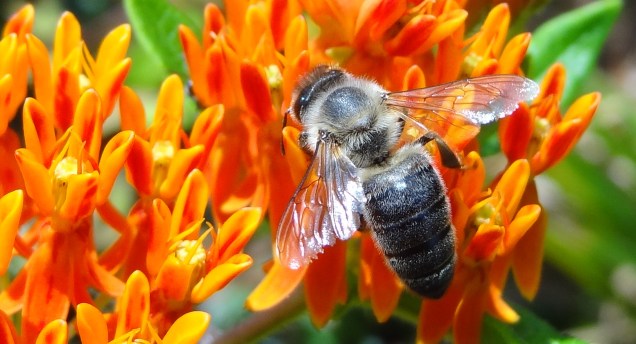
bee on orange milkweed flowers
Photo: M. LaBar (CC).

Will I help the bees if I get honeybees?

Again, the short answer is probably not. As I was saying above, honeybees are non-native to our region, so increasing their populations (for example, by increasing the number of hives) in our region is not likely to positively affect our suffering native species. For example, it has been shown in some studies that honeybees can be pretty competitive in the way they visit plants, displacing native species. Further, and especially if the honeybees are not properly managed (which is, unfortunately, the case for many new unexperienced beekeepers), they can become sick and spread diseases to native bees and other insects, also leading to increasing the pressures on these already-struggling native organisms.

Continue reading →