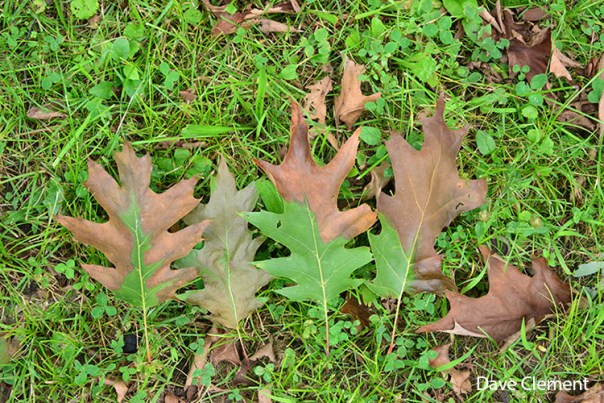
Winter’s leafless landscapes, while beautiful in their own right, can look barren compared to the cacophony of color and activity of late spring/early summer. Once an oak’s leaves have senesced and its acorns have fallen, you’d think that not much is happening way up there in the canopy. But surprisingly there is! Tallamy’s The Nature of Oaks, takes the reader on a month by month journey of how these mighty trees support an abundance of life year round.
In fact, indigenous oaks (genus Quercus) support the highest number of Lepidoptera (butterflies, moths, and skippers) species in the mid-Atlantic region- some 534 different native species (Tallamy & Shropshire, 2009). Lepidoptera in the larva or caterpillar stage, such as the Greater Oak Dagger Moth (Acronicta lobeliae) (Fig. 1), often have a narrow diet breadth feeding on only a single family of plants. The over 500 species of caterpillars that oaks support, in turn, feed birds and other wildlife further up the food chain.

Tallamy’s Nature of Oaks gives numerous examples of insects’ impressive camouflaging, and describes how it helps them go undetected by hungry birds. For instance, the oak specialist American Oak Beauty (Phaeoura quernaria) blends in amazingly well with its host plant during both its larval and adult stages (Figs. 2 & 3). It’s no wonder that we often don’t notice all of the activity on oaks, especially given that much of it takes place at night.


Tallamy also considers what’s going on beneath the canopy. Many oak-dependent species complete their life cycle in either the leaf litter or soil at the base of the tree. Research by our state entomologist and UMD alum Max Ferlauto shows that raking less results in more butterflies, moths, and beneficial arthropods. The harmful effects of leaf removal are widespread, impacting community composition, nutrient cycling, and soil stability (Fig. 4).

Of course oaks support a host of other arthropods and critters- from tiny wasps that form galls on oak leaves and terminal buds to numerous birds and mammals that depend on the trees’ nutrient rich acorns. Tallamy’s Nature of Oaks contains compelling data and entertaining anecdotes that left me awestruck by the beauty and interconnectedness of these mighty trees with all living things. Tallamy suggests if you can only plant one tree, make it an oak.
If you’re feeling inspired to plant an oak in your yard, Tallamy provides guidance on where and how to plant oaks for long term success. For instance, to overcome the concern of tree damage, he suggests planting young trees closer together (vs a specimen tree) so that they’ll be smaller in diameter and their roots will interlock. In Maryland, we’ve 21 native oak species that are commercially available, including two that reach a max height of 20 feet. For photos and details on growth requirements, habitat value, etc. see the new Commercial Maryland Native Plant List.
Where can you purchase native oaks (and other plants)? This month, the MD Department of Agriculture (MDA) launched a certification program for wholesalers, growers, and retailers of native plants. The program will make it easier for consumers to find sellers via a tiered system (novice, pro, and premium). Certified sellers will be listed on MDA, MD DNR, and UME’s web sites (coming soon). The program will also help consumers quickly identify which plants are native to MD via a new ‘Best Maryland Native Plant’ logo that retailers are encouraged to use on plant tags and signage.
If you’ve any questions or comments about growing or using oaks or native plants in general, I’d love to hear from you at lkuder@umd.edu.
Reference:
Tallamy, D. W., & Shropshire, K. J. (2009). Ranking lepidopteran use of native versus introduced plants. Conservation Biology, 23(4), 941-947.
By Lisa Kuder, Native Plants and Landscapes Specialist, University of Maryland Extension. See more posts by Lisa.