Adult Spotted Lanternfly and egg masses. Photo: Kenneth R. Law, USDA APHIS PPQ, Bugwood.org
Spotted Lanternfly (Lycorma delicatula) is a new invasive pest in the mid-Atlantic region. The first Spotted Lanternfly in Maryland was confirmed in Cecil County in October 2018. (See the Maryland Department of Agriculture press release.)
Honeydew and sooty mold from Spotted Lanternfly feeding. Photo: Kenneth R. Law, USDA APHIS PPQ, Bugwood.org
This insect is known to feed on 70 species of plants including forest and agricultural crops such as grapes, hops, apples, peaches, figs, oaks, maples, black walnuts, and tree of heaven. Spotted Lanternflies feed on plant sap and secrete a sticky substance called honeydew. Black sooty mold grows on the honeydew and blocks sunlight from reaching leaves, impairing photosynthesis. Plants may become weakened and more susceptible to secondary invaders such as ambrosia beetles. The long-term effect on the health of trees and vines is unknown at this time. Continue reading →
I thought I was doing the right thing. When I moved into my house 11 years ago, I found a purple barberry shrub (Berberis thunbergii) planted in the backyard by the previous owner. I thought right away, it had to go. I knew Japanese barberries, so commonly planted in landscapes, were escaping (by seed dispersal) into natural woodland areas and creating dense thickets in some areas to the exclusion of native plants. These thickets have been shown to make suitable habitats for Blacklegged Ticks. I didn’t want to contribute to that situation, so I donned my work gloves and set out to remove that prickly beast of a shrub.
In the barberry’s place, I planted a “native” purple-leaf ninebark, Physocarpus opulifolius ‘Diabolo’. It had deep burgundy foliage that made a nice replacement for the burgundy-toned barberry. And, I was selecting a Maryland native plant. I thought it was a perfect choice.
I sang praises about my purple ninebark for years when people asked me for native plant recommendations. It has great spring blooms and beautiful foliage color, and I never had to prune it. And native plants support native insects so I was doing a good thing to help wildlife. I was doing the right thing!
Or so I thought.
It was just this year that I learned from my colleague, native plants specialist Dr. Sara Tangren, that this particular cultivar of the native ninebark was actually detrimental to a specific native insect, the Ninebark Leaf Beetle. My heart just sank when I heard this. I am first and foremost a plant enthusiast, but I also appreciate insects—the essential roles they play in our world as well as their often stunning beauty. And when I looked up the Ninebark Leaf Beetle, I discovered that it is indeed a beauty. And then my heart sunk even further. My purple ‘Diabolo’ ninebark, it turned out, was no good for this native beetle. The alteration in the leaf color – changing the green of the native species to the burgundy of the cultivar – makes it distasteful to the beetle.
Ninebark beetle. Photo: Pennsylvania Department of Conservation and Natural Resources – Forestry, Bugwood.org
The effects of altered leaf color on plant-feeding insects were noted in a new study published in HortTechnology magazine last month. The authors (Baisden et al.) conducted experiments on several native woody plant cultivars compared to the straight natural species. They looked at whether six altered traits in the cultivated varieties – leaf color, variegation, fall color, growth habit, disease resistance, and fruit size – had any effect on insect feeding, development, and abundance.
In all three experiments they conducted, the researchers found that the cultivars with leaves that were altered from green to red, blue, or purple deterred insect feeding. Results were not consistent for the other cultivar traits they tested.
There are a couple of hypotheses as to how leaf color affects insect feeding. Most plant pigments are compounds that do not contribute to the growth of a plant. They may instead provide a defense mechanism. Anthocyanin pigments make a red coloration that may warn insects that the plant has defensive, distasteful chemicals – and they stay away.
The question of whether cultivars of native plants – nativars – have positive or negative effects on native wildlife is an active and ongoing area of research. Results in past studies have been mixed. (For more on this topic, see Mt. Cuba Center research).
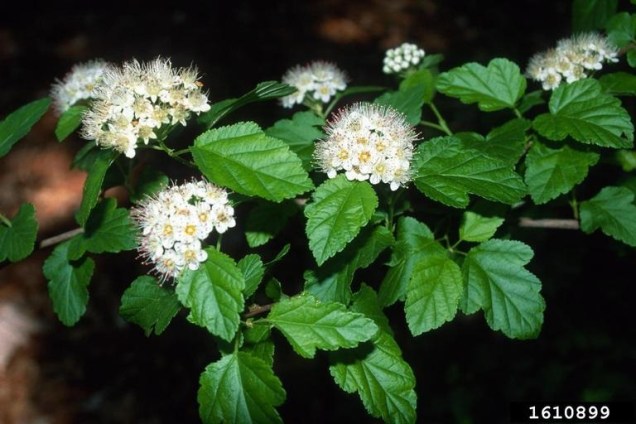
The native species of ninebark, Physocarpus opulifolius, has green foliage. Photo: John Ruter, University of Georgia, Bugwood.org
I know how appealing it is to choose plants with special characteristics – the colored foliage, bigger flowers, the more compact form, or general appearance that suits my personal taste. But my choices may not, in some cases, be to the taste of other things in our environment and the things that depend on them for food. It is a dilemma. I do like specific non-native plants (I’ll never give up my dahlias), but I also adore the lilting songs of chickadees in the springtime. Many birds like Carolina chickadees need caterpillars to feed their young and many caterpillars can only feed on wild, native plants. See New Smithsonian Study Links Declines in Suburban Backyard Birds to Presence of Nonnative Plants. I should note that a different study (Craves) found that native birds, including chickadees, were able to find insect food on non-native, invasive Amur honeysuckles. (Which makes the issue even more confusing, right?)
“When we try to pick out anything by itself, we find it hitched to everything else in the Universe.” – John Muir
For an ecologically-minded gardener, it feels complicated to sort this all out and do the right thing. I felt disappointed that my ‘Diabolo’ ninebark was a missed opportunity to support a particular native insect, but, as Dr. Trangren explained to me, it becomes more of a problem when cultivated nativars cross-pollinate with the wild species and change the genetics of the native populations, making them less capable of supporting insects on a broader scale. For this reason, she recommends choosing cultivars that are sterile, if possible.
It was a lesson learned and one that makes me more thoughtful about my plant choices and their broader impacts.
By Christa K. Carignan, Maryland Certified Professional Horticulturist; Coordinator, University of Maryland Extension Home & Garden Information Center.
Pansies are a good choice for fall and winter color in the garden. If you want to plant pansies you need to do it very soon to assure that their roots get established for winter. As a bonus, pansies often overwinter and provide early spring beauty.
Spring flowering bulbs can still be planted. For best results, place them in a sunny spot in well-drained soil amended with compost. Fertilize the planting area with a balanced fertilizer containing nitrogen, phosphorous, and potassium. Bulbs can be protected from animal pests by surrounding them with a wire mesh like chicken wire. If deer or other wildlife have ravaged your past bulb plantings, try planting bulbs that are rarely damaged by deer, such as allium, narcissus, fritillaria, hyacinth, and scilla.
Vegetables
This is a good time to incorporate organic matter into your garden beds. Composted animal manure (horse, cow, sheep, chicken) is excellent for improving garden soil. Keep garden beds covered with shredded leaves to minimize the risk of soil erosion and nutrient run-off. These can be tilled into the garden in spring or left in place as a mulch between rows of vegetables.
Cover crops should be planted before Oct. 15 but increased soil and air temperatures, due to global warming, may allow early November sowing of winter wheat or winter rye.
Spinach, lettuce, arugula, kale, and other cool-season crops should be protected from freezing with a cold frame, plastic sheeting, or floating row cover. Be sure to vent your cold frame or plastic cover on sunny days to prevent excessive heat build-up.
Insects
You may notice large, brown humpbacked crickets with long antennae that don’t chirp. These are camel or cave crickets (photo on right) and are attracted to damp, dark locations in the home, usually in the basement, the garage, or garden shed. Exclude them as you would other nuisance pests by sealing up openings around foundations, doors, and windows.
Stink bugs, ladybird beetles, boxelder bugs, house flies, elm leaf beetles, and a few other critters may be observed in large numbers congregating inside your home. Cooler fall temperatures are driving them indoors. The ladybird beetles are actually beneficial insects that will not breed or survive for very long indoors. Simply vacuum or sweep up any unwelcome guests. The stinkbugs and the other invaders will do no harm indoors except to be a nuisance. Escort these invaders out of your home or vacuum them up, but resist the impulse to spray an insecticide. You can also prevent pests from coming into the house by caulking openings around window and door frames and not storing firewood inside the house.
The Home & Garden Information Center’s horticulturists are available year-round to answer your plant and pest questions. In addition to gardening questions, we cover houseplants, indoor pests, and more. Send your questions and photos to Ask an Expert!
Sawdust tubes pushed out by ambrosia beetles as they bore into a tree. Photo: E. Nibali
Q: These things like spaghetti pasta were sticking out of our tree that suddenly died. They crumbled when I touched them. Did they attack the tree and kill it?
A: These are sawdust tubes pushed out by ambrosia beetles as they bore into your tree. The tubes are rarely seen this time of year. However, because of abnormal rainfall, some trees are producing ethyl alcohol, a reaction to stress. Alcohol production signals ambrosia beetles to attack. The beetles introduce a fungus into the tree, which clogs up its xylem (the water and nutrient transport system). Since your tree is already dead, it’s hard to say exactly what killed it. Its roots may have rotted or drowned from standing water or saturated, poorly draining soil. The ambrosia beetles may have merely pushed it over the edge. The beetles are not necessarily a death sentence. When numbers are low and a tree is fairly healthy, a tree can recover.
Multicolored Asian lady beetle adult. Photo: Jon Yuschock, Bugwood.org
To keep in the spirit of Halloween, I wanted to talk about a beneficial insect with orange and black coloration. The first to come to mind is the multi-colored Asian lady beetle, Harmonia axyridis. Both the coloration and the timing (now) that they move into homes and other structures have also earned this beetle the name “Halloween beetle”.
The multi-colored Asian lady beetle is the most common lady beetle I observe in managed and natural ornamental environments. The multi-colored Asian lady beetle is native to eastern Asia and was brought to the U.S. in 1916 to control aphids in food crops. At first, they did not establish well. Around 1988, an established population was found in a natural habitat. Since then, they have adapted very well and are now found throughout the U.S.
Adults of are highly variable in color and spot pattern. Their body color ranges from a pale orange to bright red, both with and without spots, and if there are spots their number can vary. One diagnostic feature for all multicolored Asian lady beetles is a dark patch in the shape of an “M” just behind the head on the pronotum. The juvenile stages or larvae are mostly black but with two lateral orange stripes on the middle segments of their abdomen. These larvae resemble tiny, short-snouted alligators with long legs. The larvae take a week or two to develop and then transform into pupae. Within a few days, the adults will emerge from the pupal skin and resume their hunt for aphids or other prey items.
Multi-colored Asian lady beetle larvae. Photo: Joseph Berger, Bugwood.org
Multi-colored Asian lady beetle adults are generalist predators that have been reported to consume more than 250 aphids each day and the larvae may eat more than 1,500 during their development. Multi-colored Asian lady beetles also will consume scales, a diversity of beetles and caterpillars. They are also omnivorous and feed on nectar and pollen from plants. They are highly beneficial when it comes to reducing populations of aphids. If you don’t spray your roses (or other aphid infested plants) with pesticides, these predators really can do their job well and suppress a pest population.
Not all good beetles are good all the time. In the fall months, as the weather cools, hundreds to thousands of multi-colored Asian lady beetles begin moving indoors to hunker down for the winter. At this time, multicolored Asian lady beetles are referred to as nuisance pests. In addition to their high numbers in buildings, they also produce a defensive compound that has a bad odor which makes them a little nastier when disturbed indoors. The best method to control multi-colored Asian lady beetle as nuisance pests is to prevent them from getting in the first place. Anything that can seal openings in homes will help in their control.
By Paula Shrewsbury, Ph.D., Associate Professor and Extension Specialist, University of Maryland, Department of Entomology. This article was published originally in the University of Maryland TPM/IPM Weekly Report, October 5, 2018.
Photo: Beth Bukoski, University of Maryland Extension
Q: I found these orange bugs all over the milkweed I planted for Monarch caterpillars. What are they and what, if anything, should I do about them? I don’t want to harm other organisms.
A: What you have here are nymphs (juvenile stages) of Large Milkweed Bugs (Oncopeltusfasciatus). At this time of year, it is common to see these insects on different species of milkweeds throughout Maryland. The gray and black “insects” in your photo are actually cast skins of the young nymphs. Large Milkweed Bugs go through five instars (phases as nymphs) and shed their exoskeleton at each phase until they become fully developed adults. Continue reading →
Black-eyed Susans are easy to grow and will attract many pollinators to your garden. The dark center or eye of the flower head holds 250 to 500 individual flowers, and to pollinators, each one of these is a shallow nectar cup. These are shallow enough that even small wasps and flies can drink from them, and many small wasps and flies are predators or parasitoids of pest insects. These tiny, dark flowers bloom from the outer rim of the eye and progress inwards with time. It’s a buffet that attracts a wide variety of small to medium-sized pollinators, including many species of insects beneficial for pest control. This blog provides a few examples of the wonderful insects you can attract to the home garden by planting Black-eyed Susans.
A Black-eyed Susan isn’t a single flower, it’s actually hundreds. Notice the individual corollas of the “eye”, and the yellow pollen along the outer ring which indicates those flowers are in bloom. Watch a pollinator visit, and you’ll notice that they rotate around, drinking nectar from each one of the tiny blooms in this ring. The Metallic Green Bee, shown here, is a good example of the small bees that enjoy Black-eyed Susan’s big, soft, landing pad and shallow flowers. Notice the pollen packed onto the bee’s hind legs. Continue reading →


 Pansies are a good choice for fall and winter color in the garden. If you want to plant pansies you need to do it very soon to assure that their roots get established for winter. As a bonus, pansies often overwinter and provide early spring beauty.
 This is a good time to incorporate organic matter into your garden beds. Composted animal manure (horse, cow, sheep, chicken) is excellent for improving garden soil. Keep garden beds covered with shredded leaves to minimize the risk of soil erosion and nutrient run-off. These can be tilled into the garden in spring or left in place as a mulch between rows of vegetables.


