Butterflies in Maryland: Swallowtails and Checkerspots

In seasonal regions such as Maryland, nature goes through cycles, with some seasons reserved for growing and reproducing, and others for resting and waiting for conditions to get better. One of the groups of organisms that in my opinion represent clearly those changes in seasons are butterflies, which go through extreme modifications in their bodies and ecologies to closely match the changing seasons. Today’s post is going to explore two beautiful butterfly species that we can find right here in Maryland: the common Black Swallowtail and the beautiful but imperiled Baltimore Checkerspot.

First Things First: The Life Cycle of Butterflies

life cycle of butterflies
The life cycle of butterflies is fascinating and complex, and in our region is usually tightly linked with changes in season. Image: Kids Press Magazine


Before going into details about these butterflies, I think it is important to explain how these organisms develop because their life cycles are usually tightly related to our seasons. Caterpillars have indeed pretty special and fascinating life cycles. In these insects, a female lays eggs on the preferred host plant of the species. This way, the first larva (a tiny caterpillar) that emerges from that egg will not need to move far to feed on its favorite and most nutritious plant.

Once larvae hatch they start feeding on plant material, becoming bigger as they eat. Because insects such as butterflies are covered with a special hard ‘skin’ called an exoskeleton (this is really an external skeleton!) that gives them support and structure, every time the caterpillar gets too big, the exoskeleton becomes too tight (imagine a kid outgrowing a T-shirt). At that point, the caterpillar breaks the old exoskeleton and grows a new larger one in which it can fit.

While going through these ‘changes of skeleton’ (called molts), the caterpillar is able to grow until it is large enough to make their last change: pupation. At this stage, the very large caterpillar is ready to become an adult. For this, the caterpillar will molt a last time and become a pupa, which is the form that builds the cocoon in which the last body changes happen before the adult butterfly emerges.

As one can see, because the life cycle of butterflies has so many stages, there are many chances for things to go wrong during their development, which can also explain some annual fluctuations in butterfly populations. For example, if a wave of particularly cold or hot weather happened during one of the stages at which the caterpillars are sensitive (e.g., pupa, first instars), we may not see many butterflies later in the season. The same is true if there are important disease outbreaks, if predation was particularly high earlier in the season, if the host plants were not as abundant as other years, or if insecticides were applied close to some of the preferred host plants.

Now that we have a better idea of how the life cycle goes, let’s take a look at what our two species do and how they differ in their food preferences, life cycles, and how that affects how we can promote their presence in our surroundings.

Black Swallowtails

Even though it may seem obvious to some, let me start by saying that this species gets its name from the shape of its hind wings, which look like the pointy tails of swallows. Black Swallowtails (Papilio polyxenes) are common butterflies in our region and are present across the whole eastern USA.

In Maryland, this species has between two and three generations per year, with the first generation(s) of a season reaching adulthood within the season, and the last one spending the winter in pupal phase and emerging as an adult the following spring. (Check this other blog to learn more about butterflies in the winter: Where are all the pollinators?)

Like all butterflies, Black Swallowtails are specialized on what they feed. What defines what makes a plant yummy or not to the caterpillars are the chemical compounds the plant carries. In fact, plants have evolved to produce different chemical compounds that protect them against the multitude of herbivores that exist. Black Swallowtails in particular have evolved to tolerate the chemical compounds present in plants of the parsley family (Apiaceae). It is for this reason that these caterpillars can be found in your garden feeding on carrot, parsley, or dill leaves. Adults (butterflies) are usually seen collecting nectar from flowers such as clover, milkweed, and thistles.

swallowtail butterflies
Black Swallowtails can have several generations per year, feeding on plants of the carrot family, and finally emerging as beautiful adults either in the same or the following season. Photos: eggs (wikiCommons), larva (PINKE), pupa (Woodleywonderworld), adult (J. Flanery).

Black Swallowtails are currently considered to be a species that is not particularly at extinction risk. However, to maintain their populations it is recommended that open grasslands with plants that serve as caterpillar hosts are present. Interestingly, because they are so common in our area, they can be easily reared indoors, something that is really fun and can be a great summer project for kids (and adults!).

Baltimore Checkerspot

If Maryland has a state dessert, I feel it’s only fair that it also has a state insect! The Maryland state insect is the exquisite Baltimore Checkerspot (Euphydryas phaeton), which was chosen because its colors remind us of those of the Maryland flag. In our area, Baltimore Checkerspots are not as common as Black Swallowtails, and, unlike Swallowtails, have only one generation per year.

Their diets are also significantly more specialized than those of the Swallowtails: young caterpillars feed exclusively on white turtlehead, on which their eggs are laid. While later on in their development they are able to feed at least partially on alternative plants, white turtleheads are required for them to survive the early caterpillar stages.

Finally, unlike most butterflies in our region which spend the winter as pupae, this species spends its winter as a caterpillar and pupates only in the spring. The caterpillars of this species are super cute and they always remind me of the Dust Bunnies of the movie “My friend Totoro”. Adults of this species feed on milkweeds, dogbanes, and wild blackberries.

checkerspot butterfly caterpillars
Baltimore Checkerspots go through different developmental stages, hatching on their preferred host, and feeding on them as caterpillars, before entering pupal phase and finally emerging as adults. Photos: eggs (NABA.org), larva (wikiCommons), pupa (4.bp.blogspot.com), adult (S. Snyder).

Unfortunately, even though these beauties are our state insect, they are currently imperiled in our area. The reasons for this have to do with changes in land use, which led to less white turtleheads being available to the caterpillars both because less natural habitats are present and because the deer populations are so large that they eat most of the host plants!

If you would like to try to contribute to these butterflies’ populations, you can plant white turtleheads in your yard, but in particular support conservation actions already happening in Maryland, such as the Baltimore Checkerspot Recovery Team.  

By Anahí Espíndola, Assistant Professor, Department of Entomology, University of Maryland, College Park. See more posts by Anahí.

Hidden Garden Party: Who’s Eating Whom?

aphids on cantelope leaf
Heavy aphid infestation on the underside of a cantaloupe leaf. Photo: Ashley Bodkins

Who loves a party? I know I do, especially a summer BBQ with all the family favorites! Insects are no exception and really know how to have some fun. Pictured above is a party of aphids, which are tiny little suckers — literally. They are soft-bodied insects that suck plant sap with their piercing, sucking mouthparts.

aphid damage leaf curling
Twisted, deformed leaves are a symptom of aphid feeding damage. Photo: Ashley Bodkins

Aphids can come in many colors ranging from shades of green to black. They suck the juice right from plant tissues, resulting in bent and twisted leaves, as seen in the picture above. Aphids are often found on the underside of leaves and can be in very large numbers. Once a colony is established, females can even reproduce without a male.

They secrete a sweet, sugary waste liquid that is called “honeydew.” Sometimes a fungus grows on the honeydew, which is called sooty mold, and looks like someone smeared coal soot on the plant.

Seeing ants on your plants can be your first sign that there is an aphid infestation. Ants love honeydew and often “farm” aphid colonies to reap the benefits.

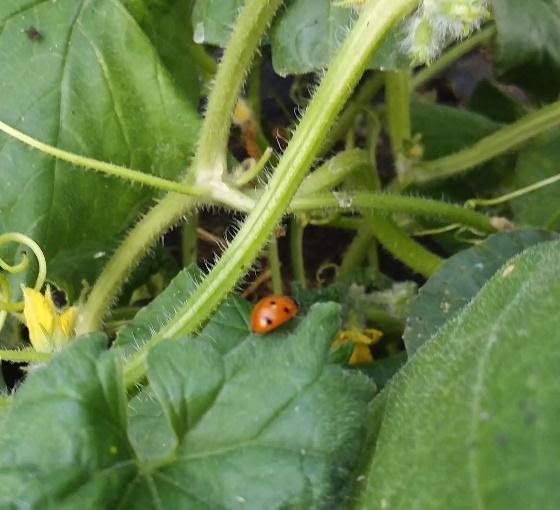
ladybird beetle
The ladybird beetle is a natural enemy of aphids. Photo: Ashley Bodkins

Aphids can transmit plant virus diseases, but generally, they aren’t found in large enough numbers to warrant chemical control. Mother Nature actually has some really interesting predators for aphids. In fact, the beautiful red-with-black spotted ladybird beetle (ladybug) is an avid aphid hunter and can eat more than 5,000 aphids throughout its four-part life cycle.

lady beetle larva eating an aphid
Ladybird beetle larva eating an aphid. Photo: Lenny Wells, University of Georgia, Bugwood.org

Other natural predators include lacewings, flower fly larvae, and parasitic wasps. Evidence of natural predators include “aphid mummies” which are light brown, hollow aphid bodies that were once inhabited by parasitic wasp larvae.

aphid mummies
Mummies of oleander aphids parasitized by Aphidius sp. wasp. Note the hole in the aphid at the top right of the photo indicating a wasp has emerged. Photo: David Cappaert, Bugwood.org
syrphid larva
Flower fly larva feeding on an oleander aphid. Photo: David Cappaert, Bugwood.org

Physical control of aphids can be accomplished by spraying the pests with a strong stream of water. This causes them to fall off the plant and hopefully disrupt their feeding. As a last resort, use chemical controls such as insecticidal soap.

By Ashley Bodkins, Senior Agent Associate and Master Gardener Coordinator, Garrett County, Maryland, edited by Christa Carignan, Coordinator, Home & Garden Information Center, University of Maryland Extension. See more posts by Ashley and Christa.

What should I plant to help pollinators?

bee on penstemon flowers
Bumblebees often can be seen feeding at the flowers of foxglove beardtongue (Penstemon digitalis), which blooms from late May through June. Photo: C. Carignan

We all want to protect pollinators and it seems that the best way to do that is to have a lot of flowers so they can feed on them. But if you’ve ever checked a seed catalog or visited a plant nursery, you may be overwhelmed by all the options. How do you choose what to plant? In today’s post we will chat a bit about the why’s of these choices and we’ll share some resources that may be useful next time you’re trying to make those decisions.

Each pollinator species is unique

As all species in the world, each pollinator species has unique reproductive, nutritional, and habitat requirements to survive. For example, a bee that nests in the early spring needs food and habitat that will be different from those of another bee that nests in the summer, or of a butterfly that emerges from its metamorphosis in late spring. For an early-spring bee it will be key that flowers are available early in the season. Those will be of no help to a summer bee. Likewise, a late spring butterfly will be able to enjoy the nectar from flowers that were not available to the early-spring bee.

Along with the timing of emergence, each pollinator is unique in its anatomy and sensorial abilities. For example, long-tongued bees can reach the nectar of flowers that may be too deep for short-tongued bees. Similarly, because of their extremely long mouth parts, hummingbirds and butterflies usually can access very tubular flowers that are just out of reach for other pollinators.

It’s not only the shape of the mouth parts of the pollinators that will play a role in what flowers they can feed on. Their general body shape and physical abilities will also define this. For instance, butterflies can’t regulate their flight as well as hoverflies or bees do, and because of this, when they visit flowers they need to have large surfaces on which to land, while bees and hoverflies may not really need them.

swallowtail butterfly on butterfly weed
Swallowtail butterfly on butterfly weed (Asclepias tuberosa). Photo: UME Home and Garden Information Center

Finally, different pollinators have different sensorial abilities, with some being able to see some parts of the light spectrum that others may not. On this, butterflies and hummingbirds can see many different colors including UV light, bats that pollinate are blind, and bees have a broad spectrum of light vision but can’t differentiate many of the colors we can.

So now you may be asking yourself why I am talking about all of this. How does this relate to the topic of this post: how to help pollinators with flowers? Bear with me, I’m getting there!

How should I choose what to plant to help pollinators?

As you may be guessing by now, because each pollinator has slightly different life requirements, if you want to help as many pollinators as possible, your best shot is trying to diversify your garden or flower bed. I like to think of this as if I were holding a dinner party at my house and I want to have as many of my friends enjoy the food.

If I know that some of my friends are vegan, lactose intolerant, or allergic to nuts, I will make sure that they find something to eat at my table. If I don’t have anything for them, they will be hungry and sad, and they will also probably decline any future dinner invitations from me (how sad is that!?). So, I like to think about these pollinator plantings as a party I am hosting for a whole season, and where I will make sure that all my little friends always have something to eat so they come back next time I invite them over!

pollinator garden
A diverse flower garden includes flowers of many different colors and shapes and will have different plants in flower throughout the season. Photo: Carol Norquist

The key to attract the most pollinators is diversifying our gardens! Ideally, the choice of plants should include different flower colors, shapes, and sizes available throughout the season. This means that there will be always several different types of flowers blooming at the same time, even though no one plant may be flowering throughout the season. Along with this, if one is trying to attract specific pollinators that have very specific food requirements (for example, oil-bees, monarchs), one would also have to make sure that the pollinators’ required food is also present (take a look at this recent post to learn more: Why do pollinators visit flowers?)

Another aspect to consider when deciding what to plant is the fact that native pollinators usually get appropriate nutrition at the right time of their life cycle if they feed on plant species that are also native to the area. For this reason, if one wants to help pollinators, native plant species are usually recommended, and in particular, avoiding invasive exotic species is key. In fact, invasive species, in addition to not providing ideal food for native pollinators may also displace native plant species, reducing even more the diversity of your flower bed and the pollinators who will visit it. Finally, this also means that a “good” flower mix for pollinators from Europe is probably not going to be ideal for Maryland pollinators.

perennial flower garden
This perennial flower garden includes a variety of species that bloom at different times throughout the growing season. Photo: C. Carignan


But then, what should I do?

There are so many things to think about! This is truly a brain twister, right? Luckily for you (and me) many biologists, ecologists, and conservation specialists have been thinking about this for a while. Today, floral mixes have been created that are appropriate to different regions of the United States. In the state of Maryland, the Department of Natural Resources has created a neat list of species you can plant depending on the conditions on your land. The Xerces Society has also put together a list for plants appropriate for different states. Alternatively, if you would like to just favor specific pollinators, you can target their preferred plants. For finding seeds and starts for these plants, take a look at this great resource the Maryland Native Plant Society has put together!

By Anahí Espíndola, Assistant Professor, Department of Entomology, University of Maryland, College Park. See more posts by Anahí.

Wheel of Munchin’: Assassin Bugs in the Garden

wheel bug
Wheel Bug (Arilus cristatus). Photo: Johnny N. Dell, Bugwood.org

In my college entomology class, I was required to put together an insect collection. At that time, I had no idea how handy that insect collection would be! I use it regularly now to show children in schools cool insect critters and also to share with Master Gardeners! 

Luckily, at the time, I had two younger cousins who absolutely LOVED helping me gather insects. One of the critters they found for my collection was a wheel bug, which is a type of assassin bug. Have you ever seen this awesome predator?  

Just as the name states, it has spikes on its thorax which, to me, resemble dinosaur armor or maybe for the less creative thinker, spokes of a half-wheel. The saliva of the wheel bug contains venom that paralyzes the victim when pumped through the wheel bug’s beak after it silently stalks its prey and sticks the beak into them. The insect world can be a little gruesome! The digested body fluids of the prey are then sucked into the wheel bug’s stomach through another channel in the beak. 

wheel bug with prey
A wheel bug feeding on its prey. Photo: Ward Upham, Kansas State University, Bugwood.org

Wheel bugs are active during both the daytime and nighttime and are often considered shy and hide under leaves, so it is not too surprising to hear that most gardeners have never encountered this amazing insect! 

According to the Maryland Home and Garden Information Center, there are over 160 species of assassin bugs in North America, most of which survive the winter as adults in sheltered locations. All species of assassin bugs (family Reduviidae) are general predators that attack anything that comes across their path. This includes a wide variety of insect pests in our gardens, such as caterpillars, beetles, true bugs (e.g., stink bugs), sawflies, and aphids. Unfortunately, they could feed on beneficial insects such as ladybird beetles, spiders, and honey bees too, if the opportunity presents itself.

Assassin bugs have a distinct “neck” that connects a small head with large eyes and sturdy beak that they use to pierce into their prey. They are considered true bugs, so they have 6 legs, three body parts, four wings, piercing-sucking mouthparts, and go through incomplete metamorphosis. That means the young bugs or nymphs look similar in shape to the adult, but they can be a different color. Sometimes the nymphs are mistaken for spiders because of their long legs. 

wheel bug nymphs
Wheel bug nymphs emerging from eggs. Photo: Johnny N. Dell, Bugwood.org

Assassin bugs are good for our gardens so no control is necessary, although they can bite humans, so care should be taken to avoid picking them up or handling them. Usually they are not found in large numbers, just a few here and there. If you are lucky enough to find one in your yard or garden this year,  take a picture and share it with a friend or family member! Let everyone know how awesome gardening is and how there is always a new “friend” to discover! 

By Ashley Bodkins, Senior Agent Associate and Master Gardener Coordinator, Garrett County, Maryland, edited by Christa Carignan, Coordinator, Home & Garden Information Center, University of Maryland Extension. See more posts by Ashley and Christa.

Carpenter bees are native pollinators

carpenter bee on redbud flowers
Carpenter bee (Xylocopa virginica) on an Eastern redbud tree. Photo: Allen Szalanski, Bugwood.org

A sure sign of spring is the emergence of carpenter bees. Have you seen the perfectly circular small holes that these bees chew into wood? I mean honestly, I have trouble drawing a perfect circle freehand, much less chewing one!  

Adult carpenter bees spend the winter hanging out in their nesting site, just waiting for the first signs of spring when they will emerge, find pollen for food, and mate. Nesting sites/holes are most often seen under the eaves of buildings, particularly on unpainted wood. Every spring, we have carpenter bees infesting the eaves of our barn.    

carpenter bee holes in wood
Holes made by carpenter bees. Photo: Ashley Bodkins

People often confuse carpenter bees for bumble bees, but there are some distinct differences between these two types of bees, including nesting locations. Bumble bees live in a social hive whereas carpenter bees are solitary, and a carpenter bee has an abdomen that is shiny black, not hairy.

Carpenter bees are native pollinators, are not aggressive, and are only noticeable in late spring-early summer. They are mostly found around structures made of wood, or around facia trim, beams, etc. 

Male carpenter bees often cause alarm when they dive-bomb and fly erratically around humans that approach nesting sites, but in actuality, these bees are bluffing as they lack a stinger and are harmless. They can be identified easily by the white spot on the front of their heads.

male carpenter bee
The male carpenter bee has a distinct whitish pattern between the eyes. Photo: David Stephens, Bugwood.org

Only female bees have a stinger, which is a modified egg-laying device (ovipositor). Female carpenter bees are docile and are reported to sting only if handled, but a female carpenter bee can sting more than once.

Carpenter bees do not consume wood, but they do create their nesting sites in wood. They feed on pollen and nectar and are important plant pollinators. Their large size allows them to pollinate some flowers that are unsuitable to smaller bees.

carpenter bee collecting pollen
Carpenter bees are important native pollinators. Note the shiny black abdomen, a characteristic that differentiates them from bumble bees. Photo: Ansel Oommen, Bugwood.org

Female carpenter bees use their strong jaws (mandibles) to chew a perfect circle entrance hole and make a small chamber that will become her home. The entrance is a little less than a half-inch wide, close to the same diameter as her body. These channels that she chews are perpendicular to the grain of the wood. Then they will turn about 90 degrees and excavate along the wood grain for 4 to 6 inches to create a gallery (tunnel). It takes approximately 6 days to bore one inch into the wood.  

Female carpenter bees build several cells within each tunnel and each cell contains one egg and enough food for the larva that will hatch. The food, called bee bread, is a mixture of pollen and plant nectar. She places the food into the tunnel, lays a single egg on it, and builds a partition in the tunnel with cemented wood particles.   Each tunnel contains 6 to 10 cells. 

Control of carpenter bees may be desired if there is significant damage to wooden structures. But be aware, carpenter bees do not cause major damage like termites, and again, they are important native pollinators.

If control is desired, you can apply a registered insecticide into the entrance holes. Then the holes should be sealed thoroughly with wood putty or caulking compound. If possible, filling the entire tunnel system with a sealant can also be effective. All exposed wood surfaces should be painted or varnished and sealed. When managing carpenter bees, it may be helpful to treat and seal entrance holes during the early morning or late evening when bees are less active. Additional management options are offered by West Virginia University Extension.

References and Resources

https://extension.wvu.edu/lawn-gardening-pests/pests/carpenter-bee

https://extension2.missouri.edu/g7424

https://ohioline.osu.edu/factsheet/hyg-2074

By Ashley Bodkins, Senior Agent Associate and Master Gardener Coordinator, Garrett County, Maryland, and Christa K. Carignan, Coordinator, Home and Garden Information Center, University of Maryland Extension. See more posts by Ashley and Christa.

Serpentine Soils Are Anything But Barren: They Support a Unique Grassland Habitat

I have never been to the African grasslands, where lions, zebras, elephants, and wildebeests seem to be in continuous danger. I have, however, been to a Maryland habitat that few people know about, and that, even though lion-, zebra-, elephant- and wildebeest-less, reminded me strongly of those African savannas.

This habitat I am talking about is the Serpentine Grasslands (or Barrens) of the Eastern United States. If you have never heard of them, fear not! Hopefully, by the end of today’s post, you will know a bit more about them and you’ll even try to go visit the few remains that still exist of this beautiful but endangered habitat of our region.

Serpentine Barren Grassland
Fig. 1 – The Serpentine Grasslands of Maryland at Soldiers Delight. Photo: U. Weber.

As you may have guessed from its name, Serpentine Grasslands or Barrens are prairies where the dominant plants are grasses. This is all good, but if they are grasslands, why are they also called Barrens, you may be asking yourself. The answer to that question is what in my opinion makes these habitats so fascinating; something that is also hidden in the other part of their name: “Serpentine”. Indeed, the word Serpentine refers to the type of soil these grasslands are on.

Serpentine soils form on a type of bedrock called serpentinite. This type of rock only exists in places where tectonic plates come into contact, fold, and volcanic activity occurs. This happened in our area about 480 million years ago when the Appalachian Mountains formed. Because of this, there is now an arc of serpentinite present in the Maryland-Pennsylvania area, parallel to the mountains.

Serpentine Soil
Fig. 2 – The Serpentine Grasslands have usually bare soils that have a greenish tint, due to the serpentinite they originate from. Photo: A. Espíndola.

Serpentinites are rich in many metals and other compounds that make the soils that form on top of them relatively toxic and unfriendly to many plants. Because not many plants can grow on these soils, not much soil is retained and the ground ends up being rocky. Because of this characteristic, places with these soils are not very fertile, and, when the Europeans arrived in the area, they started referring to them as ‘barren’, since they were not only infertile, they also had no timber on them. However, even though they were referred to as barrens, many plants do grow on these thin soils, and actually, many of Maryland’s rare flower plants and grasses are adapted to grow in this habitat!

Indeed, the Serpentine Grasslands of Maryland and Pennsylvania are some of the unique places where it is possible to find, for example, the rare moss pink, serpentine aster, or the sandplain gerardia (Fig. 3). It is also home to several endangered and rare species of butterflies and moths such as the Dusted or the Cobweb Skipper (Fig. 4).

Even though the plants and butterflies present in this habitat are relatively well-studied, we still know very little about what other organisms live in the grasslands. To remediate this, in my lab at the University of Maryland in College Park, we are working on trying to understand better what species of insects are present in the area.

Plants of the Serpentine Barron
Fig. 3 – Many rare plants are present in the Serpentine Grasslands of the Eastern US. For example, the moss pink (left; Photo: J. Gallagher) and the sandplain gerardia (right; Photo: A. Espíndola).

For the moment, we are focusing on insect pollinators, and our first works indicate that the plants growing in these grasslands are pollinated not only by bees but also by hoverflies, showing how important these lesser-known pollinators may be to sustaining a very rare habitat of our region. (Take a look here to learn more about hoverflies as pollinators.

The Serpentine Grasslands had not always been rare and endangered. Indeed, serpentine soils extended for quite an area in the Maryland-Pennsylvania region. So, what happened to this habitat that made it so rare today? Ecologists and historians can help us with this.

Like many habitats dominated by grasses, Serpentine Grasslands need fire to sustain themselves. In the absence of fire, pines and red cedars from the surrounding areas start establishing in the grasslands and compete with the grasses and all the rare plants, making the once grassland become an encroached pine forest. When the Europeans first arrived in our region, documents said that there were Serpentine Grasslands that extended for at least 130,000 acres. Today, Serpentine Grasslands occupy about 1.6% of that area.

These grasslands were managed as hunting grounds by several tribes (Susquehannock, Shawnees, Lenape Delaware), who burned them regularly to maintain the grasses and attract large herbivores to hunt. These tribes had complex systems of rights over these lands, which they shared with neighboring tribes as needed. Records show that these extensive grasslands were extremely rich in fauna. There were myriad birds species (mentioned in some records to ‘have darkened the sky’ when migrating!), wolves, bears, cougars, deer, and buffalo roaming these regions!

European colonizers quickly realized that these grasslands were great land for cattle and hunting, and thus started settling and claiming the native tribes’ lands. However, the new inhabitants did not continue the practice of burning, which led to the habitat starting to degrade and finally becoming less appropriate for cattle and cropping.

Eventually, these lands were relegated as ‘useless’ lands and were thus prime land for building or just reinvaded by pines and other trees, which were used for timber. I sometimes try to imagine what these lands — today just 30 minutes away from my house — may have looked like with those large fascinating animals living right here.

Dusted Skipper
Fig. 4 – The Serpentine Barrens are the habitat for several rare moth and butterfly species, such as the Dusted Skipper (Photo: A. Wells).

Today, the Serpentine Barrens are protected and managed with fire in several parts of the state. A large part of these protected lands are not open to the public. However, we are lucky that some places are indeed accessible to the public and can be visited throughout the year.

The largest remnant of Serpentine Grasslands on the Eastern Coast of the US is west of Baltimore, in the Soldiers Delight Natural Environment Area. Another public land where some remains of Serpentine Grasslands are still visible is in Northern Baltimore, at Lake Roland.

I am lucky enough that I can visit and work in these fascinating places. If you have never been to them and would like to see these local jewels, take me up on the invitation and consider hiking some of their trails. The spring and summer are gorgeous on these lands, and who knows, you may be lucky enough to see one of those rare beauties that still live there!

By Anahí Espíndola, Assistant Professor, Department of Entomology, University of Maryland, College Park