I have ordered (and received) my seeds! I may end up with more, at seed swaps and from friends, but I’ve made the basic purchases to fill in needs. For the first time in ages, I didn’t order any tomato seeds–I know, shock, horror–but I still have plenty and I’m going to cut back on the number of tomato plants this year in favor of peppers and other summer crops. Will everything I’m thinking of planting actually fit, either in my community garden plot or in containers at home? Only time will tell.
Anyway, I thought I’d give you all a glimpse into the reasons I chose a few of the plants I plan to grow. Below I will profile Amara Ethiopian Kale, Yellow Cabbage Collards, Dario Cocozelle Zucchini, Zipper Cream Cowpeas, and Nadapeño Peppers. I’ll link to the companies I ordered them from so you can read more, but doing so is not an endorsement by University of Maryland Extension.
Homegrown lettuce in the dead of winter or the heat of late summer? It’s possible with hydroponics. And you don’t need a fancy setup with electric pumps and a water circulation system. The Kratky method lets you do it with a grow light and an empty coffee bin.
Developed by horticulturist Bernard A. Kratky of the University of Hawaii at Manoa, the Kratky method is ridiculously simple. Plant roots need access to oxygen. When grown outdoors, a plant’s roots find this oxygen in air pockets within the ground. In a commercial hydroponic system, pumps circulate air to the plants’ roots. In the Kratky method, an air pocket is formed as the roots take up water, lowering the water level. This air pocket provides all the oxygen a plant needs at the root level.
Our food-growing spaces allow us to grow healthy produce, connect with Nature, and hopefully save money. They are also a solid response to climate change and COVID.
My blog articles this year will be about climate-resilient food gardening. Each month I’ll address one or more aspects of how climate change is affecting our food gardens and changes we can make to reduce global warming and ensure a future of healthy harvests.
HGIC has a new Climate-Resilient Gardening section (thanks to Christa Carignan!) where you’ll find more information on these topics. We plan to continually update content and add new pages. And please check out the University of Maryland Extension’s new Healthy Garden, Healthy You project that connects food gardening and human health.
This first installment includes an overview of how our mid-Atlantic climate is changing and a look at heat-tolerant crops and cultivars. Future articles will explore low-dig soil prep, composting food scraps, peat alternatives, heat stress in plants, reducing plastics, and “hardening” our garden spaces.
Resiliency is mentioned a lot with respect to climate change. A climate-resilient garden can both withstand and recover from warmer, more extreme weather. Resiliency can also mean transforming how we grow food by creating and sharing a community knowledgebase of new ideas and techniques.
It’s seed catalog season! If you’re anything like me, you’re paging through them right now marking possible purchases for the 2022 growing season. (Happy New Year, by the way.) On my first pass, I always mark much more than I can plant in my own gardening space, and now that I’m no longer choosing what to grow in the Derwood Demo Garden, my selections are further limited. I have to make sensible choices, darn it. Nothing too big or aggressive, or that takes too long to produce, or is marginal in our climate, or that I’m not sure I like to eat. Good thing I’ve had all that practice trying and failing.
Now, I would never limit anyone else’s choices, or tell them they won’t succeed at what they’re attempting. I’m usually all for stretching the boundaries. So the spirit of the list below is not to discourage; it’s just to pass on what hasn’t worked for me. Maybe some of these plants have done great for you, or you’re convinced you can get past the challenges. But if your space and time is limited and you have to be realistic, feel free to make use of my what-not-to-grow advice.
Gardeners adding fruit to their landscapes tend to think first of familiar treats such as raspberries, blueberries, and strawberries, which are all great to grow in our region, or fruit trees like apples and peaches, which present some challenges but are possible. But if you’re the typical suburban homeowner, you look at your proposed fruit orchard, and then you look at your yard, and the two don’t match up. Maybe that’s a matter of sheer space available. But often, it’s a matter of sun.
Most fruiting plants really prefer a full-sun location, which is something that those of us with mature trees lack. If your landscape trees are still small–well, someday you’ll get to the point where you have more shade than sun. Trees are wonderful and we should all plant more of them, but then we do end up without much space left for that meadow of sun-loving native perennials, never mind the vegetable garden and the orchard.
But what if I told you that you can plant fruit in the shade?
Most of us plan our gardens each year with abundant annual vegetables to harvest and enjoy. There are, however, several perennial vegetables you may want to consider adding to the mix, some familiar and others, perhaps, less so.
Perennial vegetables have some attractive benefits: they tend to be low maintenance, are generally easy to cultivate, high-yielding, and often more pest and disease resistant than their annual brethren. On the downside, they can be slow to establish and, if they do succumb to disease, will often need to be removed.
One critical consideration in planting perennial vegetables is location. These are perennials and once established some will not be easy to relocate or, as in the case of sunchokes, to eradicate, so site them thoughtfully. And be certain to clear away any perennial weeds before planting.
Following are just a few selections for Maryland, ones I have personal experience growing. The most comprehensive and enlightening reference by far is Eric Toensmeier’s Perennial Vegetables (2007, Chelsea Green Publishing), which offers a fascinating window into the many options available for our area.
Rhubarb (Rheum rhabarbarum)
Yes, rhubarb is a vegetable although we use it more like a fruit, sweetened in pies and sauces. (An annual rhubarb crisp endeared my neighbors to me!) It is the stalks we cut and use as the leaves and even though much of the flower heads are toxic to people and animals.
Root crowns should be sited in full sun with ample space (plant 3 feet apart) as the clumps can grow to be 3-5 feet wide. Rhubarb really prefers cold climates and our Zone 7 is about as far south as it will grow happily. A heavy feeder, it is good to provide extra nutrients with compost annually. Once mature, the attractive large-leafed clumps can be divided for propagation, which should be done every few years to re-energize the plant. Two or three plants will keep you in pies (but try it in savory stews and soups, too). Some growers recommend removing the showy flower stalks once they open. To harvest, twist or cut the stalk at the base and be certain to remove all of the leaves. Rhubarb will die to the ground in winter and in early spring you will see its lovely red buds swelling up from the earth. And you will know it is spring!
Ramps (Allium tricoccum)
Here it is, an easy-to-grow shade-loving vegetable that also happens to be delicious! Often referred to as wild leeks, ramps are native to eastern and central North America. These early spring bulbs have wide leaves compared to most onions, growing to about 10” long. They die back with the coming of summer.
Ramps are found in the wild in moist deciduous forests. They prefer rich, moist soil, much like woodland humus, and form small clumps that can slowly spread to form large colonies. Harvest the whole plant leaving some bulbs for next year, or simply harvest some leaves. The smallish bulbs are like onions or garlic, the leaves like scallions or leeks.
Ramps are being over-harvested in the wild. This is yet another good reason to start your own colony (and move some into that forested land nearby).
Sunchoke (Helianthus tuberosus)
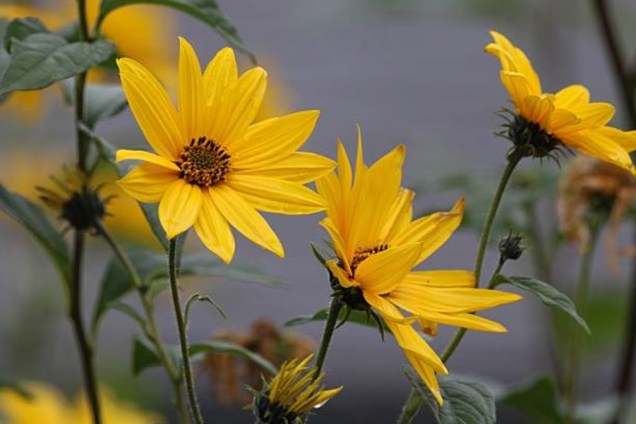
Also known as Jerusalem artichoke (although neither an artichoke or from Jerusalem, go figure). These edible tubers are native to northeastern North America. Sunchokes grow 6-10 feet tall with cheery sunflower-like blooms in full sun or light shade. If sited in a wind prone area they will need support, or you can prune them back by a third to encourage bushier growth.
Sunchokes are very productive. Some varieties have knobby tubers while others are smoother (and easier to clean). They are sweet to the taste and rather nutty when roasted. Anything you can do with potatoes you can probably do with sunchokes. Harvest annually leaving some pieces of tubers with eyes 1-3 feet apart for next year’s crop. The flavor is best after a hard frost. A word about inulin: sunchoke tubers are high in inulin, a type of starch, which is not digestible by humans and can cause gas. Some people do not tolerate it well. Inulin does increase the ability to absorb calcium.
Here is where caution is required! Left to their own devices sunchokes will form large colonies – they are best treated like a mint using containing methods. I grew mine in a large raised bed and they gave me more tubers than I could use and a glorious mass of tall yellow flowers.
Cardoons (Cynara cardunculus)
Found in the wild all along the Mediterranean, cardoons are more popular as a food crop in Southern Europe and North Africa where they are native. They are related to globe artichokes but are grown for the edible stalks rather than the flower heads, which taste like artichokes and are used like celery. Their dramatic spiny silvery foliage and beautiful thistle-like flowers, however, have earned them a place in many gardens. Perhaps as architectural interest in a border? Bonus: Deer won’t touch them.
Cardoons do best in full sun and well-drained soil, although they tolerate some light shade. Start them from seed 6-8 weeks before the last frost and transplant them after the last frost date. The first year they can grow 3-5 feet tall and 3 feet wide, so plan some space. Plants have about a five-year productive life span. They can be divided in spring.
For eating, the stalks are usually blanched (protected from sunlight), to make them more tender and easier to cook, in the fall. This is done by tying the plant into a bundle and wrapping it with cardboard or newspaper to 18 inches then leaving it alone for a month. Hill up the soil around the stems. Cut the stalks off at ground level. Alternatively, you can harvest just some of the fleshy leaf stalks. Clean the leafy bits from the stalk (it will look like a celery stalk), peel away the outer skin, and parboil them before using them in recipes to mitigate any bitterness.
Asparagus (Asparagus officinalis)
Last on this list but probably the most widely known and loved perennial vegetable: asparagus. This edible shoot is a native of Eurasia but has naturalized throughout North America.
Asparagus can live for 15 years and longer, so situate it thoughtfully. (I well remember helping my dad pull out an ancient asparagus bed as a kid. Suffice to say it involved a tractor and chains.) It requires full sun and good drainage. Annual applications of compost or well-rotted manure keep it productive and plentiful water all season will keep it happy. It is easy to grow from seed but generally, year-old rooted crowns are planted in early spring to speed the time to harvest. Plant them 15-18 inches apart in wide beds or rows, with 4-5 feet between rows. All male varieties will not seed (females have berries) and tend to be more productive and disease-resistant. A broad selection of asparagus is available including lovely purple varieties (white spears are blanched).
Spears develop from the underground crowns in early spring. Do not harvest at all in year one and harvest lightly in years two and three. Spears should be snapped off or cut at 6-8 inches. After 8-10 weeks let the spears grow. They will form a lovely, tall, fern-like frond. After frost, the foliage will turn yellow, and at that point, it can be cut down to 2 inches. Asparagus can have a number of pests and diseases. Purchase resistant varieties, keep patches weeded and remove all foliage after frost for best prevention.
These are but a few of the interesting options available to you!
It’s fall, the air is starting to get crisp, you are walking and you see these strange trees. You are sure that they are trees, yet they have these fruits that look like tomatoes… but they are on a tree. What are those fruits? They look so attractive with that wonderful orange… should you harvest them? Should you eat them? Are they any good? What IS this? In today’s post, I want to (re)introduce you to these plants and their fruits, and hopefully the next time you see them you will have answers to all those questions and will know what to do. 😉
In the fall, persimmon trees are recognized for their many orange fruits that look like tomatoes! Photo: P. Tain.
What are these orange fruits?
These fruits are what here in the USA we call persimmons (from the Powhatan word “pichamin”). Persimmons are the fruits of a group of trees that belong to the same family as ebony, and that can be found on a number of continents, including North America. Among all the persimmon species that exist, a number of them are edible, producing fruits in late fall. In the USA, there are two persimmon species that produce edible fruits, and one of them is native to right here in Maryland: the American persimmon (Diospyros virginiana).
Although the wild American persimmon still grows in our forests and was well-known by native Americans, who used its hardwood, consumed the fruits, and introduced them to the European colonists (see some Native American legends involving persimmons here), the American persimmons we see cultivated in orchards come from selected lines. Indeed, varieties of American persimmons have been selected, and many cultivars of American persimmons can be purchased and grown in gardens and orchards to produce fruit. Besides the American persimmon, there are also other species available for purchase, in particular the Oriental persimmon (D. kaki), which is very well-known in Europe.
The American persimmon tree harbors fruits that turn orange, soft, and tend to fall when they are ripe. Photo: W. Pollard.
Although American and Oriental persimmons are edible both raw and cooked (see here for some recipes), it is important to note that the fruits are very astringent prior to ripening, meaning that they have to be ripe for them to be palatable. The level of ripening is usually shown by the coloration of the fruit (ripe fruits are orange), its softness (ripe fruits become soft to the touch), and their voluntary falling from the tree while not rotten. It is often said that persimmons need to go through a frost in order to ripen. This is in fact not accurate: unripe persimmons will simply rot after a frost; ripe persimmons will not rot after a frost and will in fact start slowly drying out, which will make them become sweeter. This may have led people to assume that frosts actually lead to ripening, while the frost will not help in the ripening of any fruit that was not already ripe at the moment of the frost.
Is it true that I need to plant more than one persimmon tree to have fruits?
The short answer is mostly no. American persimmon trees are what we call dioecious plants. This means that each plant will either harbor female flowers (which will become fruits) or male flowers (which will provide pollen for pollination and will not produce fruits). The first consequence of this is that if one plants or encounters a male plant, it will be impossible to ever harvest fruits from it. The second consequence of this is that a female persimmon flower needs to receive pollen from a male plant in order to produce seeds (and reproduce). In most wild forms of American persimmons, pollination is also required for fruit production.
American persimmon trees display small and delicate white flowers, which are either female or male. Photo: M. Beziat.
That being said, female plants of most selected cultivars of American persimmons can actually produce fruit without pollination. If they do not receive any pollen, these female flowers will still develop into fruits, which will not harbor any seeds and which will be fully edible. If one were to plant these cultivars in their garden or orchard, fruit production would not be restricted by female flower pollination.
But does that mean persimmons do not need pollinators?
Not really. Wild persimmons still need pollinators to transfer pollen from the male to the female plants. So who are these pollinators? In fact, we know relatively little about wild persimmon pollination. In terms of flowering time, American persimmons flower between May and June, and their flowers are small and white (and cute!). Floral visitors have not been extensively studied, but there is at least one study describing a large variety of wild bees (e.g., sweat bees, bumblebees, leaf cutter bees) visiting their flowers. From this respect, persimmons play a role in sustaining this group of pollinators and will benefit from their pollination services.
Persimmons also support other insects including many lovely moths from our region, such as Luna moths – top – and Regal moths – bottom). Photo: Askalotl, C. McClarren and A. Reagol, M. Clock-Rust.
Although not pollinated by them, persimmons also support other types of insects (and sometimes pollinators): moths! In fact, persimmon leaves are the favorite food of caterpillars of many native moths. In particular, Luna moth and regal moth (besides many others) caterpillars prefer persimmon leaves. It appears then that persimmons do not just feed us with their delicious fruits, but also feed many of these beautiful native moths, allowing for them to maintain their populations in our area!
By Anahí Espíndola, Assistant Professor, Department of Entomology, University of Maryland, College Park. See more posts by Anahí. Anahí also writes an Extension Blog in Spanish! Check it out here, extensionesp.umd.edu, and please share and spread the word to your Spanish-speaking friends and colleagues in Maryland. ¡Bienvenidos a Extensión en Español!