Planning, preparation, timing, and flexibility are becoming more important for food gardeners trying to adapt to climate change. For example, some gardeners are planting more late crops and reaping larger and longer harvests of leafy greens in the fall. But severe cold snaps can punctuate long periods of mild weather and injure plants, so being prepared to cover and protect those crops with a floating row cover is still essential.
Similarly, HGIC receives questions each year from gardeners about protecting figs from cold winter weather. If climate change is giving us milder winters do we still need to protect fig plants over the winter? The answer is yes, for most Maryland gardeners, because severe cold snaps will kill aboveground wood even if the average winter temperature is rising. Bending stems as close to horizontal as possible and covering the plant with a tarp or other insulating material is a time-honored technique:
Two cinder blocks used to weigh down supple one and two year old fig stems. The stems could have been pruned to a more manageable length. Photo credit: Jon Traunfeld
Fig plant is completely surrounded by bags of insulating leaves. Photo credit: Jon Traunfeld
Planting cover crops in late summer/early fall is a great way to improve and protect soils. Some vegetable gardeners had tomato, pepper, cucumber and other crops going strong into October and asked us if they could plant cover crop seed past the recommended end date of October 1st. Mild conditions and sufficiently high soil and air temperatures allowed for successful late planting well into October. But if you don’t carefully monitor the 7-10 forecasts you can end up wasting time and money.
This cover crop was sown on November 3rd in Central MD and included winter rye, crimson clover, and hairy vetch. The temperature cooled considerably from the previous week, dropping to a record low of 25⁰ on Nov. 9th:
A few hairy vetch sprouts are visible but may be killed by freezing temperatures. It’s unlikely that the crimson clover and annual rye seeds will germinate and survive. Photo credit: Jon Traunfeld
The availability of tree leaves in fall gives gardeners some flexibility and another option for soil improvement. Leaves can be spread out over the soil to prevent erosion, improve soil health, and provide a nice mulch for next year’s garden plants. Climate change is forcing us to be better planners and to act quickly when dealing with extreme and unstable weather.
Tree leaves are valuable for soil and plant health. Don’t let them leave the neighborhood! Photo credit: Jon Traunfeld
As Watershed Specialists, we spend a lot of time helping people decide which species of trees might be best for a particular project based on a variety of factors including
sun, soils, and size. Every now and then, people will also see if they can add their favorite tree to the project. Now the number of reasons why people like a particular tree is
probably rivaled by the number of grains of sand on the beach and there’s not enough room in this article to list them all. But this got me to thinking; we spend so much
time talking to other people about trees, I wonder what our favorite ones are? Well, below is the answer to that very question. And after reading this, drop any one of us an email and let us know what your favorite tree is and why.
Paw Paw
Amanda – Paw Paw (Asimina triloba)
As an eastern North American native species, not only does Paw Paw have a very distinctive flower, it produces one of the largest edible fruits of all our native trees. The main reason this is Amanda’s choice of favorite native tree is that her son loves the fruit! And because of recent interest in Paw Paw fruit, it has earned the nickname Hipster Banana.
Jackie – Red Maple (Acer rubrum)
Red Maples live up to their name: they give us that first shimmer of red in early spring with its flowers and seeds and wraps up the year with fiery red leaves in the fall. Even
though its nickname is Swamp Maple, Jackie appreciates Red Maples not only for their color, she’s actually made syrup from its sap!
Red Maple
Kelsey – Willow Oak (Quercus phellos)
A tree she grew up with in her home state of Michigan, Kelsey’s favorite is the Willow Oak. This fast-growing species produces plenty of acorns which keeps the squirrels busy, it also casts a great shadow on her apartment, something she appreciates during the summer months.
Willow Oak
Jennifer – Tulip Poplar (Liriodendron tulipifera)
Earning its name from a coffee-cup sized flower that people don’t often see since they’re so high up in the tree, the Tulip Poplar is Jen’s favorite. This tall growing tree is important to a number of birds and butterflies. And its cat-shaped leaf reminds her of the two felines that are really in charge of her house.
Tulip Poplar
Eric – Black Gum (Nyssa sylvatica)
My fave is the Black Gum. I grew to appreciate it over time because of the wide variety of conditions it grows in. And when people tell me they love the red color of a Burning Bush, which can invade natural areas, I often suggest that plants like Black Gum not only have a beautiful red color, they produce flowers and fruit that are beneficial to native insects and animals.
Black Gum
By Eric Buehl, Senior Agent Associate, Sea Grant Extension Programs. This article was published originally in the Maryland Sea Grant Headwaters Newsletter, October 2019.
Leaving fallen leaves, plant twigs, and wood in your landscape can help pollinators survive the winter. Photo: Anahí Espíndola
Even though I love the heat of summer, I have to admit that fall makes me happy in a different way. I like the trees that turn into beautiful colors, the crisp air, quiet nights, and the days that slowly become shorter and make me want to drink tea and eat cookies. There is however one thing that makes me a little sad about fall, and it’s that all those beautiful pollinators I love so much are now gone! But are they? Actually, have you ever asked yourself where pollinators go in the fall? Well, thanks for asking — today is your lucky day! In today’s blog post we will talk about what happens to pollinators in the fall, and what we can all do to continue helping them during this quiet time.
When the season reaches an end, pollinators find themselves in a hard spot. They could hopefully collect food (nectar, pollen, etc.) during the spring and summer, but now all the flowers are gone and decisions need to be made if they are to survive until next year. When the season reaches an end, pollinators have basically two options to make sure they or their progeny survive until the next season: migrate for the winter, or stay and protect themselves against the cold.
How to Help Pollinators in the Fall
#1 – Let them go!
Some famous pollinators migrate. You may be familiar with the impressive and beautiful Monarch butterfly migration, which happens every year, and which allows Monarch populations that are far North reach latitudes where the climatic conditions are more benevolent to their survival. Other less famous pollinator migrations are those of hummingbirds, which also migrate to less harsh conditions at the beginning of the fall.
The best thing to do to help migratory pollinators is to help them migrate! This may sound a bit counterintuitive but providing plant resources for migrant pollinators for too long can be a bad idea, because that may make them stay in the region for longer, expose them to parasites for longer, and not reach their final destinations in time.
Let’s take the Monarchs as an example. Monarch caterpillars feed on milkweed, and there are both native and non-native species of milkweed they can develop on (Figure 1).
Figure 1 – Monarchs can develop on many species of milkweed. Non-native milkweed such as the tropical milkweed (Asclepias curassavica; left) can hinder their migration. Favoring native milkweed species (such as the common milkweed; right) is a way to help Monarchs stay safe in the winter.
The native milkweeds naturally start drying out by the end of summer. This changes the chemistry of the plant and “tells” the caterpillars that the end of the season is coming. This is one of the triggers for the caterpillars to start transforming into adult butterflies. Without that trigger from the host plant, the caterpillars continue feeding. This is what happens when they develop on non-native milkweeds that stay green for longer. In fact, caterpillars that develop on those non-native species become adults later in the season, and when they finally emerge, it is too late in the season and they are unable to migrate and make it to the next spring. One of the best ways to protect these migrants is to let them finish their natural cycle and leave in time (I know it’s hard to see them leave!), which in the case of Monarchs requires favoring planting native milkweeds over their non-native counterparts.
#2 – Let them diapause!
Most of the pollinators in our region, however, are adapted to spend the winter right here. Where are they? As I mentioned in another blog post, the vast majority of pollinators in our area are insects. Insects can’t move, fly, or feed if the temperatures are too low. To deal with very low temperatures, insects in temperate regions like ours enter a physiological stage called diapause.
During this stage, the insect physiological rate is reduced and all development is put in a pause until conditions are more favorable. Even though we usually think about these stages when the season comes to an end for us (the fall), it is interesting to note that many of our pollinators reach this stage at the beginning of the summer and they maintain it until the following spring. The practical consequence of this is that if we want to protect pollinators, we don’t just need to provide food for them; we also need to make sure that wherever they decide to spend their diapause is safe from disturbances.
So, how to do this? First, it’s important to realize that each pollinator species enters diapause at different times and places and at different developmental stages (e.g., larva, pupa, adults). Our native bees diapause in nests (solitary or communal), which can be built in different places, depending on the species. The majority of our native bees are ground-nesting bees and they can enter diapause as early as the beginning of the summer and as late as the fall. For nesting, these bees usually prefer loose soils such as those that are sandy or rocky (Figure 2). Making sure that we are not disturbing the ground in places where we see nests will be key for them to survive until the following year. Practically speaking, this means that if you see bees digging holes in the ground of your garden, you may not want to till that part of it.
Figure 2 – The Rufous-Chested Cellophane Bee (Colletes thoracicus) establishes nests in the ground. They can be identified by the mounds left around their entrances. These bees are solitary and non-aggressive, so if you see them nest, don’t disturb that area and rejoice in the bees’ return next spring! Photo by CsabaVadasz.
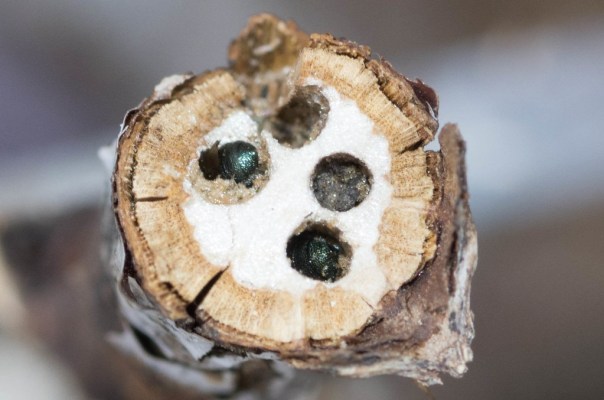
The second most common place for bee nesting is in cavities. These cavities can be plant twigs and branches, cracks in rocks or walls, or even, in some regions of the world, empty snail shells! If you would like to help these bees in your garden or yards, just leave the remains of all your dry plants through the winter. Chances are that some bees have chosen your dry plants as a place to set their nest (Figure 3). These bees also are the ones that like nesting in homemade bee hotels, and it is really fun to see them emerge early in the spring from the little tubes.
Figure 3 – Some bees nest in twigs and branches, like these nimble Ceratina Bees (Ceratina strenua) which have chosen a raspberry branch as a perfect place to raise their progeny. Waiting until the spring to clean your dry raspberry branches is a good way to keep these bees protected throughout the winter. Photo by Terry Miesle.
Other bees prefer to build their nest completely above ground. You may have seen little mud “amphoras” or other structures made of little rocks that hang from walls. If you see these nests close to your house, try to not disturb them and keep an eye on them next spring!
Other pollinators, like moths and butterflies, diapause in leaf litter, on wood, or in the ground. They usually do so by enveloping themselves in dry leaves, by digging themselves in the ground, or by attaching their chrysalis onto sticks and branches (Figure 4). To protect these pollinators, you can leave parts of your yard or garden soil undisturbed, keeping at least some of your dry leaves on the soil.
Figure 4 – Some moths and caterpillars diapause in cocoons, such as this Black Swallowtail (left; photo: Megan McCarty) or this Polyphemus moth (right; photo: Leckie Seabrooke). Note how the moth has enveloped itself in dry leaves.
Finally, some moths and butterflies diapause as adults, hiding in wall cracks or small orifices. In these cases, it can be hard to spot them before it’s too late. To avoid that, you can observe around your garden or yard (and around the house) to try to find them. This way, you will know what places you should not disturb when you are doing yard or garden work.
Adult and 4th Instar Juvenile Spotted Lanternflies. Photo: Richard Gardner, Bugwood.org
Spotted Lanternfly(Lycorma delicatula) arrived in Maryland last year. These invasive insects are being controlled now in 15 sites in Cecil County and several in Harford County. The Maryland Department of Agriculture has expanded its survey sites along the Pennsylvania and Delaware borders to monitor for this pest. They also are surveying in Washington County since Route 81 goes through there. A Spotted Lanternfly infestation was found along Route 81 in Winchester, Virginia.
The map below shows (in blue) where state quarantines for Spotted Lanternfly are in effect in Pennsylvania, New Jersey, Delaware, and Virginia. Permits are required for any commercial or university vehicles doing business in the quarantine zone or passing through quarantine areas. Here is a link to the Pennsylvania permit page. Maryland has reciprocity with Pennsylvania for permits.
This is a potentially very devastating pest that has over 70 host plants including vegetables, garden plants, many trees, and especially invasive Tree of Heaven (Ailanthus altissima) which it may need to feed on to complete its life cycle. Lanternfly adults are very active now and are in the process of laying eggs. Please be vigilant and report any sightings to the Maryland Department of Agriculture at Dontbug.MD@Maryland.gov.
Adult Spotted Lanternflies and an Egg Mass. Photo: Richard Gardner, Bugwood.org
For the latest information, check out Penn State Extension’s website on Spotted Lanternfly. They are the leader in research on this pest and have excellent information, photos, and videos.
By Mary Kay Malinoski, Extension Specialist, University of Maryland Extension, Home & Garden Information Center
On morning runs through the neighborhood I began noticing a unique home garden. It encompassed a large part of the backyard and it seemed like a new bed or structure was always popping up. I wanted a closer look. I had planned to ring the doorbell to meet the gardeners and learn more about this intriguing garden. Instead, I had the good luck to meet Sy Ahmad while he was in his garden and I was jogging by. I made two subsequent visits and left awe-struck each time by the lovely and thoughtful integration of spaces for gardening, cooking, eating, and relaxing.
This captivating garden is always changing and wherever you look there is some interesting feature to capture your eye and fire your imagination. I am amazed that the garden is only four years in the making and that Sy and his family are not seasoned gardeners or builders. They learned much of what they’ve created from web content, especially videos. Sy kindly agreed to this interview to share his family’s experience and inspiring garden!
Looking down from garden entrance. The new, elevated wood containers on the left will be filled next spring with climbing and vining plants. Photo credit: Sy Ahmad
Vertical plants and horizontal planters intersect throughout the garden. Polypropylene netting excludes deer. Photo credit: Sy Ahmad
Q: Why and when did you start your garden? What did you envision?
We started about 4 years ago in 2014, and we always wanted to build something big on our own; our own creation.
Q: Is it a family endeavor?
It actually started as a father and son project then turned into a 3 generation father, son, and grandson project.
Malabar spinach climbs one of the vertical structures that includes a narrow horizontal bed half-way up. Photo credit: Jon Traunfeld, UME
Gathering spot with terraced beds creates a flowing design that best utilizes sloped land. Photo credit: Sy Ahmad
Q: Your garden is visible from a major road and is striking in its size and appearance. What responses have you had from community members?
Some friends actually thought we were building a chicken coop when we started. Our neighbors do admire it and come by often to pick up veggies, but others driving by don’t normally stop by.
Q: What advice do you have for gardeners who are just starting out?
Start small of course, and put up a fence that will keep out deer and last for the long term. Then grow and add on as time goes by.
Plastic cistern collects rainwater from roof for use in garden. Photo credit: Jon Traunfeld, UME
Q: What type of growing media do you fill your raised beds with?
We use a mixture of materials which consist of 1 part compost, 1 part peat moss, and 1 part vermiculite.
Q: Tell us about some of the crops you especially like to grow and think other gardeners should know about.
We grow many herbs, which can be quite useful in the kitchen, such as, mint, cilantro, basil, rosemary, parsley and more. Vegetables such as butternut squash, various types of tomatoes, Swiss chard, and even flowers such as zinnia.
Home-built brick oven fired up for guests. Photo credit: Sy Ahmad
Home-made brick oven pizza with home-grown arugula. Does it get any better than that? Photo credit: Sy Ahmad
Night lights turn the garden into a special evening social space Photo credit: Sy Ahmad
I was reminded on social media this morning of an article published back in June by John Porter on the Garden Professors blog. It’s about which fruits (some of which are vegetables in a culinary sense) continue to ripen after being harvested, and which don’t. Using more scientific words, which are climacteric and which are non-climacteric. There’s a useful list — bookmark it!
Unripe Siberian kiwis in May
I referred to that list this summer to confirm that kiwis are among the fruits that will continue to ripen once picked. I have three Siberian kiwi plants (Actinidia kolomikta), two female and one male, and the females have been producing their tiny little fruits fairly bountifully. The problem with these kiwis, though, is that they don’t all ripen at once, and when they do ripen, the fruits tend to go from hard to soft quickly and then fall off. I’ve taken to checking the relative softness whenever I pass under the arbor during fruiting season, plucking off the ripe ones and popping them into my mouth.
So I thought, hm, what if I pick all the fruits once some have started ripening, and let them finish indoors? And, as indicated by kiwi’s climacteric status, it worked. Sort of. I have to say that the indoor-ripened fruits just weren’t as tasty. They’d be okay for jam, though, so perhaps next year that’s what I’ll do.
So what does this have to do with the tomatoes in the title? Continue reading →