As a newer gardener, I have not previously gotten around to using soil test information. I’ve been planning an ornamental overhaul in a small area of my yard and wanted to soil test to make sure the plants added to the area had the best chance of success. The HGIC website has a lot of soil test information, but I’ve never looked at it closely myself until now. Even though our content is well-written and organized, the subject is intimidating with many choices to make, multiple steps, math homework to figure out how much fertilizer to use in your space, and as I learned, many caveats or roadblocks. I can see plenty of people just giving up and not adding any soil amendments, or just going to the hardware store and buying a bag of fertilizer and applying without thinking too much about it.
Even after reading our material thoroughly, I still needed several questions answered from our experts. I’ve got a handle on it now, for the most part. With this post, I hope to detail how I figured out what fertilizers I needed, how to apply it, and then the most important things I learned that I didn’t feel are made clear.
The goal
I’ve got this space in my backyard that wasn’t being used for much. In the summer of 2020, mid-pandemic, pre-offspring, I decided to revisit a teenage hobby of mine – remote control cars. I took a shovel and cleared out an area and built ramps and hills out of dirt, for my very-own mini-dirt track. 2 years later, my wife asks me “are you going to keep the track? It’s ugly.” So, my task is to beautify it with improved landscaping and added vegetation. We also have a bunch of hostas in our front yard garden that keep getting eaten by deer. Our backyard is smaller and enclosed, so we hope the hostas will avoid attack in their new backyard, trackside location. We are also adding other plants good for shade conditions.
March, before landscaping beganJune, landscaping work pretty much completeJuneJune – landscaping complete. New plants, mulch, grass growing in infield, and this year, I’m allowing the moss to keep growing on the straight.
The location is on a bit of an incline, with the higher elevation area being more sandy and rocky, and the bottom softer and wetter. There is an “infield” of the track that is often stood on that is grass, but has been overtaken with weeds. I am planting nice plants and shrubs around the outside, and re-seeding the infield with grass. Since I know from a lot of digging to make the track that the soil is quite different in different areas, I wanted to soil test so that I could find out what exactly I might need to do to make sure the plants have the soil they need in their different locations.
“Why are the pinecones on my tree moving?” a client asks. “Because those aren’t pinecones, they’re bagworms,” I reply.
Dangling from evergreens like teardrop-shaped Christmas tree ornaments, bagworms cause many a homeowner to scratch their head in wonder. Pinecones that dance?
Bagworms dangle from a juniper branch. Credit: Erik Rebek, Bugwood
But the tell-tale thinning of trees that can follow is no laughing matter. Covered with bits of needles and leaves, the bags that give bagworms their name serve as protection for the caterpillars inside. Bagworm caterpillars are the juvenile form of a moth.
That sounds innocent enough, but like all caterpillar-like insects, they are born hungry. Walking stomachs, they prowl among your trees, munching away to cause sometimes serious defoliation. They particularly enjoy evergreens such as arborvitae, cedars, junipers, and pines. But they will also dine on maples, locusts, lindens, and other deciduous trees.
Eggs hatch out from bagworms’ bags in May. Tiny larvae spin an eighth-inch bag with bits of needles or leaves glued together with webbing. Like tiny backpackers, bagworms tote those bags around as they feed. As they grow, the bags get bigger and bigger and your tree foliage gets thinner and thinner.
I don’t know if bagworms have an adventuresome streak, but they do a bit of hang-gliding. They spin a fine web and use the wind to glide to other trees in a stunt called “ballooning.”
By August or September, the bags – and bagworms – are 1- to 2-inches long. They stop wandering and feeding and tie up to a twig using tough silky threads. In late summer, they transform into moths. But get this, ladies, only the males have wings. So the gals just hang out in their bags and wait for the boys to, um, visit. Post rendezvous, each female bagworm lays 200 to 1,000 eggs in its bag. Next spring, the eggs hatch to start the cycle over again.
Stopping that cycle is important and now is a crucial time. Mid-June to mid-July is the best time to treat trees with bagworms with a very effective organic control called Bt. A naturally occurring soil bacteria, Bt or Bacillus thuringiensis kills only small caterpillars. And guess what? Bagworms are just the right size right now. Bt doesn’t harm humans or animals and is easy to find. It’s sold in hardware stores and garden centers under names like Dipel and Thuricide. Applying Bt is a do-it-yourself job if you can reach your trees with a sprayer. If not, call in a pro.
Even easier is picking off the bags if you have only a few bagworms. Snip them off with scissors or pruners, bag and trash them. Don’t leave them on the ground where the eggs can hatch. Since there can be as many as 1,000 eggs in each bag, removal is important. Get those bags gone. And gone before the eggs hatch in May.
Tiny bagworms are hard to spot when they first appear in May on plants such as this Colorado blue spruce. Credit: Dave Lantz
Learn more about bagworms and see some great photos on the HGIC website.
You can beat bagworms and keep your trees safe. Fortunately, this is one insect for which there is an easy – and organic – fix. So get out there and bag some bagworms.
By Annette Cormany, Principal Agent Associate and Master Gardener Coordinator, Washington County, University of Maryland Extension. This article was previously published by Herald-Mail Media. Read more by Annette.
This article was previously published by Herald-Mail Media.
People often say you have to feed your plants, but in reality plants make their own food through the process of photosynthesis, which yields oxygen and glucose. Glucose is the food that plants use for energy and growth, they don’t need us to actually feed them. Since plants can make their own food, they are called autotrophs. The green pigments in plants, called chlorophyll, capture light energy from the sun. The process isn’t nearly as simple as I’ve described it.
Plants can further be divided into two classifications, C3 or C4, which is determined based on how efficiently the plant can photosynthesize and whether the plant has to go through the process of photorespiration, which is required for C3 plants. This makes C4 plants, like corn, sorghum and sugarcane more drought resistant because of the complex processes that occur within the plant at molecular levels. The majority of plants are C3 plants. For more information on this topic check out the article from University of Illinois, The difference between C3 and C4 plants.
So why do plants need a soil that is sufficient in macronutrients and micronutrients if that is not their food? Well, the short answer is that nutrients help plants grow and keep them healthy so that they can photosynthesize efficiently. As the plant mass increases, the plant leaf size/surface area increases, which allows the plant to capture more sunlight and turn it into more food.
You can check out the Home and Garden Information Center’s webpage about fertilizer to learn more about macronutrients and micronutrients. Macronutrients are those elements that the plant needs the most of to be healthy. Water provides hydrogen and oxygen. Carbon dioxide provides oxygen and carbon which are part of the required macronutrients for all plants. The remaining macronutrients are provided by soil (unless the plant is being grown hydroponically, of course). Plants can only take up or use nutrients that are dissolved in soil water. This is why it is so important to make sure that your soil gets sufficient water. Some plants are called heavy feeders and this is generally in relation to their need for larger amounts of the macronutrients, especially nitrogen. Some examples are tomatoes, everything in the cabbage family, and beets. The University of Maryland provides more information on fertilizing vegetables.
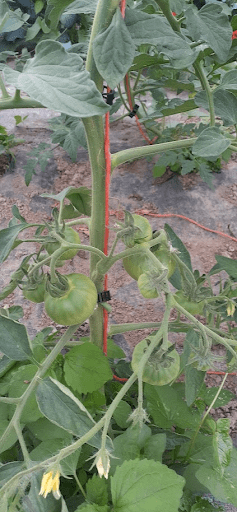
Tomatoes (left) and a colorful cauliflower harvest with nasturtiums (right). Photos: A. Bodkins
By providing an optimum growing environment, through correct amounts of light, moisture, and nutrients, the plant will have the best chance at reaching its full potential. As I eagerly wait for the first produce from my vegetable garden this season, I want to be sure that all my plants reach their full potential and produce a large amount of food for me and my family to enjoy this growing season.
Please comment below with what you are doing this year to ensure that your plants are healthy and happy and growing well. Do you test your soil every 3 years or whenever you are planting a garden in a new area? Do you research the plant needs (full sun, part sun, or shade) before planting? What questions do you have about managing soil fertility and nutrients?
By Ashley Bodkins, Senior Agent Associate and Master Gardener Coordinator, Garrett County, Maryland. Read more posts by Ashley.
This year, the University of Maryland Extension Master Gardener Grow It Eat It Program celebrates the resource that supports all life on earth – soil! Look for soil education programs offered by your local Master Gardener program, and visit the Home & Garden Information Center website for more information about soil health.
It has been a weird spring weather wise, and that weird weather may have stressed some of your plants out. In this months episode we are talking all about abiotic disorder in the garden. Abiotic disorder in plants are caused by non-living factors such as weather, and the enviroment . We will give some examples of what we have seen so far this year, and what you should be looking for in your garden .
We also have our:
Native Plant of the Month (Bottlebrush grass)at 26:45
Bug of the Month (Green Lacewing) at 30:15
Garden Tips of the Month at 36:45
If you have any garden-related questions, please email us at UMEGardenPodcast@gmail.com or look us up on Facebook.
The Garden Thyme Podcast is brought to you by the University of Maryland Extension. Hosts are Mikaela Boley- Senior Agent Associate (Talbot County) for Horticulture, Rachel Rhodes- Senior Agent Associate for Horticulture (Queen Anne’s County), and Emily Zobel-Senior Agent Associate for Agriculture (Dorchester County).
Tender spring lettuce and spinach leaves are just a memory for many Maryland gardeners. As we move into the summer season the types and flavors of garden greens expands significantly. While some, like Swiss chard and kale, can be cut or torn and dropped into fresh salads and dishes, most will benefit from some level of cooking, like sautéing on their own or being added to stovetop or baked dishes. Most of the summer greens below grow quickly and have a long harvest period. They help us improve food security and adapt to climate change.
General growing tips for summer greens:
Water, water, water and fertilize to promote rapid, healthy growth and maintain leaf and stem succulence
No row cover! They can cause a heat build-up. Instead, use insect netting to exclude insect pests
Plant summer greens in containers and move them to shady spots close to your front or back door
Create some shade for lettuces and other marginal crops like cilantro … plant on the north side of taller crops or try 30% to 50% shade cloth material
Most leafy greens below can be treated as cut-and-come-again crops: they put on new growth below each harvesting cut. Older, stressed foliage is less palatable
Explore seed racks and online seed catalogs for heat-tolerant crops and varieties
Leafy amaranth
Two well-adapted species for Maryland gardens are Amaranthus viridis (callaloo, also known as slender amaranth) and Amaranthus tricolor (Chinese spinach; leaves somewhat smaller than A. viridis).
Several species are very popular in Central and South America, India, Southeast Asia, and Africa. Nutritionally, they compare favorably with spinach and Swiss chard. Plants in this family use a special C4 photosynthetic pathway, also present in corn and sugarcane, which allows for vigorous growth under hot, dry growing conditions.
Leafy amaranth is basically a tasty and productive pigweed. Flowering accelerates with shorter days after the summer solstice. Frequent harvesting delays flowering and promotes branching. Immediately remove any flower stalks that emerge to prevent re-seeding.
Callaloo growing in 3-gallon bags in a high tunnel. UME Small Farms Program. Photo credit: Jon TraunfeldCallaloo can quickly become a weed problem. Don’t let plants flower. Each plant can produce >100,000 tiny seeds dispersed by water, wind, tools, and animals. Photo credit: Jon TraunfeldTri-color amaranth. Photo credit: Jon Traunfeld
Other heat-tolerant greens in the Amaranthus family:
Swiss chard and Perpetual Spinach (a.k.a. leaf beet) fall within the beet species- Beta vulgaris- and will produce large amounts of leafy goodness from spring through early fall. Orach (Atriplex hortensis) is another family member that grows best in spring and fall but can tolerate summer heat.
Two varieties of Swiss chard in the UMD Community Learning Garden. Photo credit: Jon Traunfeld
Leafy Brassicas
Several crops in the Brassicaceae plant family tolerate Maryland summers. Collard plants produce reliable and abundant harvests from summer through fall. ‘Morris Heading’ is an heirloom “cabbage-collard” variety found in Baltimore City community gardens throughout the growing season. ‘Green Glaze’ is touted as being heat-tolerant but I am not aware of studies that looked at temperature effects on the productivity of collard varieties.
Collard plant in late July surrounded by common purslane, and edible weed. Photo credit: Jon Traunfeld
Mustard and kale are somewhat less heat-tolerant than collards. ‘Green Wave’ and ‘Red Giant’ mustards and ‘Lacinato’ kale are common varieties grown in summer gardens in Maryland. I’m very curious about Portuguese kale (Couve tronchuda). It resembles collard and is described as sweet and tender and more heat-tolerant than other kales. If you grow it please leave a comment about your experience.
‘Lacinato’ kale (a.k.a Tuscan kale, dinosaur kale, black kale) growing in Baltimore City in late July. Leaves are harvested from the bottom. Photo credit: Jon Traunfeld
Check seed catalogs for mild-flavored leafy Asian greens that hold up well in warm weather like Tokyo Bekana (Brassica rapa var. Chinensis), ‘Komatsuna’ (Brassica rapa var. perviridis), Vitamin Green and Tatsoi (Brassica rapa Napa group), and ‘Chijimisai’ (tatsoi x komatsuna).
Malabar spinach
Basella alba (green stem) and Basella rubra (red stem) below are “summer spinaches” that produces a vigorous leafy vine. Leaves and stems can be sautéed or used to thicken soups and stews.
New Zealand spinach
New Zealand spinach (Tetragonia tetragonoides) below is a low growing annual with a spreading habit that has somewhat fuzzy, arrow shaped leaves, and mild spinach flavor.
Photo credits: Jon Traunfeld
Molokhia (Corchorus olitorius), known as Egyptian spinach and jute leaf, is an important food plant in the Middle East, Africa, and Asia. It’s higher in vitamins and minerals than most other leafy greens. This is the jute plant, known for its strong stem fibers. Young leaves can be eaten fresh, sautéed, or used to thicken soups and stews.
Sweet potato (Ipomoea batatas) – shoot tips, young leaves, and tender stems are excellent in many top-of-the-stove dishes. Harvesting young foliage, even on a regular basis, will not reduce your harvest of sweet potato roots later in the season.
Sweet potato plants with a less typical cut-leaf shape. Photo credit: Jon Traunfeld
Hibiscus as a Leafy Green?
Sunset hibiscus (Abelmoschus manihot) and roselle hibiscus (Hibiscus sabdariffa) leaves have a compelling lemon-sour flavor similar to garden sorrel. These plants are in the Malvaceae family along with cotton and okra, planted throughout the tropics and sub-tropics. Roselle is also grown for its strong fibers and its fleshy calyx which farmers and gardeners use to make tea, juice, and preserves.
Green stem hibiscus plant harvested for its leaves used in many Indian foods. Photo credit: Jon Traunfeld
Don’t Dismiss the Lettuces!
Lettuces are generally a cool-season crop but these varieties have demonstrated some level of heat tolerance:
‘Merlot,’ ‘Speckled Bibb,’ ‘Adriana,’ ‘Jericho,’, ‘Coastal Star,’ ‘New Red Fire,’ ‘Starfighter,’ ‘Tropicana,’ ‘Red Cross,’ ‘Magenta,’ ‘Cherokee,’ ‘Green Star,’ ‘Summer Crisp,’ ‘Little Gem,’ ‘Muir,’ ‘Burgundy,’ ‘Bronze Beauty,’ ‘Forlina,’ and most oakleaf types of leaf lettuce. Asian sword leaf lettuces, (pointed lettuce) have long, thin leaves and are described as crisp and tender with a mild bitterness.
One of the sword lettuces growing mid-summer in a Howard Co. community garden. Photo credit: Jon Traunfeld
An Auburn University study found that ‘Aerostar’, ‘Monte Carlo’, ‘Nevada’, ‘Parris Island’, ‘Rex’, ‘Salvius’, and ‘Sparx’ grown in a “hot greenhouse” out-performed 10 other heat-tolerant lettuce cultivars and received the highest flavor and texture ratings.
Give some of these greens a try this summer. The investment in seed, space, and time is minimal and you may discover some surprising new textures and flavors.
Resources:
Callaloo recipes– Dr.Nadine Burton, Alternative Crops Specialist, UMES Extension
One Spotted and multiple Striped Cucumber Beetles, feeding on overripe pumpkin. Photo: Whitney Cranshaw, Colorado State University, Bugwood.org
Q: Last summer I had cucumbers and zucchini wilting and dying even though I’m pretty certain I didn’t have root rot or squash vine borer. What should I try this year so I can hopefully get a harvest?
A: Bacterial wilt disease, transmitted by cucumber beetles is the prime suspect for crop failure in this instance. Both of these garden pests – Striped Cucumber Beetle and Spotted Cucumber Beetle – are native to North America and can cause serious damage to vegetables in the squash/cucumber family, though they can also feed on unrelated fruits, vegetables, and ornamental plants.
Although their feeding causes direct plant damage, the main issue comes from their introduction of one or more plant pathogens. These beetles can transmit diseases like bacterial wilt and viruses, none of which are curable.
Delaying the planting of squash and cucumber transplants until mid-June may evade the host-seeking adults. Until they bloom, cover plants with insect netting or row cover (the former is ideal as it doesn’t trap heat). Bees will need to reach the flowers for pollination, but once the fruits start to develop, plants tend to be less susceptible to infection. Since more than one beetle generation can occur per year, clean-up veggie garden debris in autumn to deny remaining adults overwintering shelter.
For now, ‘County Fair’ is the only available variety resistant to bacterial wilt. This pickling cucumber is parthenocarpic– it produces mostly female flowers that don’t require pollination to set fruit. The Cucumber Beetles page at the Home & Garden Information Center has more information about these insects and their management.
By Miri Talabac, Horticulturist, University of Maryland Extension Home & Garden Information Center. Miri writes the Garden Q&A for The Baltimore Sun. Read more by Miri.
Besides it being the month when summer starts, June is a great month because it is when Pollinator Week happens! 😊
Tagging along with that week, in today’s post I want to talk about some actions you can take with(in) your community to help pollinators! Because, if we want to help pollinators, a very valid and effective way to amplify your actions is to get others on board! Here, a non-extensive list of ideas.
1. Become a Bee City
Ask your City or Campus to become a certified Bee City or Bee Campus USA. Bee Cities and Campuses are certifications that cities and campuses across the USA can obtain if they implement a series of actions (“commitments”) established by the Xerces Society. Once these actions are done, the City or Campus in question becomes certified as a pollinator-friendly space. The types of actions outlined are really activities that lead to increasing education on pollinators and pollination, to improving pollinator habitat on the institution’s land, to promoting actions in the way that the institution functions that may allow for increasing pollinator support (see here for city commitments and here for campus commitments). Becoming a Bee City or Campus is not hard, and most institutions say yes if their members ask. If you think this is something you would like your City and/or Campus to do, reach out to your representatives or leadership and get them on board! And to have an idea of what cities and campuses are already involved, take a look at the Bee City USA affiliates.
2. Organize a Pollinator Week Event
Pollinator Week is a National event organized by the Pollinator Partnership and includes many possible actions that lead to increasing pollinator survival and/or awareness. This year, Pollinator Week will be happening June 20-26. One can participate in activities already organized by others, or one can propose and host an activity! If you would like to get together with your community and organize an event, do it, and then submit it to the Pollinator Week event list! That way, others will know about it and will participate as well! To submit (or participate in) an event, go to the bottom of the Pollinator Partnership page.
3. Ask your city to host a No-Mow Month in early-spring
Early-spring pollinators emerge usually when very few plants are flowering, meaning that the early spring is a critical time for these pollinators. In human-occupied landscapes like cities or suburban areas, a lot of the landscape is occupied by lawns, which can provide some flowers early in the spring. No-Mow Month (usually April or May, depending on the city’s conditions) is an action that seeks to allow the availability of the early flowers in lawns so that local pollinators can survive during the early spring. Once other plants in the landscape start flowering (usually at the end of April in most of Maryland), the lawn can be mowed with this not negatively affecting pollinators.
It is important to note that this action is based on voluntary participation, meaning that participants opt-in (instead of being mandated to do it). This action has been shown to be effective in increasing pollinator diversity and abundance in regions where it is implemented, and is not associated with excessive lawn growth because it occurs so early in the season. Further, it can be strengthened with native plantings, which can boost its effects and also support local landscapers during the reduced-mow month. Localities where the action has been implemented tend to have high adoption rates, increased nature awareness, and willingness to further support biodiversity around homesteads, with no- to very-reduced vermin occurrence.
This action usually requires some temporal amendments to City Code (e.g., to ensure that participants will not be penalized if their lawns surpass the maximum allowed height during the no-mow month) so it needs approval by City Councils. Although this may sound really complicated, it is not, and several Cities in Maryland have implemented this program very successfully during the month of April (see here for College Park, MD, and here for Greenbelt, MD), following Appleton, WI’s trailblazing action. If you think this is something you would like to implement in your community, get in touch with these cities’ Bee City USA committees so they can share their expertise, and then contact your representatives to ask them to adopt this action where you live!
4. Ask your community to establish pollinator-friendly plants and nesting resources
Communities can also support pollinators through the way they decide to landscape their land. Requesting your community leadership to implement pollinator-friendly gardens and offer nesting resources for pollinators (e.g., bee hotels, create small wild spaces) is a really good way to help pollinators at a larger scale. To do this, you can get in touch with you City/Town Horticulturist and/or Public Works people, and request this. If you would like to implement this in your neighborhood and on private land, you can coordinate with your neighbors and create plots of native plants or small nesting areas in everybody’s green spaces. A very effective way to do this in Maryland is by establishing a neighborhood Green Team. If you would like to know about how to do this, take a look at this page of recommended native plants and this list of native plants that do well in our area.
5. Ask you city/town/neighborhood to adopt an IPM plan
Although we tend to think about helping pollinators only by planting flowers and maybe creating nesting spaces, pollinators also can be helped by the way we manage our landscapes. For example, herbicides and pesticides can be sometimes very harmful to pollinators, or cutting plants at certain times of the year can really negatively affect them. Reducing the use of pesticides and herbicides, or changing the way we manage our own private land is one possibility. However, cities, towns, neighborhoods, schools, and campuses also manage their public lands! For that reason, they can also implement actions to manage spaces in ways that support pollinators.
A very good way to institutionalize this is by requesting these institution to implement Integrated Pest Management (IPM) plans. IPM is a way of controlling pests and increasing “beneficial” organisms in a given space by means that reduce the use of pesticides and herbicides. These plans establish a framework that allows institutions to still control pests and diseases, while reducing the negative impacts on biodiversity that some conventional practices have. These plans can be very general or very specific, and if your institution does not have one, it may be time to ask them to implement one! To do this, get in touch with your institutional horticulturist or your government representative. Here are some examples: city, campus and school district plans.
By Anahí Espíndola, Assistant Professor, Department of Entomology, University of Maryland, College Park. See more posts by Anahí.
Anahí also writes an Extension Blog in Spanish! Check it out here, extensionesp.umd.edu, and please share and spread the word to your Spanish-speaking friends and colleagues in Maryland. ¡Bienvenidos a Extensión en Español!