With the planting season upon us, many of us are starting to think about what flowers may be the best for our gardens and pollinators. We may have started to look into floral mixes or even flower starts, but probably there are too many choices and now we’re overwhelmed and don’t know what to do. In previous posts, we talked about the importance of diverse floral choices and how appropriate native species are when choosing plants for pollinators. There is, however, an extra twist that is becoming more mainstream in this story and today I want to talk about it. Let’s chat about local ecotypes, what they are, what they contribute, and how to get them (and how to not get them).
What are local ecotypes?
In a few words, local ecotypes are native plant species that have a genetic background typical for the local region and adapted to it. I know, there were a lot of technical words in that sentence, so let me break it down to make it easier to understand.
Like all organisms, plants have lineages that reflect their ancestry. In the same way that we as humans are genetically more closely related to members of our own family than to those of other families, plant populations are also more closely related to other plants of the same species that live close to them. From a genetic point of view, this means that plants that come from regions close to each other will tend to have more similar genetic characteristics than those from regions far apart from each other. This genetic makeup specific to a given region is what we call broadly a local genotype.
Helenium autumnale. Photo: Beverly Turner, Jackson Minnesota, Bugwood.org
Helen’s flower is an underdog when it comes to native plants. It is not as well known or as popular as butterfly milkweed, bee balm, or black-eyed Susans — but perhaps it’s time for its day in the sun. It makes a nice addition to a pollinator garden.
Helenium autumnale is the species name of this North American native perennial plant. It goes by the (somewhat unfortunate) name of “common sneezeweed” because dried parts of the plant were formerly used for making snuff to induce sneezing. As an ornamental garden plant, it is not known to prompt sneezes from pollen dispersal (it relies on insects for pollination) and I prefer to address it by its lovelier common name, Helen’s flower… or just plain Helenium.
Wild Helenium autumnale boasts cheerful yellow button-like flowers tended by a skirt of turned-down petals in late summer to fall. Its natural habitat in Maryland includes swamps and moist riverbanks, so in your garden, it will like a location where it has some regular soil moisture. It can grow in full sun or partial shade and stretches in height from 2 to 5 feet tall. The flowers support a variety of pollinators such as bees, wasps, syrphid flies, butterflies, and beetles.
A wide variety of cultivars of Helenium are now available. They range in color from bright canary yellow to orange and crimson and various combinations in between. Many of the cultivars tolerate drier soil and have a more compact habit.
Mt. Cuba Center in Delaware conducted field trials of 44 Helenium species and cultivars from 2017 to 2019. They evaluated plants for their habit, vigor, disease resistance, floral display, and pollinator visits.
Helenium flowers in a garden, “The warm glow of early Autumn” by hehaden, Flickr
Given the high interest in pollinator gardens right now, I was curious about their observations of pollinator visits in particular.
The native Helenium autumnale had the most observed pollinator visits (162), while the cultivar H. ‘Zimbelstern’ came in second (151). Both of these had excellent powdery mildew resistance as well. Other cultivars such as Helenium autumnale ‘Can Can’ and H. ‘Tijuana Brass’ also had excellent ratings for these two characteristics. The best performers in the study overall (considering all the characteristics evaluated) were ‘Kanaria’, ‘Zimbelstern’, and ‘Can Can.’
The native Helenium autumnale had the most observed pollinator visits (162), while the cultivar H. ‘Zimbelstern’ came in second (151).
If you plan to start (or add to) a pollinator garden this spring, do consider adding Helen’s flower if you have a moist site in full sun or partial shade. Mt. Cuba’s report provides good information on plant care, including staking and pruning tips and recommendations for managing the two most common diseases — powdery mildew and aster yellows.
Visit the Home & Garden Information Center website for additional resources on native plants and gardening for pollinators.
By Christa K. Carignan, Coordinator, Digital Horticulture Education, University of Maryland Extension Home & Garden Information Center. Read additional posts by Christa.
I thought I was doing the right thing. When I moved into my house 11 years ago, I found a purple barberry shrub (Berberis thunbergii) planted in the backyard by the previous owner. I thought right away, it had to go. I knew Japanese barberries, so commonly planted in landscapes, were escaping (by seed dispersal) into natural woodland areas and creating dense thickets in some areas to the exclusion of native plants. These thickets have been shown to make suitable habitats for Blacklegged Ticks. I didn’t want to contribute to that situation, so I donned my work gloves and set out to remove that prickly beast of a shrub.
In the barberry’s place, I planted a “native” purple-leaf ninebark, Physocarpus opulifolius ‘Diabolo’. It had deep burgundy foliage that made a nice replacement for the burgundy-toned barberry. And, I was selecting a Maryland native plant. I thought it was a perfect choice.
I sang praises about my purple ninebark for years when people asked me for native plant recommendations. It has great spring blooms and beautiful foliage color, and I never had to prune it. And native plants support native insects so I was doing a good thing to help wildlife. I was doing the right thing!
Or so I thought.
It was just this year that I learned from my colleague, native plants specialist Dr. Sara Tangren, that this particular cultivar of the native ninebark was actually detrimental to a specific native insect, the Ninebark Leaf Beetle. My heart just sank when I heard this. I am first and foremost a plant enthusiast, but I also appreciate insects—the essential roles they play in our world as well as their often stunning beauty. And when I looked up the Ninebark Leaf Beetle, I discovered that it is indeed a beauty. And then my heart sunk even further. My purple ‘Diabolo’ ninebark, it turned out, was no good for this native beetle. The alteration in the leaf color – changing the green of the native species to the burgundy of the cultivar – makes it distasteful to the beetle.
Ninebark beetle. Photo: Pennsylvania Department of Conservation and Natural Resources – Forestry, Bugwood.org
The effects of altered leaf color on plant-feeding insects were noted in a new study published in HortTechnology magazine last month. The authors (Baisden et al.) conducted experiments on several native woody plant cultivars compared to the straight natural species. They looked at whether six altered traits in the cultivated varieties – leaf color, variegation, fall color, growth habit, disease resistance, and fruit size – had any effect on insect feeding, development, and abundance.
In all three experiments they conducted, the researchers found that the cultivars with leaves that were altered from green to red, blue, or purple deterred insect feeding. Results were not consistent for the other cultivar traits they tested.
There are a couple of hypotheses as to how leaf color affects insect feeding. Most plant pigments are compounds that do not contribute to the growth of a plant. They may instead provide a defense mechanism. Anthocyanin pigments make a red coloration that may warn insects that the plant has defensive, distasteful chemicals – and they stay away.
The question of whether cultivars of native plants – nativars – have positive or negative effects on native wildlife is an active and ongoing area of research. Results in past studies have been mixed. (For more on this topic, see Mt. Cuba Center research).
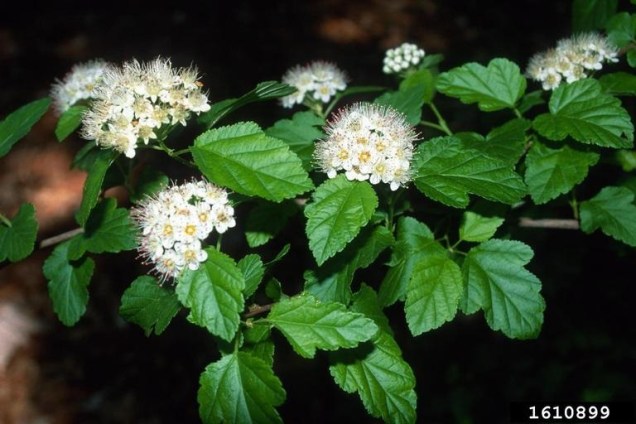
The native species of ninebark, Physocarpus opulifolius, has green foliage. Photo: John Ruter, University of Georgia, Bugwood.org
I know how appealing it is to choose plants with special characteristics – the colored foliage, bigger flowers, the more compact form, or general appearance that suits my personal taste. But my choices may not, in some cases, be to the taste of other things in our environment and the things that depend on them for food. It is a dilemma. I do like specific non-native plants (I’ll never give up my dahlias), but I also adore the lilting songs of chickadees in the springtime. Many birds like Carolina chickadees need caterpillars to feed their young and many caterpillars can only feed on wild, native plants. See New Smithsonian Study Links Declines in Suburban Backyard Birds to Presence of Nonnative Plants. I should note that a different study (Craves) found that native birds, including chickadees, were able to find insect food on non-native, invasive Amur honeysuckles. (Which makes the issue even more confusing, right?)
“When we try to pick out anything by itself, we find it hitched to everything else in the Universe.” – John Muir
For an ecologically-minded gardener, it feels complicated to sort this all out and do the right thing. I felt disappointed that my ‘Diabolo’ ninebark was a missed opportunity to support a particular native insect, but, as Dr. Trangren explained to me, it becomes more of a problem when cultivated nativars cross-pollinate with the wild species and change the genetics of the native populations, making them less capable of supporting insects on a broader scale. For this reason, she recommends choosing cultivars that are sterile, if possible.
It was a lesson learned and one that makes me more thoughtful about my plant choices and their broader impacts.
By Christa K. Carignan, Maryland Certified Professional Horticulturist; Coordinator, University of Maryland Extension Home & Garden Information Center.
Pollinators of all types – insects, birds, and bats – are in decline due to habitat loss, pesticide use, and diseases. Insects – including Maryland’s 400 species of native bees – provide valuable pollination and a food source for wildlife. Insect pollination is essential for the production of about one-third of our food crops. And some pollinators, such as butterflies and hummingbirds, are simply a delight to see!
You can make a difference for pollinators by incorporating these practices in your garden or yard.
Before deciding what plants to buy, determine what you want your overall landscape to do for you. Are you an avid gardener, have an active family, or want a landscape that doesn’t require a lot of maintenance? The answer indicates how you will use or interact in your landscape and that helps guide your plant options.
Included here are some functions that plants can perform in the landscape and the outdoor spaces where you would use them.
There are many tempting plant choices at garden centers. Be sure to research the mature height and width of plants before you make a selection for your landscape.
Many plant problems in the landscape could be avoided by choosing the right plant for the purpose and the site. Many insects and diseases are opportunists, taking advantage of plants that are stressed and aren’t healthy enough to fight back.
Whether your landscape plants are having issues with insects, diseases, lack of blooming, or just overall poor performance, chances are that they were not suited for the location in the first place. Improper planting practices or other non-biological factors can contribute to problems and will be addressed in another blog post.