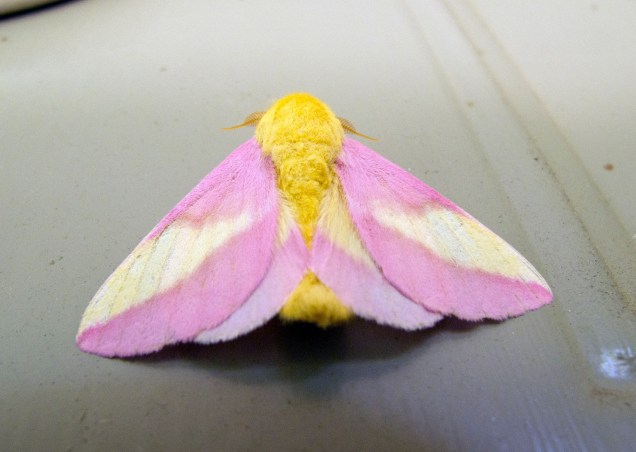
What is mothing, you may ask? Mothing is a form of wildlife observation where you head outside, usually at night, with a light source to attract and observe moths. While it may sound simple, after spending several evenings mothing with family, friends, and colleagues this past week, I was reminded of how joyful and awe-inspiring it can be to slow down and truly notice the natural world around us. A quiet peace comes with tuning into nature at night, and a renewed appreciation for the many species, especially nocturnal ones, that often go unseen in our daily lives.
Pausing for the Small Things: What We Can Find When We Slow Down
If you had told my teenage self I would one day study and teach about insects for a living, I probably would have laughed. Like many people, I did not always see insects as fascinating. As a kid, my parents often took me camping across Maryland, exploring nature trails near our home and hiking through nearby parks. I would spend hours using aquatic nets to find crayfish and dragonfly larvae, snapping photos of ant trails and spider webs, holding cicadas and scarab beetles, and catching butterflies with an insect net.
But as I grew older, that childlike curiosity faded, gradually replaced by fear, likely shaped by the societal norms around me. I learned to scream at spiders in my room and reflexively swat at bees or flies outside. Insects became little more than a nuisance.
Then, passionate educators rekindled that spark during a college course on insect pests of ornamentals and turf. I began to appreciate insects again, this time through the lens of their ecological roles, intricate life cycles, and astonishing morphologies. I will never forget seeing moth and butterfly wings under a microscope for the first time, each scale revealing a world of unexpected beauty and detail. I felt lucky to have access to a lab with microscopes where I could spend many quiet moments observing pinned insects of all kinds under magnification. A part of the course involved creating an insect collection. I found that once you start intentionally looking for different insects around you, you begin to notice them everywhere! These moments and this course brought me full circle, transforming what once seemed hidden and scary into something deeply meaningful and exciting. It was so profound that it set me on a path toward a career in entomology and inspired a personal mission to help others connect with the insect world through positive, safe, and empowering experiences.
Beyond the ecological sciences, I also learned a more personal lesson: sometimes it takes a moment of stillness to notice the tiny wonders that have been there all along. I continue to remind myself of it, especially amid the busyness and chaos of everyday life. I hope you can take a moment today or sometime this weekend to observe a new animal or insect. And if you are feeling curious, take it a step further by using a field guide or online resource to identify what you saw and learn about its biology. You will find that every insect and animal has a story to tell, an evolutionary history, a unique life cycle, complex relationships with plants and animals, and even connections to human culture.

Mothing: Observing Nighttime Activity and Wildlife
Is mothing the new birding? Mothing is a great way to peer into the world of nocturnal insects and animals. After hosting a couple mothing events this past week with friends, family, and colleagues, I discovered you see much more than moths at night, attracted to artificial lights including scarab beetles, weevils, plant hoppers, rove beetles, parasitic wasps, mayflies, stoneflies, lacewings, caddisflies, and more (depending on the time of year and where you are). This can be a great way to attract and observe these animals up close, especially with magnification like hand lenses or magnifying glasses. For people who are hesitant around insects, it can be a great environment to interact with insects at their own pace (with the forewarning that getting close to a light source at night may result in insects flying around you or landing on you, but headnets and backing away from the light can be helpful).
There is something about going outside at night when things appear to have slowed down, and pausing to see these lesser-seen nighttime animals in action. It can be a great way to discover life in your gardens and green spaces, recording your local diversity. Observing what is present or not present can also help inform your gardening, clueing you into what plants you may want to add to support the present life and the native species that may not be present. Of course, mothing or light traps are not a perfect or complete way to know all that is present in your space, but can be a great place to start, especially since we may only be currently observing daytime (diurnal) life in our gardens.
One of my mothing nights this week was in my parents’ fenced backyard with only ~200 square feet of green space, in a suburban neighborhood with lots of light pollution (see photo below). Even in this space, we observed many different moths, beetles, flies, spiders, and even slugs (great food for immature/larval fireflies). This shows you can observe nocturnal insects just about anywhere, on your apartment balcony, on your porch, in your wooded backyard, you name it. Local parks and groups have also been hosting different mothing events. If you want to look for events around you, they may be listed on the National Moth Week website event map.

Tips for Mothing
I am not a mothing aficionado, but below are some general tips based on my experiences. The National Moth Week website also has some great mothing 101 tips and video guides for setting up your own mothing station.
Protect Yourself
Wear long sleeves, long pants, long socks, and tall shoes/boots to protect yourself from mosquitoes, ticks, and other biting insects. This also includes wearing insect repellent like Deet, Picaridin, or lemon eucalyptus (age dependent; be sure to read the product label for application directions and safety precautions). A hat, bandana, or head covering can help keep flying insects from landing on your head or getting caught up in your hair. Sometimes the insect activity can be dense near the light source or sheet, so you could also bring nose plugs, ear plugs, and/or headnets for extra protection. Remember to hydrate and bring water and snacks if you will be out for long periods.
Find or Bring a Light
Depending on where you choose to go mothing, you can bring your portable light or find an existing outdoor light source. Be sure you have permission to moth in the area you choose. You do not need a particular light to attract moths (any bright light will do), but research has shown that moths are preferentially attracted to short-wave radiation. Black Light (UV-A; 315-400nm) is preferred among mothing hobbyists and attracts the most insects. I hung up some Black Light bulbs and strips (9-10W, 385-400nm) that attracted lots of different moths and insects.
Hang up a white or light colored sheet
Hanging a white or light-colored sheet near your light source can act as a landing site for moths and provide an excellent, typically contrasting background for moth photography. A sheet can be draped over a sturdy tree branch, fencing, clothes drying rack, photo studio backdrop frame, and more. Be sure to secure your sheet and frame, especially if it is windy.
Sometimes the Later the Better
Different moth and insect species are out at various times of night. Some species specialize in being out only at twilight (dawn or dusk; known as crepuscular species). You can try mothing at any time of night, but if you wish to see a lot of different nighttime species, typically the later into the night you go out, the better. I went out around 11 pm or midnight the past couple mothing trips (July). Of course, this depends on the time of year and your location but be prepared to see different species and amounts of insects at various times of night. If you can set up your mothing station and periodically check on it throughout the night, that could be a tactic. It all depends on your preferences. Another option is to set up a “moth hotel” (filling a box with egg cartons, placing a funnel over the mouth of the box, and then putting a light on top of that), something you can put out all night and check to see what moth guests you have in the morning. Remember to release your moths before the hotel becomes a buffet for daytime wildlife.
Respect the Space and the Animals
As with any wildlife observation, we want to respect the animals. With moths, their wings are delicate and are covered in powdery scales. As fuzzy as they may seem, you should avoid poking or touching moths, particularly their wings. If you discover any nearby caterpillars, avoid touching them as some have stinging hairs that can be quite painful and sometimes lead to allergic reactions. I have heard a saying: “If it’s fuzzy, no touchy!” We can get close to moths, as it can be fun to spot their coiled “tongue” (proboscis) that will sometimes be unraveled and probe the sheet or surface they are on. Consider bringing extra lights, flashlights, magnifying glasses, and hand lenses for a closer look. There will also likely be many other tiny insects near the light source or on the sheet, particularly small parasitic wasps, beetles, plant hoppers, and more. An excellent time for an up-close look at a tiny world!
If you are in a space that is not your own, remember to clean up after you are done mothing, and respect the other rules the space may have (regarding noise, prohibited areas, prohibited items, etc.). As the saying goes, “leave it [the space] better than you found it.” Remember to turn off any lights you brought so that attracted moths and animals can carry on. One dilemma I have found is getting moths and other insects off the sheet when done observing them, as some will cling on. You can either leave the sheet out until morning, as many insects will typically carry on once your light is off and the sun rises, or you can grab a peer and both take either ends of the sheet, shake off, and encourage insects to fly away. Be mindful of insects that may have found their way between folds in the sheet.
If you have any mothing tips, please let us know in the comments below!

Maryland’s Moths: Identification, Participatory Science, and Colorful Species
Maryland is home to over 2,600 moth species. That is over 17 times the number of butterfly species in Maryland (~150+)! With all this diversity, there are some unique and colorful species to discover while mothing. Moth identification is not always easy, as some identifications require looking at vein patterns in their wings, but luckily, a large community of experts can help. After taking moth photos, you can upload them to a participatory science project or data sharing website like iNaturalist.org. On iNaturalist, artificial intelligence (A.I.) can provide starting identification suggestions, and real people can comment on your photo with their moth identification. I find it fun to see what the iNaturalist A.I. suggests and then dive into my copy of Peterson Field Guide to Moths of Northeastern America to check the identification. Sometimes we can only identify the moth to a broader group (vs. a particular species) based on the features seen in the photo(s). There are many resources online for tips on nighttime moth photography if you want to learn more. I have had some decent results for some basic photos using a flashlight and my cell phone. As long as the photo is not too blurry, your moth photos are valuable data on local moth diversity! For iNaturalist, photos can be uploaded on a computer, through their website, or one of their smartphone apps.
To combat the notion that moths are drab or boring, I have put together some example colorful moth species graphics that can be found in Maryland (grouped by moth family); find these graphics linked here or on our Facebook or Instagram pages. Do you have a favorite moth species?
Supporting Moths and Nocturnal Insects
There are many ways to support our local moths and other beneficial insects, including:
Reducing outdoor chemical use (pesticides, herbicides, fungicides)
Planting a diversity of native plant species appropriate for your region and the planting space (sun, soil, and water conditions)
Prioritizing keystone plant species (plant species that are especially important for supporting wildlife), including native oaks, maples, willows, birches, poplars, pines, and wild cherry trees
Intentionally selecting plant species that support our specialist moths and their caterpillars (can only feed on one or a small group of plant species), such as the native milkweed tussock moth (Euchaetes egle) whose caterpillars only feed on milkweed (Asclepias spp) or dogbane (Apocynum spp.) plants.
Including nighttime blooming flowers in our pollinator gardens, like common evening primrose (Oenothera biennis).
Opting for motion-activated or dimmed outdoor nighttime lights to reduce light pollution that can disorient and negatively impacts moths and other nocturnal animals
Avoiding outdoor bug zappers (electric traps) that have been shown by researchers, Timothy Frick and Douglas Talamy, to not effectively manage biting insects but instead kill many beneficial moths, beetles, and more.
Leave the leaves each fall through late spring as many native moths, butterflies, parasitic wasps and more will spend the winter (in one of their life stages– pupal stage, caterpillar stage, etc.) in leaf litter to survive the harsh climate and emerge the following spring. See this recent research paper to learn more about the impacts of removing leaves in residential yards.
Spreading the word by teaching our peers the importance of moths and other insects and the many sustainable actions we can take to support them and the vital services they provide us (pollination, nutrient cycling, decomposition, natural pest control, and food provision for other animals).

Let’s shine a light on moths this week and beyond, to better support and understand these important animals! Happy Mothing!
By Madeline E. Potter, M.S., Faculty Specialist for Entomology and Integrated Pest Management, University of Maryland Extension