Lawn Alternatives for Shady Yards

Although a non-native example, this New Zealand Hair Sedge (Carex comans) illustrates the soft, flowing look multiple sedge species provide. Photo: M. Talabac

Q: Iโ€™m happy to try a lawn alternative for my shadier areas but Iโ€™d like it to look more like a lawn than a groundcover or mix of flowering plants. What kind of grasses work for that?

A:  Not many true grasses will grow well if you have less than full sun, but several perennials that look like grasses can work nicely. My primary recommendation would be to try one or more species of sedge (Carex). I was excited to see the study results for sedges from Mt. Cuba released recently: โ€œCarex for the Mid-Atlantic Regionโ€ that may be a useful reference.

Mt. Cuba Center is a public garden and research facility in Delaware which displays and studies native plants, and they perform periodic plant trials to evaluate species and cultivars for garden performance. Lately they have been including an assessment of pollinator appeal as well, though in this particular case that wouldnโ€™t apply since sedges are not grown for pollinator draw. (Even though the caterpillars of several of our less-often-seen butterflies feed on sedges.)

Sedges are a species-diverse group and make for an excellent grass-like aesthetic in partial shade to full shade. Many form low soft-looking tuffets, though with time or dense planting can form a more-or-less uniform โ€œlawn.โ€ Still, donโ€™t expose them to much foot traffic since nothing is quite as tolerant to that as turfgrass. Well over one hundred sedges are native in Maryland, and the Mt. Cuba study results include lists of those well-suited to more sun than shade, more shade than sun, and a tolerance to mowing (not that they require it by any means).

A few true native grass species tolerate some shade, but wonโ€™t give you a comparable look to a lawn since they grow much taller or have a different leaf color or texture (often wider, coarser leaves). Examples include river oats (Chasmanthium latifolium) and Eastern bottlebrush grass (Elymus hystrix), which still could make nice accents if you wanted spots with showier seed heads.

The non-native asparagus relative mondo grass (Ophiopogon), which has dark green grassy evergreen leaves and a slowly-spreading growth habit, has been successfully grown as a lawn look-alike under mature trees. I would not recommend using its cousin Liriope, the spreading form of which (Liriope spicata) can be too aggressive and is considered invasive. (Plus, itโ€™s way over-planted.) Mondo grass thus far does not appear to be colonizing natural areas in or near Maryland.

By Miri Talabac, Horticulturist, University of Maryland Extension Home & Garden Information Center. Miri writes the Garden Q&A for The Baltimore Sun and Washington Gardener Magazine. Read more by Miri.

Have a plant or insect question? The University of Maryland Extension has answers! Send your questions and photos toย Ask Extension.ย Our horticulturists are available to answer your questions online, year-round.

Dealing with little stinkers

brown marmorated stink bug

Brown marmorated stink bug, one of the little stinkers that try to get into the house in autumn. Photo: Kristie Graham, USDA ARS, Bugwood.org

Q:  The bugs trying to spend the winter in my home arenโ€™t a hazard, right? Iโ€™m going to try to seal up where they may be getting in, but there are already some that have managed to appear inside that would be hard to track down.

A:  They donโ€™t bite, arenโ€™t attracted to indoor plants (though they might be drawn to grow lights, as they are to any light source), and are generally just a nuisance. If not easy to find, you can let them wander around until they expire, then dispose of them. Live bugs can be vacuumed or caught and released outside to meet their fate. Boxelder bugs, brown marmorated stink bugs, and multicolored Asian lady beetles are the trio of common culprits here in Maryland. Crickets, pillbugs, and millipedes come inside too, but at least they donโ€™t fly.

Our homes must look like giant boulders to them, basking in the waning sunlight and retaining relative warmth, riddled with inviting crevices in which they can wait out the winter. Our abodes might be especially attractive since our groomed landscapes donโ€™t have as many natural tree cavities, fallen logs, brush piles, or layers of leaf litter to tempt them instead.

If anyone is still puzzled by how theyโ€™re getting in, check your door and window weather-stripping for degradation or gaps, look for torn window screening, and inspect vent covers and conduit or pipe entry points on the exterior of the home. Seal any gaps and cracks that you can. If you use a window air conditioner, take it out for the season or plug up any access points around it.

By Miri Talabac, Horticulturist, University of Maryland Extension Home & Garden Information Center. Miri writes the Garden Q&A for The Baltimore Sun and Washington Gardener Magazine. Read more by Miri.

Have a plant or insect question? The University of Maryland Extension has answers! Send your questions and photos to Ask Extension. Our horticulturists are available to answer your questions online, year-round.

Get to know your local mantis

Carolina mantid
Carolina mantis adult female in early autumn. Notice how her wings donโ€™t reach the end of her abdomen, as they would with our other local mantids. Photo: M. Talabac

Q:  Iโ€™ve heard that not all of our praying mantis types are native. Theyโ€™re all good for garden pest control though, right, or are some bad instead?

A:ย  Maryland is currently home to five species of praying mantis, but only one is native, which is the Carolina mantis. The others are the European, Chinese, Narrow-winged, and Asian jumping mantids, with the latter being the most recent introduction. While non-native, the other mantids have more-or-less been integrated into our ecosystem for some time now, so they donโ€™t necessarily need management or removal. Evidence of this includes the fact that insect-eating birds and other predators will readily consume them, and their eggs can also be parasitized by the tiny wasps that presumably evolved to have a relationship with our native mantis. In the grand scheme of things, other invasive species deserve more attention. Plus, at least they also eat various other non-native insect pests.

If you prefer to support native mantids found in your yard, make sure youโ€™ve identified them correctly. Maryland Biodiversity Project has image galleries for each mantis species and provides a few ID tips for telling the difference between them, at least for adults and egg cases (called ootheca). Put โ€œmantidsโ€ in the search box to see the species list.

Comparison of 5 mantis ootheca. The native Carolina mantis has a narrow gray ootheca.
Photo: Pawel Pieluszynski

Mantids are generalist predators, so can consume pest insects and beneficials like pollinators alike. Theyโ€™re opportunists, nabbing anything they can subdue (including each other), so are neither universally good nor bad. Gardeners generally consider them helpers since they do consume pests, though we donโ€™t know to what extent the non-native species may be depriving the native species of a food source due to competition. (Given how many other non-native insects exist in our area, I imagine this impact isnโ€™t that significant, especially when compared to the greater problem of habitat loss and degradation.)

By Miri Talabac, Horticulturist, University of Maryland Extension Home & Garden Information Center. Miri writes the Garden Q&A for The Baltimore Sun and Washington Gardener Magazine. Read more by Miri.

Have a plant or insect question? The University of Maryland Extension has answers! Send your questions and photos to Ask Extension. Our horticulturists are available to answer your questions online, year-round.

Crapemyrtle woes

An infestation of Crapemyrtle Bark Scale on a crapemyrtle trunk. Sooty mold is darkening some of the outer bark layers. Photo: Jim Robbins, Univ. of Ark. CES, Bugwood.org

Q:  My crapemyrtle has white stuff on the bark that Iโ€™ve never noticed before, though the foliage looks unaffected, if a bit dull lately. I thought these plants were pretty pest-free, so what might this be?

A:ย  Weโ€™ve had a lot of inquiries about this lately. Your plant has Crapemyrtle Bark Scale (CMBS), a non-native insect pest that was discovered in Texas in 2004 and confirmed in Maryland in 2020. Incidentally, crapemyrtles also can host Crapemyrtle Aphid, and itโ€™s possible for the two to be infesting a plant simultaneously; their impacts on the plant are similar.

While CMBS could potentially feed on other host plants, so far they seem to strongly prefer crapemyrtle. The aphid sticks to crapemyrtle. Both secrete honeydew, the sugar-water waste common to sap-feeding insects, which is dulling the leaf appearance and probably cultivating a bit of sooty mold.

Since mid-Atlantic gardeners have embraced crapemyrtle to such an extreme that itโ€™s everywhere you look, thatโ€™s a big buffet enabling this pest proliferation. We really need to diversify our landscapes.

Scale insects lead relatively sedentary lives, generally only moving about to any notable degree as newborns, appropriately called crawlers. After roaming to find a feeding site, crawlers settle down and stay put, using their straw-like mouthparts to feed on plant juices. Layers of protective wax, in this case felt-like and white, cover their bodies as they mature. For our purposes, this also means they are harder to treat with contact-type insecticides like oils or soaps because that shell prevents the pesticide from reaching them. Crawlers, running around shell-less for that brief window of time, are the most vulnerable life stage any treatment should focus on.

The problem is, this pest is so new to our area that we are still collecting data on when those crawlers appear. Insect development is dependent on temperature, so while we can make predictions based on how CMBS behaves to our south, weโ€™re still refining our knowledge for Maryland. Complicating matters is the likelihood of several generations per year, and they might overlap.

For such a tiny thing with limited mobility, you may wonder how it got there in the first place. Like plant mites, crawlers can blow around on the wind, and might also disperse by hitching a ride on other animals, like birds. CMBS arrived in our area the way many plant pests do โ€“ accidental introduction on plants with undetected infestations shipped-in from out of the area.

Management of an established scale population, usually booming by the time we notice them, takes time. Donโ€™t expect one or two treatments to resolve the issue quickly, and youโ€™ll probably need to employ the services of a certified pesticide applicator. Manually scrubbing scale off while not wounding bark is difficult and not highly effective, given the nooks and crannies they can wedge themselves into that you cannot reach.

Not only should certified applicators treat trees too high to reach, but they will have more effective equipment and the ability to apply chemicals the general public cannot due to the Maryland pollinator protection law. Overlapping the use of more than one type of pesticide may be needed, and re-treatment might occur for over a year. Dead scale wonโ€™t fall off right away, though treatments for scale will probably suppress aphids at the same time.

While we usually suggest trying other methods to suppress pests, once scale are numerous, there is little recourse than resorting to pesticide treatment. Certain species of lady beetle larvae will consume these scale and could knock-down their numbers somewhat, so avoiding contact-type pesticide use or enthusiastic scale-squishing attempts does at least spare them. Drastically cutting back a large crapemyrtle is not recommended since that can ruin its branching structure, though you could try it with dwarf shrubby varieties since otherwise-healthy plants should regrow over future seasons. With proper application timing to avoid impacts on scale predators and other insects (something well-trained pesticide applicators and pest scouts know how to do), treatments can be done with minimal risk to the biodiversity in your landscape. Orโ€ฆjust plant something different and rely on other plant species to provide summer color.

By Miri Talabac, Horticulturist, University of Maryland Extensionย Home & Garden Information Center. Miri writes the Garden Q&A for The Baltimore Sun.ย Read more byย Miri.

Have a plant or insect question? University of Maryland Extension has answers! Send your questions and photos toย Ask Extension.

Q&A: Why are lilac leaves brown and curling?

Irregular brown spots and blotches appear on lilac leaves, followed by leaf curling and defoliation in late summer. Photo: UME Ask Extension

Q: My lilacs look like death-warmed-over this time of year. Do you know whatโ€™s wrong, and is there anything I can do at this point?

A: Lilacs are sadly not very well-suited to our mid-Atlantic conditions. Weโ€™re at the southern edge of their heat tolerance, so while they werenโ€™t among the best flowering shrub choices to begin with, climate change is only going to worsen their prognosis. Several types of leaf-spotting fungi and bacteria, plus general heat stress (which also increases their vulnerability to borers), results in foliage that looks quite beat-up by late summer. Brown spots, crispy leaf edges, and bare stems from premature leaf drop are all typical. You can explore lilac ailments and their management on our lilac diagnostic page.

No fungicide will reverse these symptoms once they appear, and while they might work as a preventative if applied before bud-break (and re-applied repeatedly well into the summer), itโ€™s simpler to just grow something else if a plant is going to be that much of a hassle. This is especially true if the treatments donโ€™t work and the plant still winds up looking horrible. Fungicides also carry the risk of harming other organisms.

For now, you can rake up and dispose of any fallen leaves, though this isnโ€™t a foolproof way of removing a source of infectious spores. Cut down the oldest, thickest stems this winter (they tend not to bloom well at that age anyway) and open up the canopy by selectively removing some stems that contribute to foliage crowding. You can do this thinning after bloom next spring.

For anyone really wanting to grow lilac despite these challenges, try cultivars with above-average disease resistance and heat tolerance. While not immune to problems, they perform much better, even if they donโ€™t look exactly the same or have blooms as large or heavily perfumed. โ€˜Miss Kimโ€™ is a round, compact-growing cultivar with pale lavender-purple flowers thatโ€™s been around for decades. Other varieties are now available with pink or deeper purple blooms, some of which even rebloom a bit, sporadically producing flowers into summer and early autumn, though high heat could still hamper that.

dwarf lilac with lavender flowers
Dwarf lilac species and hybrids handle Maryland conditions much better than the traditional varieties. Some recent introductions will also re-bloom sporadically later in the summer. Photo: M. Talabac

All lilacs, but especially the traditional, classic โ€œFrenchโ€ types, should be planted in a location with great air circulation (so, not up against a fence or wall) so wet leaves dry quickly after rain, dew, or irrigation. Wet foliage is more easily infected by pathogens.

The main perk of growing lilacs is fragrance, so if you want a scented replacement, consider: Winterhazel (Corylopsis), Koreanspice Viburnum (Viburnum carlesii) and its hybrids, Summersweet (Clethra), Seven-son Flower (Heptacodium), Carolina Allspice (Calycanthus), various deciduous Azaleas (Rhododendron viscosum and several others), Mockorange (Philadelphus), and Fragrant Abelia (Abelia mosanensis). Their scent characteristics, flower colors, mature sizes, and preferred growing conditions may differ from lilac, but nothing is going to be an exact substitute. Plus, several of these species will offer the additional bonus of showy autumn foliage or (for the native ones) better wildlife value. These are just some shrub ideas; there are also fragrant perennials and, if you have the room, several fragrant trees.

By Miri Talabac, Horticulturist, University of Maryland Extension Home & Garden Information Center. Miri writes the Garden Q&A for The Baltimore Sun. Read more posts by Miri.

Have a plant or insect question? University of Maryland Extension has answers! Send your questions and photos to Ask Extension.

Celebrate National Moth Week

A moth feeding on nectar of a purple  verbena flower
Hummingbird Clearwing. Photo: M. Talabac

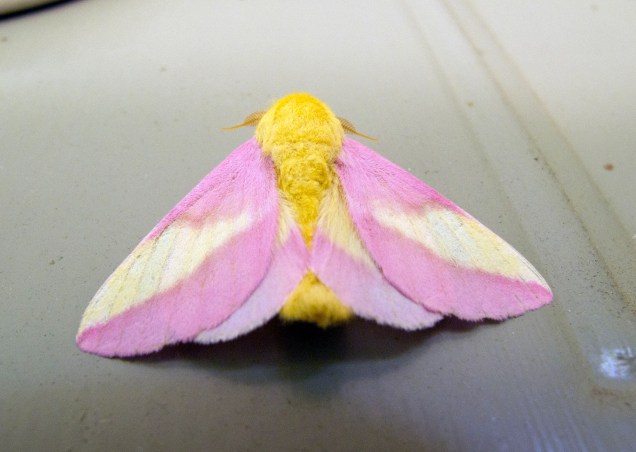
The last full week of July is National Moth Week, and I encourage everyone to take a closer look at the vast diversity of moths that fill our natural world. Butterflies and moths belong to the same insect group, but moths far outnumber butterflies in species diversity. Since many moths have muted colors or fly at night, weโ€™re largely unaware of this bounty. Letโ€™s take a whirlwind appreciation tour of the group to illustrate the amazing, bizarre, and quirky features of this major insect order.

Moth adults come in all shapes and sizes, and like butterflies, wings are their most prominent feature. There are โ€œmicro-mothsโ€ whose wingspans are less than an inch, and giant โ€œsilk mothsโ€ up to 6 inches, making them the largest moths in North America. (Our native silk moths are not closely related to true silk moths, but they got the name because people thought they could be farmed for silk.) The wings of some moths look like mere slivers, seemingly insufficient for flight, while others are tucked around their body so they look fairly cylindrical. Some lay so flat at rest with their wings spread that youโ€™d swear they were two-dimensional.

Continue reading →

Q&A: What is a good summer-blooming plant that’s deer resistant?

Yellow flowers of St. Johnswort plant
St. Johnswort flowers. Photo: M. Talabac

Q:ย  What can I use as a summer-blooming shrub, especially if this part of the garden is sunny and somewhat dry? I also sometimes have deer problems.

A:  I think St. Johnsworts (Hypericum) are underused, and several species are native here in Maryland, though those might be harder to source. Some of the commonly-grown forms are non-native hybrids, though well-behaved ecologically. (The only locally invasive species, Hypericum perforatum, is fortunately not likely to be sold at a nursery.)

St. Johnsworts bloom anywhere between June and September, prefer direct sun, generally tolerate drought well, and are distasteful to deer. Blooms are nearly always an intense yellow, and some species or cultivars have colorful summer or autumn foliage. A few cultivars have berry-like seeds that ripen by fall and make good bouquet accents. I love the bark on native Hypericum densiflorum โ€“ peeling with a smooth underlayer thatโ€™s a rich, warm-toned cinnamon-brown thatโ€™s especially showy during dormancy.

Youโ€™ll find St. Johnsworts sold as both perennials and shrubs, because some species stay low, sprawl like a groundcover, and have stems that arenโ€™t very woody, occasionally dying back in winter as other perennials do. Other species have woody stems and grow to about three or four feet tall and wide. Flowers are loaded with pollen, but no nectar, so butterflies will probably detour while bees and flower flies (predators we like to keep in the garden) will visit. Donโ€™t deadhead developing seed capsules if you want to support Gray Hairstreak butterfly caterpillars, which can use Hypericum as a host plant (among a huge variety of other plants).

For more plant ideas, visit the Home & Garden Information Center’s pages on Plant Selection and Deer-Resistant Native Plants.

By Miri Talabac, Horticulturist, University of Maryland Extensionย Home & Garden Information Center. Miri writes the Garden Q&A for The Baltimore Sun.ย Read more byย Miri.


Questions about home gardening? Send them to Ask Extension