How can you improve your soil?

a sloping landscape partially planted with cover crops
A cover crop of spring seeded oats is included on this slope with grass and trees. Photo: A. Bodkins

Healthy soil can sustain plant growth, prevent environmental damage, mitigate stormwater runoff, and help recharge and clean groundwater. 

Soil type is probably not something that people consider when they move to a new property, so it reminds me of the statement โ€œyou get what you get and you donโ€™t throw a fitโ€. However, it is no secret that soils are not all created equally in their ability to grow plants. To make matters worse, theย soil is constantly being manipulated to accommodate our needs.ย When infrastructure like roads and buildings are constructed soil is moved and in many instances, there may not be any native soil profiles still intact on the property. Often a small layer of topsoil is put back onto the landscape after construction and regrading of the land, but there is no guarantee that it was the topsoil found there before construction began. Once the excavation is completed there is no going back. This article from Penn State Extension, Can Disturbed Soils Grow Healthy Landscape? is a great read.ย If you suspect that the soil you are planting vegetables into has been hauled in from another location, it is wise to get the soil tested for lead content. Some labs also test for heavy metals like arsenic (As), cadmium (Cd), and chromium (Cr), which can be found in soils on old industrial sites.

Soil is the gift that can keep giving, but there are some management practices that can help improve all soils. The physical, chemical and biological processes of soil are all interconnected. If you want to learn more about your own soil, I recommend the Kansas State publication that walks you through the steps to Estimate Soil Texture by Feel. Knowing the soil texture in your garden is one piece of the soil puzzle.

Soil organic matter increases water holding capacity, improves water infiltration, serves as a source of micro and macronutrients, and provides large particles for micro and macroorganisms to break down.  Soils that are high in clay or sand can benefit from the addition of organic matter, which comes from anything that was once alive. Macro and microorganisms help to break down organic matter and release nutrients into the soil. There are many forms of organic matter that include compost, plant material,  livestock waste, humus or leaf litter.  

dark soil is rich in organic matter
A cross-section of healthy soil. Photo: USDA

Cover crops are another way to improve your soil because they capture excess nutrients that are left over from the growing season and prevent the nutrients from becoming environmental pollutants. Cover crops also prevent soil erosion from wind and rain during the late fall, winter, and early spring seasons when weather is not appropriate for most vegetable or agricultural crops. Once cover crops are terminated they can be plowed into the soil and add organic matter. This is called green manure. Iโ€™ve found that in my own garden, cover crops can also help prevent weeds from growing. Some cover crops like forage radishes die and create natural pathways through the soil for water to flow.

buckwheat cover crop planted over a vegetable garden soil
Buckwheat that I planted as an early season spring crop to help reduce weed germination in my vegetable garden. I had planned to terminate it and plant a late crop of cucurbits, but changed my mind after it was growing so beautifully and I saw all the insects that were visiting it daily.

Other management practices to help your soil include regular soil testing to monitor any changes and keep the soil pH in the correct range for your desired plants. Limit soil compaction by keeping vehicles, equipment, and even people from walking through gardens, especially when the soil is wet. At the very least, I think the best practice for improving and keeping your soil healthy is to leave it alone as much as possible, keep it covered with plants that are not invasive, and let the natural processes of the Earth work together to benefit the soil.

By Ashley Bodkins, Senior Agent Associate and Master Gardener Coordinator, Garrett County, MarylandRead more posts by Ashley.


This year, the University of Maryland Extension Master Gardener Grow It Eat It Program celebrates the resource that supports all life on earth โ€“ soil! Look for soil education programs offered by your local Master Gardener program, and visit the Home & Garden Information Center website for more information about soil health.

did you know soil is a natural resource and a living ecosystem

Celebrate National Moth Week

A moth feeding on nectar of a purple  verbena flower
Hummingbird Clearwing. Photo: M. Talabac

The last full week of July is National Moth Week, and I encourage everyone to take a closer look at the vast diversity of moths that fill our natural world. Butterflies and moths belong to the same insect group, but moths far outnumber butterflies in species diversity. Since many moths have muted colors or fly at night, weโ€™re largely unaware of this bounty. Letโ€™s take a whirlwind appreciation tour of the group to illustrate the amazing, bizarre, and quirky features of this major insect order.

Moth adults come in all shapes and sizes, and like butterflies, wings are their most prominent feature. There are โ€œmicro-mothsโ€ whose wingspans are less than an inch, and giant โ€œsilk mothsโ€ up to 6 inches, making them the largest moths in North America. (Our native silk moths are not closely related to true silk moths, but they got the name because people thought they could be farmed for silk.) The wings of some moths look like mere slivers, seemingly insufficient for flight, while others are tucked around their body so they look fairly cylindrical. Some lay so flat at rest with their wings spread that youโ€™d swear they were two-dimensional.

Continue reading

Learn what not to do in your garden this summer

Do you do to-do lists?  I do. They help keep me focused and organized.  And boy is it satisfying to check things off.  But this time of year, I have another list, a summer What Not To-Do List for my garden.  This keeps me from serious missteps which can harm plants or waste time and money.   

Don’t: Plant

First on my What Not To-Do List is planting.  Itโ€™s just too hot and dry for plants to establish well.  Spring and fall are your best planting times.  Be wise and wait.  I know there are plant bargains to be had now.  As a career tightwad Iโ€™m tempted, too.  Donโ€™t succumb.  

Don’t: Dig or Divide

No digging and dividing either.  Most plants prefer to have this done in spring or fall so they can settle in and develop robust roots before extreme weather.  So step away from that shovel. If you do plant or divide plants in summer you will need to water, water and water again, a significant time drain.  And still, your plants will be stressed. Very stressed.  

Don’t: Prune

Third on my What Not To-Do List is pruning.ย  Trees hate to be pruned in summer.ย  They weep copious sap and those wounds attract the abundant insects and diseases afoot now.ย ย Summer pruning courts disaster.ย  Instead, prune trees in the dormant season โ€“ January to mid-March โ€“ when they are less vulnerable.ย ย 

Continue reading

Tomato Talk: Wilts and Tips for a Big Harvest

Nothing causes that sinking feeling like walking into the garden and seeing one or more tomato plants wilting. Not just some lower leaves that are yellowing, curling, or drying up from leaf spot diseases. No, Iโ€™m talking about healthy green leaves and stems that start to go limp. Oftentimes, this spells the beginning of the end for the affected plant(s) so itโ€™s important to figure out whatโ€™s causing the wilting symptom. Even if you lose one or more plants this year youโ€™ll want to prevent a recurrence next year. UMEโ€™s Home & Garden Information Center seems to be getting more tomato wilt questions this year than usual.

Wilting may indicate that roots or stems are injured, soil moisture has been too high or too low, or that the vascular tissue directly below the epidermis (skin) of tomato stems is blocked up with fungal or bacterial pathogens. Plants with disease-caused wilt should be removed. Here are some possible causes for wilted tomato plants in Maryland.

Fusarium wilt– this disease is caused by a soil-dwelling fungus. Lower leaves turn yellow and leaves and stems begin to wilt, often on one side of the plant. Leaves may revive overnight. Cutting affected stems lengthwise with a razor blade (directly below the surface) will reveal brown discoloration or streaking. The disease rarely infects all of the tomato plants in a row or a bed.

This fungus can survive in the soil for years even if the tomato is not grown in that location. One solution is to grow resistant varieties- look for those that are resistant to at least two of the three known races of fusarium wilt. Example:

Natureโ€™s Bites F1: Fusarium Wilt 1, Fusarium Wilt 2, Fusarium Crown & Root Rot, Leaf Mold, Root Knot Nematode, Tobacco Mosaic Virus

Another option is to grow tomato plants in containers filled with compost and soilless growing media. Donโ€™t set the containers on the garden soil that had the fusarium wilt problem last year. 

Continue reading

Shade Gardening – The Garden Thyme Podcast

Listen to podcast

Hello Listener,

The summer heat is here, and if you are like us, you are taking a break under the shade of a lovely tree. In this episode, we are talking all about shade — why we love it, some tips for gardening in your shady area ( 10:07 ), and a list of native plants ( 16:35 )ย that enjoy the shade as much as Mikaela.

We also have our:ย 

  • Native Plant of the Month – Northern Maidenhair Fern- Adiantum pedatumย  at 30:35
  • Bug of the Month – Eastern Beach tiger beetles at ย 33:50ย 
  • Garden Tips of the Month atย ย 39:45

  1. If you have any garden-related questions please email us at UMEGardenPodcast@gmail.com
    or look us up on Facebook at https://www.facebook.com/GardenThymePodcast.
  2. For more information about the University of Maryland Extension and these topics, please check out the UME Home and Garden Information Center website at https://extension.umd.edu/hgic.

The Garden Thyme Podcast is a monthly podcast brought to you by the University of Maryland Extension. Hosts are Mikaela Boley- Senior Agent Associate (Talbot County) for Horticulture, Rachel Rhodes- Agent Associate for Horticulture (Queen Anneโ€™s County), and Emily Zobel- Senior Agent Associate for Agriculture (Dorchester County). Theme Song:  By Jason Inc.

Spotted lanternfly: The latest invasive species spreading through the eastern U.S.

A man is holding an adult spotted lanternfly to show its wings
Adult Spotted Lanternfly. Photo: M Raupp, UMD

ยฟHablas espaรฑol? Aquรญ esta una traducciรณn: Mosca linterna con manchas: la especie invasora mรกs reciente que se estรก extendiendo por el este de los Estados Unidos.

Spotted lanternfly (SLF), Lycorma delicatula (Hemiptera: Fulgoridae), is an invasive planthopper moving its way through the eastern U.S. SLF was first detected in the U.S. in 2014 in southeastern Pennsylvania. It is native to parts of Asia and believed to arrive as egg masses laid on landscaping stones shipped to PA. Despite quarantines and eradication efforts, SLF infestations have been confirmed in 12 states and detected in several others.

A map shows that spotted lanternfly is confirmed in 12 states in the northeast USA
Since spotted lanternfly was first detected in Pennsylvania in 2014, confirmed infestations are in 12 states as indicated by this map (as of June 30, 2022). Image: https://nysipm.cornell.edu/environment/invasive-species-exotic-pests/spotted-lanternfly/spotted-lanternfly-range-us/

As we look at the SLF distribution map, we can see that counties with infestations are hundreds of miles away from any other infestation. This is related to the fact that SLF are excellent hitchhikers, taking advantage of human-assisted transportation. Many infestations occur along major interstates and train lines. In addition, the nymphs are active walkers and adults are able to hop and fly to new host plants and locations. Researchers at Penn State found that some SLF nymphs travel as much as 213 feet, and adult flights ranged from 30 to 150 feet in their search to find suitable hosts.

In response to SLFโ€™s impressive ability to disperse, states have implemented regulatory quarantines and permitting programs implemented through State Departments of Agriculture, which requests actions be taken by businesses and the public who travel in and out of SLF-infested areas.

What do we know about the life cycle of SLF?

The life cycle of SLF consists of one generation per year, with eggs (the overwintering stage) laid in the fall (September โ€“ November). Egg masses are laid on smooth surfaces such as tree branches, landscape stones, rocks, wood from decks or fencing, outdoor furniture and equipment, etc. Egg masses are covered with a mud-like substance likely for protection. The protective covering is gray when freshly laid and becomes brownish with age. The eggs hatch in the spring between 240 (usually early to mid-May) and 1100 (late June to early July) degree days (DDs).

Spotted lanternfly egg mass ona tree trunk
Freshly laid egg masses of spotted lanternfly are gray in color and camouflage well on tree branches and other structures. Photo: M.J. Raupp, UMD

There are 4 nymphal instars (immature stages). Newly hatched nymphs are small (~1/8โ€) and at each molt they somewhat double in size. The first three nymphal instars are black with white spots and the last nymphal instar is red with white spots and black stripes.

early instar spotted lanternflies
Early instar spotted lanternfly nymphs are often found on new growth of plants. Photo: PA Dept. of Agriculture
late instar spotted lanternfly nymph
Late instar (4th) nymphs are about ยฝโ€ long, bright red with white spots and black stripes. Photo: D. Ludwick, Penn State Extension
Spotted lanternfly adult
The adult spotted lanternfly has beautiful coloration and is ~ 1 inch in length. Photo: M.J. Raupp, UMD

In PA, adults begin to emerge in July (50% adult emergence at ~ 1,100 DDs) and they remain active (feeding, excreting honeydew, mating, and laying eggs) until the first hard freeze, which kills them. Adults of this planthopper are beautiful and relatively large (~1โ€). Adults have black bodies and legs; their front wings are gray with black spots and the ends are black with gray veins. Their hindwings are red, black and white. When the adult spreads its wings, the bright red color is quite impressive. Nymphs and adults are robust jumpers and adults can also fly.

Why is SLF problematic?

SLF is a voracious feeder on over 70 different plant species, which include numerous economically-important plants such as grapevines, some herbaceous ornamental plants, fruit trees, numerous ornamental trees, and tree of heaven. It uses its piercing sucking mouthparts to remove phloem sap from its host plants. Hundreds to thousands of SLF individuals can sometimes be found on a single tree. Surprisingly, even at these high numbers, death of hosts is only known to occur on grapes and a few sapling trees, although branch dieback on trees has occurred. Further research is needed to determine the longer-term impact of the stress of so many SLF feeding on trees has on secondary problems.

In addition to damage to hosts from feeding, SLF is also considered a nuisance pest. SLF excretes large quantities of honeydew which drops down onto leaves, branches, tree bark, driveways, cars, and anything else that might be underneath an infested host. The honeydew also has its associated black sooty mold, which makes it more unsightly. On sunny days the honeydew can be seen “raining” down from SLF infested trees.

Abundant honeydew-/sooty mold-covered foliage may reduce photosynthesis and further stress trees. In addition, many bees, wasps, and other insects that feed on sweets are attracted to the sugar rich honeydew. Because densities of SLF are so high, the honeydew/sooty mold can be quite significant and impactful to homeowners and growers.

An impressive breadth of hosts

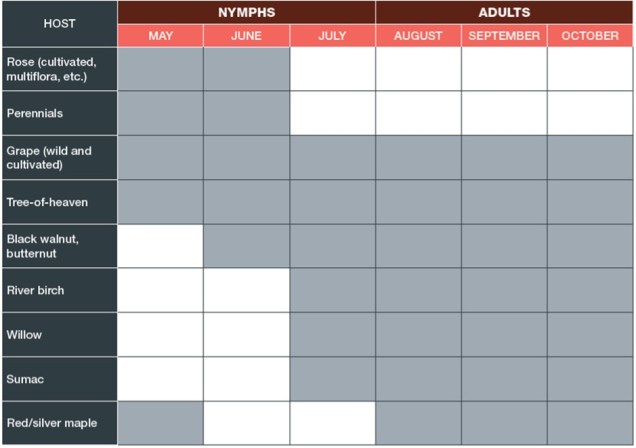
An interesting aspect of SLFโ€™s ecology is that it changes the plants it feeds on as nymphs and adults develop over the season.

table showing host plants preferred by spotted lanternfly nymphs and adults
This table is a (non-extensive) representation of common host plants that spotted lanternfly feed on during the season. The table allows knowing when to start monitoring for activity of nymphs and adults, and what host plants they are likely to be on. It is recommended to always monitor for SLF infestations, since densities change over time both within the season and between years even on the same host plant. Tree of heaven, Ailanthus altissima, is an invasive tree and a highly preferred host. Information in this table is based on observations in Eastern Pennsylvania and may vary based on local conditions. Image: https://extension.psu.edu/spotted-lanternfly-management-guide.

How can SLF be managed?

Managing SLF is challenging, as is the case for many emerging, invasive species. It is unlikely you can stop it from coming onto your landscape or farm, and unlikely you can get rid of all of them. Given this, the goal is to reduce SLF populations to acceptable levels. Using an Integrated Pest Management (IPM) approach will result in the greatest success.

At this time, natural enemies are not reducing SLF populations. However, many generalist predators (spiders, assassin bugs, birds, etc.) are feeding on SLF, a parasitoid brought into this country years ago for spongy (formerly gypsy) moth control has been found attacking SLF, and two fungal pathogens were also identified, one of which (Beauveria bassiana) is commercially available. Further research is underway to identify measures to enhance the impact of these biological controls for SLF.

Cultural controls can be implemented. This includes destroying the overwintering egg masses, putting traps (circle or sticky traps) on trees to catch the nymphs and adults as they move up trees, and removing tree of heaven. Numerous studies have examined the efficacy of contact and systemic insecticides against SLF (see websites below).

We need you!

Please assist in tracking SLF to help slow the spread of SLF and improve its management. If you find SLF, please report it to your State Department of Agriculture or University Extension Service. In Maryland, report SLF at the MDA website (click on โ€œReport Spotted lanternfly hereโ€).

For more information

By Dr. Paula Shrewsbury, Professor and Extension Specialist in Ornamental and Turf IPM in the Department of Entomology at the University of Maryland

Q&A: What is a good summer-blooming plant that’s deer resistant?

Yellow flowers of St. Johnswort plant
St. Johnswort flowers. Photo: M. Talabac

Q:ย  What can I use as a summer-blooming shrub, especially if this part of the garden is sunny and somewhat dry? I also sometimes have deer problems.

A:  I think St. Johnsworts (Hypericum) are underused, and several species are native here in Maryland, though those might be harder to source. Some of the commonly-grown forms are non-native hybrids, though well-behaved ecologically. (The only locally invasive species, Hypericum perforatum, is fortunately not likely to be sold at a nursery.)

St. Johnsworts bloom anywhere between June and September, prefer direct sun, generally tolerate drought well, and are distasteful to deer. Blooms are nearly always an intense yellow, and some species or cultivars have colorful summer or autumn foliage. A few cultivars have berry-like seeds that ripen by fall and make good bouquet accents. I love the bark on native Hypericum densiflorum โ€“ peeling with a smooth underlayer thatโ€™s a rich, warm-toned cinnamon-brown thatโ€™s especially showy during dormancy.

Youโ€™ll find St. Johnsworts sold as both perennials and shrubs, because some species stay low, sprawl like a groundcover, and have stems that arenโ€™t very woody, occasionally dying back in winter as other perennials do. Other species have woody stems and grow to about three or four feet tall and wide. Flowers are loaded with pollen, but no nectar, so butterflies will probably detour while bees and flower flies (predators we like to keep in the garden) will visit. Donโ€™t deadhead developing seed capsules if you want to support Gray Hairstreak butterfly caterpillars, which can use Hypericum as a host plant (among a huge variety of other plants).

For more plant ideas, visit the Home & Garden Information Center’s pages on Plant Selection and Deer-Resistant Native Plants.

By Miri Talabac, Horticulturist, University of Maryland Extensionย Home & Garden Information Center. Miri writes the Garden Q&A for The Baltimore Sun.ย Read more byย Miri.


Questions about home gardening? Send them to Ask Extension